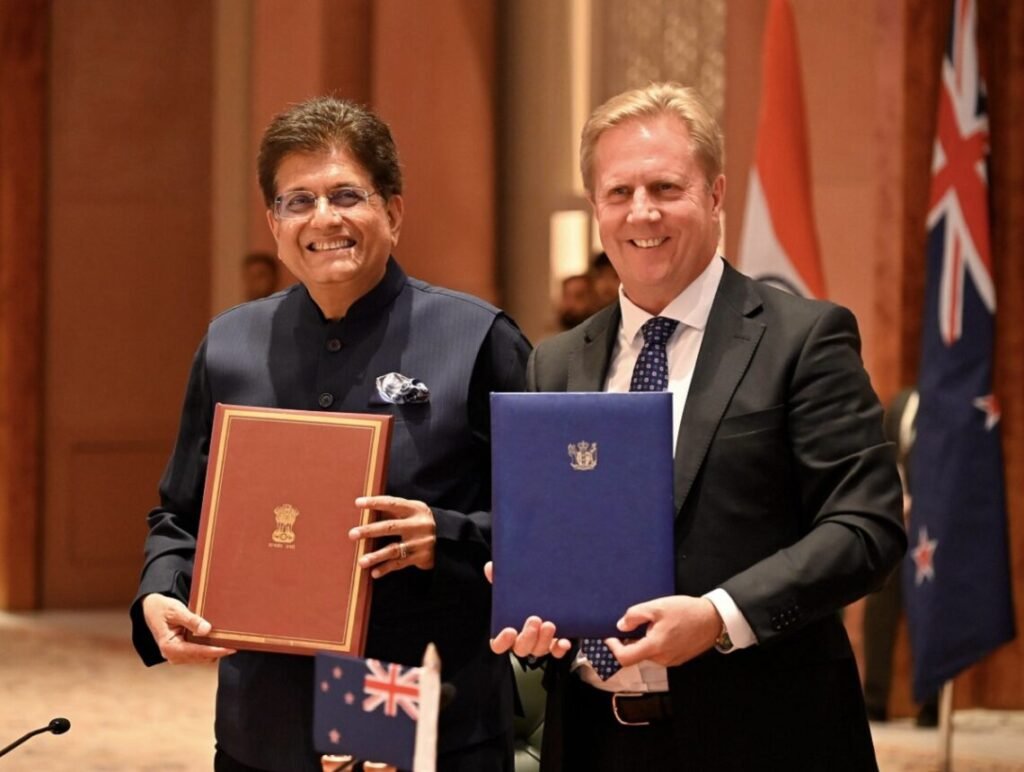
New Delhi (TDI): India and New Zealand officially formalized a comprehensive Free Trade Agreement (FTA) marking a significant milestone in bilateral economic relations on Monday.
It was signed by India’s Commerce Minister, Piyush Goyal and New Zealand’s Minister for Trade and Investment, Todd McClay at a ceremony in New Delhi.
This strategic framework is designed to broaden economic cooperation, diversify trade corridors and encourage professional mobility between the two nations.
The agreement introduces zero-duty access on 100 percent of goods exports upon entry into force and effectively eliminating tariff lines across a broad range of products.
Read More: India, South Korea Announce $50bn Trade Expansion Plan
A central pillar of the pact is New Zealand’s commitment to facilitate $20 billion in foreign direct investment (FDI) into India over the next 15 years.
This capital allocation is expected to target manufacturing, infrastructure, innovation and services offering a significant boost to India’s “Make in India” initiative.
Policymakers expect that the reduction of trade barriers will provide immediate advantages to labor-intensive industries, including textiles, footwear and leather goods while also creating new opportunities for small and medium-sized enterprises (MSMEs).
Beyond trade in goods the FTA offers enhanced market access across 118 service sectors with Most-Favored Nation commitments applied to approximately 139 sub-sectors. The key growth areas include IT-ITES, finance, education, tourism and audio-visual services.
In a message, PM @narendramodi said that the India-New Zealand FTA marks a major milestone towards deeper global engagement and shared prosperity.
It strengthens economic ties between two vibrant democracies, unlocking opportunities for farmers, artisans, youth, entrepreneurs,… pic.twitter.com/zglAERVVcj
— PMO India (@PMOIndia) April 27, 2026
To support the movement of talent, the agreement introduces a quota of 5,000 temporary employment visas for skilled Indian professionals permitting stays of up to three years.
The deal further creates new pathways for student mobility and working holiday programs allowing India to position itself as a primary supplier of skilled labor in emerging global markets. The signing has been welcomed by leadership in both nations as a defining moment for their economic partnership.
External Affairs Minister S. Jaishankar emphasized the strategic significance of the agreement on X, he said that the signing represents a landmark development for bilateral ties and proposed that the FTA would forge stronger economic partnerships and enhance market access for exporters.
Prime Minister Narendra Modi described the development as a historic milestone in a statement on X. He said, “This FTA synergizes the complementarities of our two economies through collaborations that drive collective growth.”
“It catalyzes new opportunities for our farmers, artisans, youth, entrepreneurs, women and MSMEs, unlocking pathways for global market access and enterprise across sectors, from agriculture and manufacturing to technology, education and services,” Modi added.
Today, we mark a historic milestone in the relationship between India and New Zealand: the signing of our Free Trade Agreement.
It was only 13 months ago that I travelled to India to meet with Prime Minister Modi and launch Free Trade Agreement negotiations. India is one of the…
— Christopher Luxon (@chrisluxonmp) April 27, 2026
New Zealand Prime Minister Christopher Luxon highlighted the signing as a decisive step for his nation’s international engagement.
He said, “For New Zealand, this FTA opens the door to one of the world’s most dynamic markets and creates unprecedented opportunities to trade, invest, innovate and connect.”
He further added that the agreement is instrumental in supporting New Zealand’s objective to double the value of its exports over the next decade and providing equal opportunities for local exporters.
As both nations move toward implementation the agreement is viewed by analysts as a stable and rules-based framework for trade in an era of global economic uncertainty.
By combining New Zealand’s advanced agricultural and technological expertise with India’s manufacturing scale and demographic dividend, the partnership aims to enhance supply chain resilience and create long-term source of growth for both countries.

Muhammad Usman Hashmi is a researcher in International Relations, focusing on climate diplomacy, global governance, and political economy in the Global South. He has contributed to policy dialogues with the Foreign Policy Community of Indonesia and serves as a Senior Research Fellow at the International Council on Human Rights, Peace and Politics. He is also associated with Rethinking Economics Islamabad, contributing to research on development and sustainability.