When the President of Uzbekistan, Shavkat Mirziyoyev signed Decree No. 48 on 31 March 2026, it was more than just creating a new state body. He has made a shrewd bet that one of the world’s landlocked countries (with 37 million people), historically at the edge of the global financial world can take a seat at the table already occupied by Dubai and Astana.
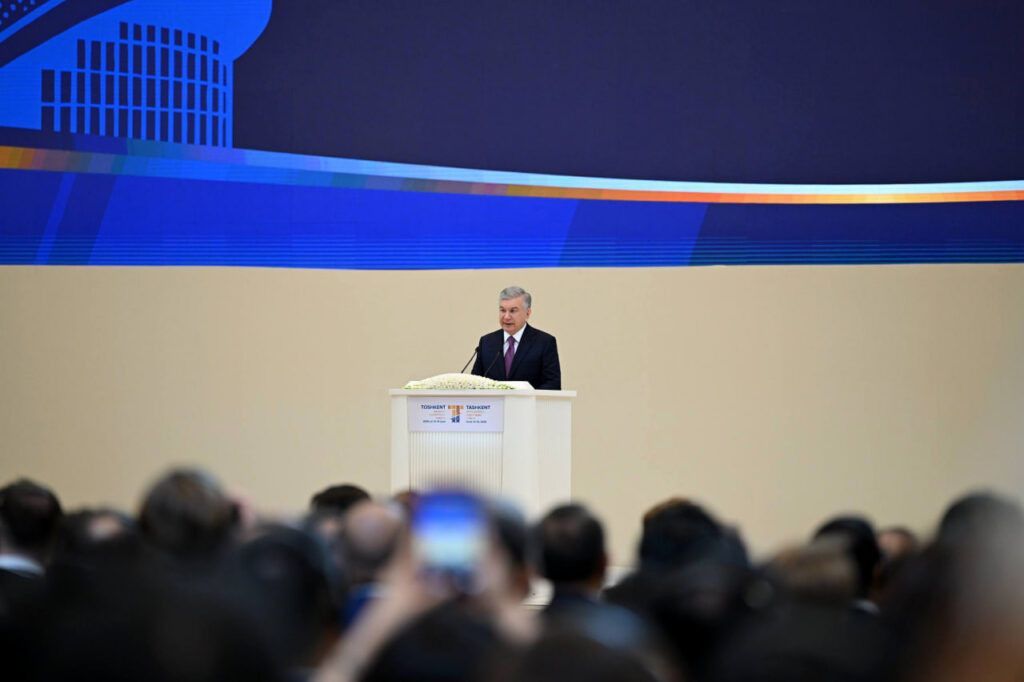
It is the Tashkent International Financial Centre (TIFC), that has been the main focus of the Fifth Tashkent International Investment Forum, concluding today – June 18.
TIFC is not just an office that provides tax breaks. A particular institutional setup features under the headline: a special legal regime under common-law, a dedicated financial regulator, an arbitration center (TIAC), and tax exemptions until 2076.
The last number is correct. The 50-year fiscal guarantees is an unusual one that governments do not usually offer. This ambition shows that Tashkent is playing a long game.
The TIFC is based on a special legal regime imbedded into the constitutional framework of Uzbekistan; the purpose of this design is to minimize the regulatory fragmentation, not to build a completely closed financial enclave, similar to the DIFC in Dubai, or to some extent, the AIFC in Astana where the courts interpret the law of financial center authorities in accordance with the English case law.
Read More: What to Expect from Fifth Tashkent International Investment Forum
The structure of the TIFC Court mirrors the international bench model that has provided the credibility to the DIFC; the TIFC Court consists of two tiers: a Court of First Instance and a Court of Appeal: judges of “any nationality” are appointed.
All these have ambitious economic targets attached to them; the center will generate an additional $20–25 billion to the economy by 2030, account for up to 1% of GDP growth annually, produce up to 15,000 high skill jobs, and train up to 10,000 specialists.
The forum sets the background. The investment story was brought to the global investment community when the government floated the Uzbekistan National Investment Fund (UzNIF) on the London Stock Exchange during the fifth TIIF, which is being held on June 16–18, 2026. The time is carefully planned.
Uzbekistan hopes that the two decisions will go hand-in-hand, evoking an image of a maturing state, rather than one that is simply developing.
The macroeconomic environment is supportive of the pitch. In 2025, the national GDP of Uzbekistan increased by 7.7% and passed the value of $147 billion, the fastest pace since 2021. The country’s sovereign rating was upgraded from bb– to BB for the first time by Fitch Ratings and S&P Global, while Moody’s revised its outlook for the country to “positive.”
Read More: Uzbekistan Seals $26.6B at Investment Forum
Foreign direct investment rose 46.9% and FDI held 40.5% of the total amount of the capital invested. A government that cannot exhibit financial discipline cannot sell a financial center. For the moment, Uzbekistan is passing that test.
Here the road becomes quite narrow for Tashkent. Since 2004, the DIFC has accumulated a rich institutional legacy, established a world-class judicial system, and has become an integral part of the UAE’s vast commercial environment.
The AIFC founded in 2018, is also based on the DIFC, and has already welcomed $14 billion in investments and over 3,500 companies have registered with the AIFC. There is a “head-start” advantage for each of the centers that cannot be created by presidential decree.
The AIFC’s own pitch to investors is that the cost of setting up is around 70% lower than in Dubai, which Tashkent would have to match even more in order to attract capital that has already been invested in Astana. But the structural issue is even more narrow: the notion of “separate jurisdictions” which can create the “gaps, overlaps, inconsistencies which could lead to arbitrage” as the IMF warned about for Kazakhstan, which are now being replicated by Uzbekistan in its own model.
Read More: Uzbekistan Rises as Eurasia’s Investment Hub
But “Tashkent vs. Dubai” comparison is a misreading of the intent of the TIFC. Uzbekistan has no intention of diverting foreign investments from the Gulf. It’s aiming to become the financial hub for the heartland of Eurasia (– Central Asia and the Caucasus, Afghanistan and western China) which neither Dubai nor Astana have managed to capture.
For 2026, Uzbekistan expects to welcome more than $50 billion in investment, with its own three areas of focus, aside from the TIFC, being an International Digital Technology Centre and a center for Islamic finance services, a diversified institutional offering recognizing that there is no single center that can cater to all investor needs.
It is not whether it’s Tashkent vs. Dubai. It is if, over the next decade, the TIFC can become the “first port of call” for investors to enter Central Asia, the jurisdiction that makes potential regional opportunity translated in a viable legal and contractual manner.
That is not an unrealistic goal if the trend of reforming Uzbekistan continues. Otherwise, the TIFC will be considered an institution that came in late, got built, and was waiting for nothing.
The architecture has been laid down in Tashkent. Trust, precedent, and track record cannot be legislated.

Muhammad Mahad Samija
Muhammad Mahad Samija is a student of Political Science at Government College University, Lahore. He can be reached at muhammadmahadsamija@gmail.com