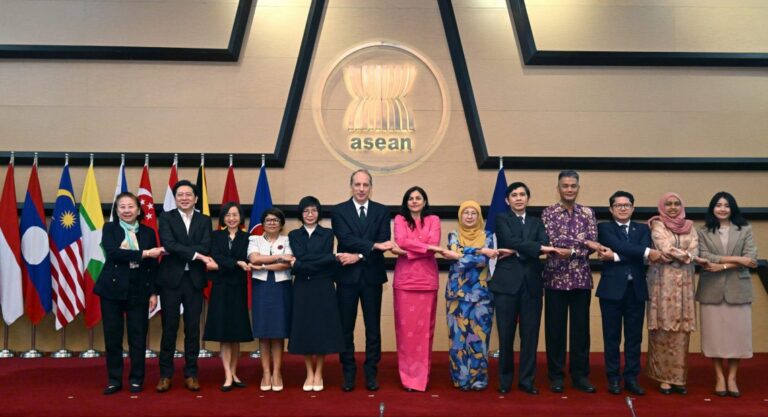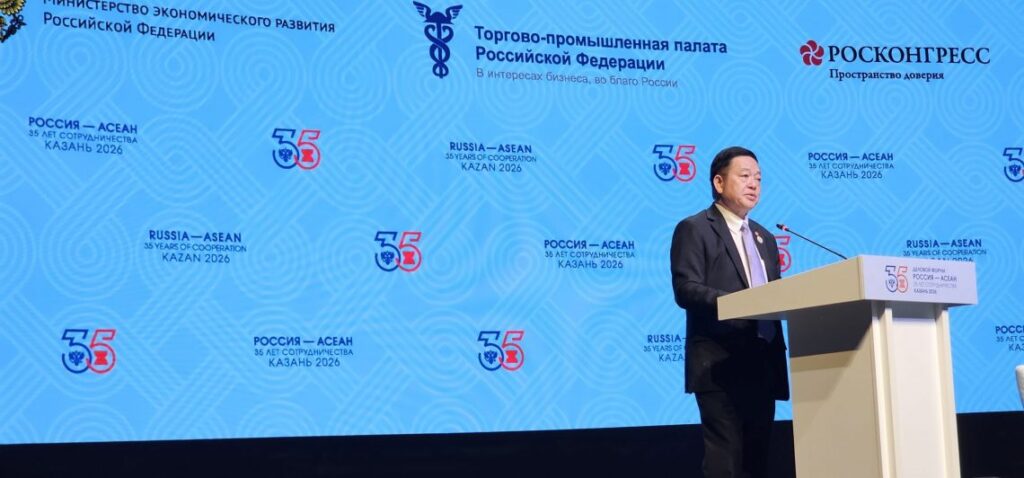
Kazan (TDI): The Secretary-General of ASEAN has called for deeper economic engagement between Southeast Asia and Russia, highlighting opportunities in energy, food security, supply chain connectivity and digital transformation during the ASEAN–Russia Business Forum 2026.
Speaking at the forum held alongside the ASEAN–Russia Summit in Kazan, Kao Kim Hourn said both regions possess “complementary strengths” that can support stronger trade, investment and long-term economic resilience.
He noted that ASEAN, with a combined GDP making it the world’s fifth-largest economy and a population of nearly 700 million, continues to expand as a major manufacturing and digital hub. Russia, he said, brings significant advantages in energy resources, agriculture, industrial production and advanced technologies.
Trade between the two sides reached $17.8 billion in 2025, a figure he described as modest relative to their combined economic potential, arguing that there remains substantial room for expansion.
Kao said global economic conditions are shifting rapidly, with supply chains being restructured and technological change reshaping industries. In this environment, he stressed the importance of building more resilient and diversified partnerships.
Read More: Russia–ASEAN Summit 2026: What Is at Stake for Southeast Asia?
He identified four priority areas for future cooperation. The first is energy, where ASEAN’s rising demand could align with Russia’s capabilities in oil, gas, infrastructure and emerging clean energy technologies. He also pointed to long-term projects such as the ASEAN Power Grid, which requires significant investment.
The second is food security and agriculture, where Russia’s production and fertiliser capacity could complement ASEAN’s growing agro-industrial sector. He said collaboration in this area could strengthen both commercial opportunities and regional resilience.
The third area is supply chain connectivity and industrial cooperation, with ASEAN positioned as a key manufacturing hub integrated into global value chains, while Russia contributes strengths in engineering, transport infrastructure and logistics.
The fourth is digital transformation, where ASEAN’s fast-growing digital economy, valued at more than $305 billion in 2025, creates space for cooperation in artificial intelligence, cybersecurity, digital payments and advanced technologies. He also highlighted the ASEAN Digital Economy Framework Agreement, expected to significantly boost regional GDP growth in the coming years.
Read More: Vietnam Calls for More Active ASEAN Role in Global Affairs
Kao emphasized that while governments can establish frameworks, it is the private sector that ultimately drives economic transformation through investment, innovation and cross-border partnerships.
He urged businesses on both sides to move beyond traditional sectors and explore emerging opportunities that can deliver long-term value.
The remarks reflect ASEAN’s broader strategy to diversify economic partnerships amid global uncertainty, while Russia continues to seek expanded engagement with Asian markets following shifts in global trade patterns.