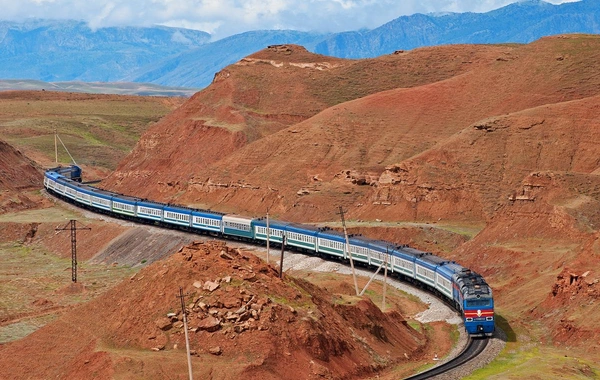
For decades, Central Asia’s landlocked geography was more a curse than a condition; a structural handicap that kept the region dependent on Russian-controlled transit routes and largely peripheral to global trade flows.
The China–Kyrgyzstan–Uzbekistan (CKU) railway, now in active construction, is the most ambitious attempt yet to change that calculus.
What Is the CKU Railway?
Also known as the Kashgar–Andijan line, the CKU Railway connects Kashgar in China’s Xinjiang to Andijan in Uzbekistan via Kyrgyzstan, with a final plan charting a 530 km pathway, about 304 km of which passes through Kyrgyzstan.
The project has been under discussion for over two decades, repeatedly shelved over financing gaps and geopolitical resistance.
It finally crossed a major threshold on December 16, 2025, when CKU Railway Company LLC – a joint venture formed by China, Kyrgyzstan, and Uzbekistan – signed a loan agreement with a syndicate of Chinese banks in Bishkek to finance the $4.7 billion construction project.
Under the deal, China will provide $2.3 billion as a 35-year loan, with the remaining amount distributed by shareholding: China at 51 percent, Kyrgyzstan and Uzbekistan each at 24.5 percent.
The engineering scale is formidable. The CKU involves the construction of 50 bridges and 29 tunnels, which together account for 40 percent of the entire route.
A further complication is the gauge mismatch between rail systems: China uses the world standard gauge width of 1,435 millimeters, while Kyrgyzstan and Uzbekistan use the broader Soviet-era gauge of 1,520 millimeters.
Read More: China-Kyrgyzstan-Uzbekistan Railway Redraws Eurasia’s Economic Map
Construction will therefore proceed in two sections; a 165.5 km stretch from the Chinese border to Makmal station in the Chinese gauge, and a 146.2 km stretch from Makmal to Jalal-Abad in the Soviet gauge. Cargo will be reloaded and trains reorganized at Makmal station due to the gauge difference.
The CKU’s most immediate effect is logistical and geopolitical simultaneously. The railway is estimated to transport up to 15 million tons of cargo annually, reduce delivery times from China to Europe by seven days, and shorten the route by thousands of kilometers.
But the freight numbers are only part of the story. As a project of China’s Belt and Road Initiative, the CKU will connect China directly with Kyrgyzstan and Uzbekistan, reduce its dependence on Russian transit, and create a shorter, faster southern corridor for freight between China, Europe, and the Middle East.
The strategic logic that gave the project its final push was Russia’s invasion of Ukraine. The shifting geopolitics in Central Asia following Russia’s full-scale invasion in 2022 revived interest in the CKU after 25 years.
Russia, now sanctioned, is not in a position to oppose the railway it long informally blocked, and is currently reliant on China for trade.
Both Kazakhstan and Russia were historically reluctant to support the project precisely because they profited substantially from the existing northern transit corridor connecting China and Europe.
What Each Country Gets and What It Risks
Kyrgyzstan is the country where the contradiction between promise and peril is sharpest. Kyrgyz President Sadyr Japarov framed the stakes bluntly at the December 2024 launch ceremony: “If now we live in a ‘dead-end’ country between Europe and China, with the completion of the construction of the CKU railway we will turn into a transit power.”
The Naryn region – through which roughly 90 percent of the Kyrgyz section runs – is rich in coal, iron, aluminum, and rare earth elements that have remained commercially inaccessible for lack of rail infrastructure. The railway would open all of it.
Yet the financial exposure is real. As of 2023, Kyrgyzstan’s external debt stood at just under $4 billion, with 43 percent owed to China’s EXIM bank – around 40 percent of the country’s GDP.
Kyrgyz economist Almaz Kadyraliev warned that “rising debt dependence on China could increase economic vulnerability and limit the country’s independent macroeconomic policy,” while Kyrgyz Parliament Deputy Dastan Bekeshev argued that “the Kyrgyz Republic is unlikely to face serious financial difficulties because it is contributing directly to the project and currently possesses the resources to meet its obligations.”
Read More: Fifty-Five Years on the Silk Road: Türkiye and China Eye Rebalance
For Uzbekistan, the calculus is considerably more favorable. Tashkent does not share a border with China and has long been disadvantaged by routing cargo through Kazakh networks.
The CKU delivers direct overland access. Uzbek President Mirziyoyev has stated that “the railway would become the shortest land route connecting China with Central Asia and would allow access through the Trans-Afghan corridor to the markets of South Asia and the Middle East.” Cargo flows toward Uzbekistan are projected to generate annual transit revenues of $150–200 million by 2050.
China’s interest is the least ambiguous of the three. The CKU will expand China’s connectivity to Eurasian and European markets while sidelining Moscow and Astana, making Tashkent and Bishkek more important transit partners for Chinese exports.
It is also a hedge against maritime vulnerability: a continental corridor through Kyrgyzstan and Uzbekistan preserves Chinese trade access to key markets even under scenarios where seaborne routes become unreliable.
Industrial Belt or Transit Pipe?
The most contested analytical question is whether the CKU generates productive economic depth or remains a conduit through which Chinese goods flow into Central Asian markets.
Based on conservative estimates from the feasibility study, initial freight volume is expected to be between 5 and 8 million tons annually, increasing to 13–15 million tons over the long run.
The railway will catalyze industrial development along the corridor; logistics hubs, metallurgical plants, cement and steel facilities.
At the same time, the mountainous terrain traversed by the CKU might limit its capacity, and it is likely to function as a feeder or complementary route rather than a standalone alternative.
Read More: China, Kyrgyzstan, Uzbekistan Ink Railway Deal
The gauge discontinuity at Makmal compounds this: any transshipment point is also a bottleneck and a cost center, reducing the efficiency case for the line compared to consolidated routes through flat Kazakhstan.
The CKU is ultimately an exercise in what might be called structural sovereignty; Central Asia acquiring the physical infrastructure to determine its own trade routes rather than inheriting them from Soviet-era planning or Russian geographic leverage.
The project will turn landlocked Central Asian states into land-linked countries, boosting their economic potential; if the transit revenues materialize, if the debt terms remain serviceable, and if the industrial zones around Makmal and Jalal-Abad develop into genuine production clusters rather than cargo-handling facilities.
Those are substantial conditions. What is no longer in dispute is that Central Asia’s logistical map is being redrawn, and the redrawing is already underway.

Muhammad Mahad Samija
Muhammad Mahad Samija is a student of Political Science at Government College University, Lahore. He can be reached at [email protected]