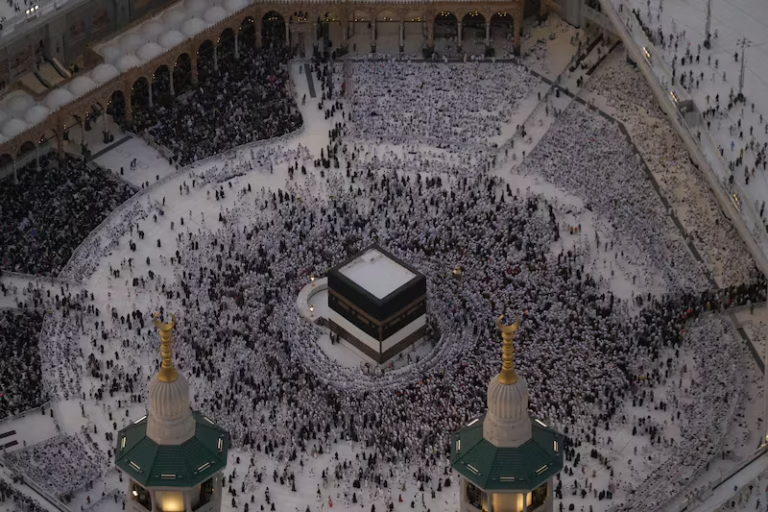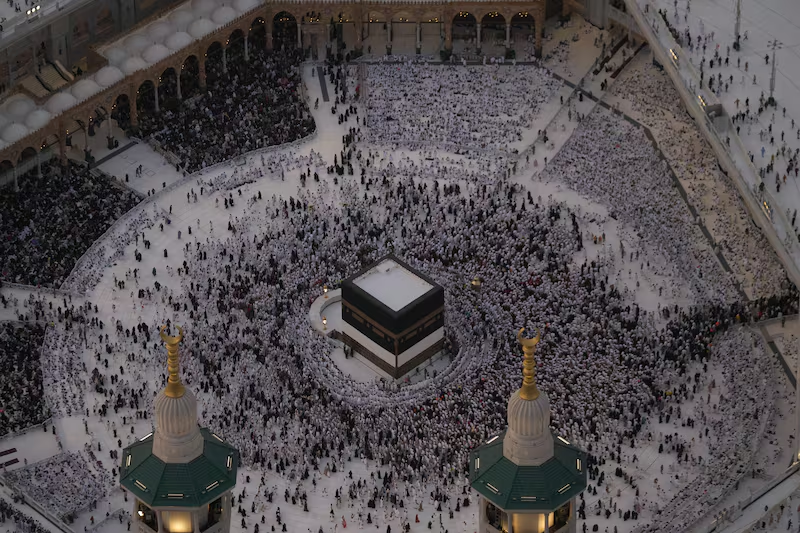
Saudi Arabia says its air defenses destroyed a drone south of Makkah on Tuesday evening. The Houthis say nothing was sent toward the city. Neither side has released evidence, and the Makkah drone claim has not been independently verified.
Yemen Coalition spokesman, Turki al-Maliki, said the Royal Saudi Air Defense Forces brought the drone down before it reached restricted airspace, and called it an attempt to frighten worshippers and harm civilians.
“The security of the two holy mosques and pilgrims is a red line,” he said. The coalition described it as the second attempt on the city since a ballistic missile was fired toward it in July 2017.
Read More: Saudi-led Coalition Says Houthis Targeted Makkah With Drone
Saudi authorities raised a security alert in Makkah for the first time since 2017, and did the same in Taif and Jeddah. All three were lifted within minutes.
A Houthi military source told the Yemeni news agency SABA, “We categorically deny that there is any threat from Yemen directed at the city of Mecca,” and called the Saudi account misinformation. Houthi military spokesman Yahya Saree said the claims “cannot deceive anyone.”
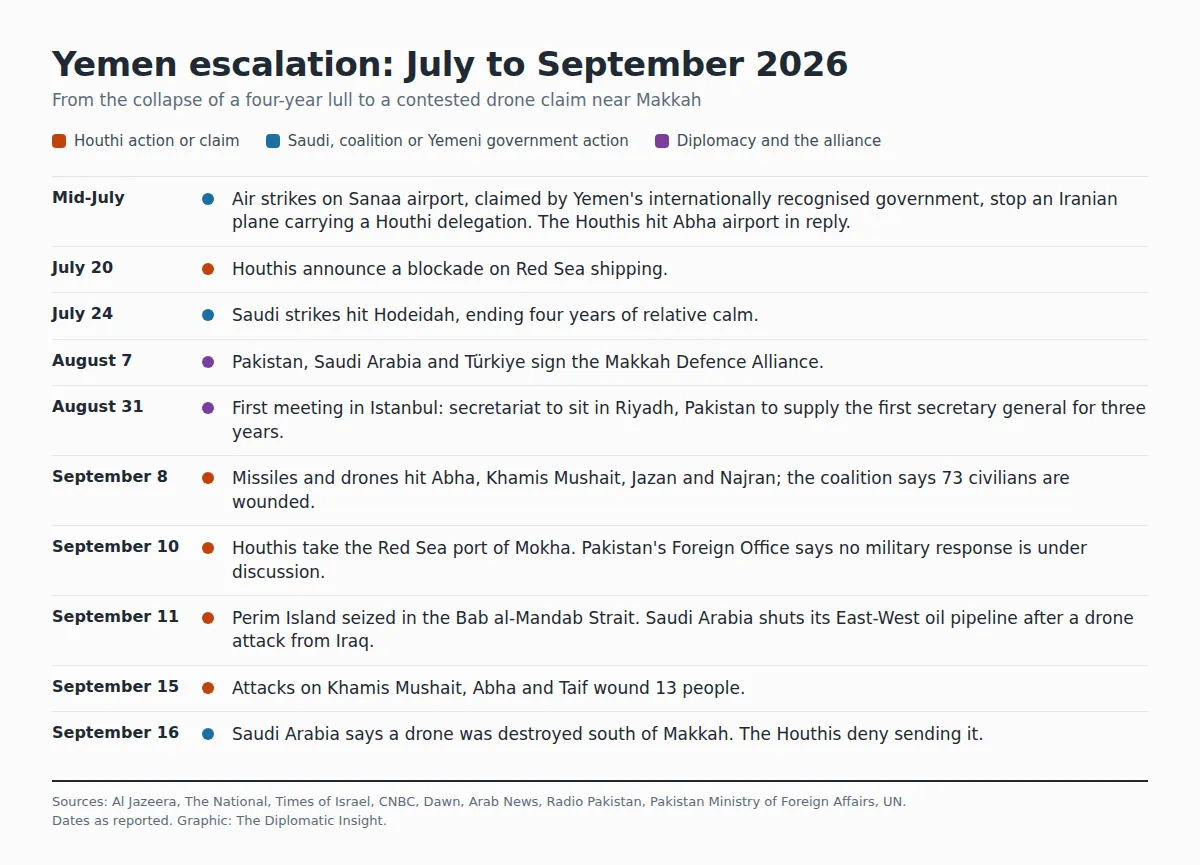
The episode surfaces at the sharpest point of an escalation that began in July, when a four-year lull between Saudi Arabia and the Houthis, the Iran-backed group that has held Yemen’s capital since 2014, broke down.
How We Got Here
Houthi fighters took the Red Sea port of Mokha on September 10 and Perim Island, in the middle of the Bab al-Mandab Strait, the following day.
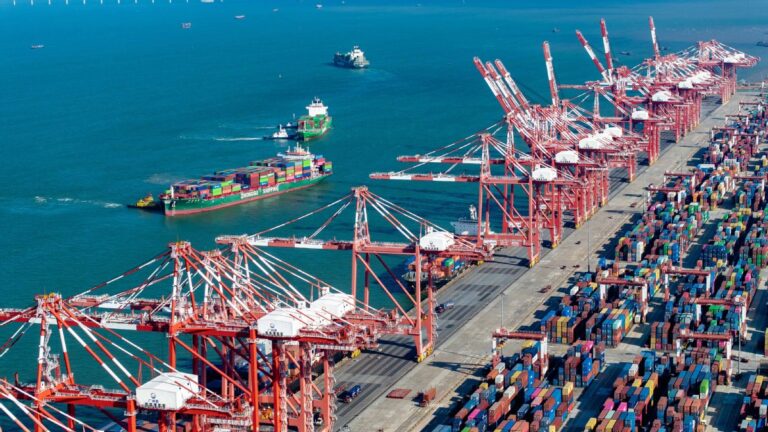
They now hold positions on both sides of a channel that carries much of the Gulf’s oil and cargo towards the Suez Canal.
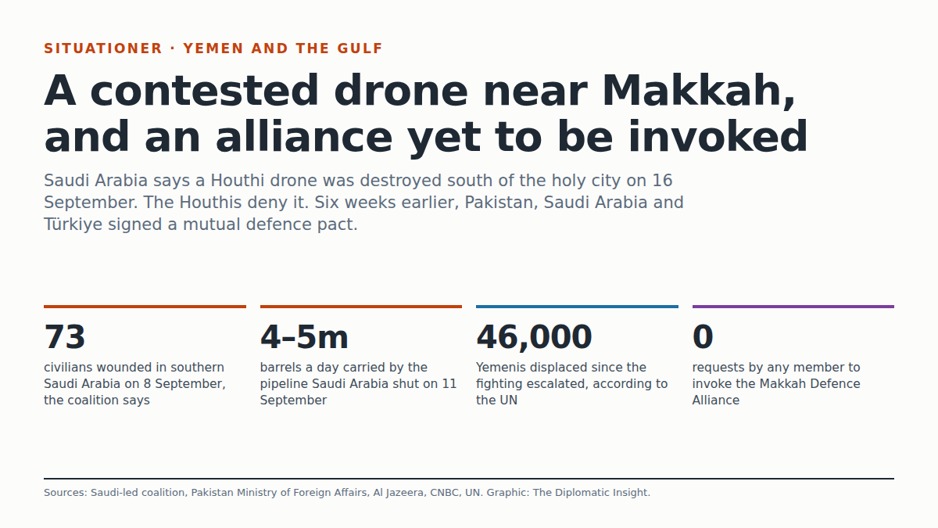
Missile and drone attacks on southern Saudi Arabia wounded 73 civilians on September 8, according to the coalition, and 13 more in Khamis Mushait, Abha and Taif this week.
In the past two days the Houthis have said they struck an air base at Khamis Mushait and an oil facility at Yanbu on the Red Sea coast, and shot down a Saudi F-15 over Marib with a locally made missile.
Yahya Saree put the number of Saudi air strikes at 40 in 24 hours across Taiz, Marib and Hodeidah. Saudi Arabia has not commented on the claims. The United Nations said last week that at least 46,000 Yemenis had been displaced since the fighting escalated.
The war has already reached the oil market. Saudi Arabia shut its East-West crude pipeline on September 11 after a drone attack that the Iraqi prime minister’s office traced to the province of Maysan.
The 1,200-kilometre line had been carrying four to five million barrels a day, or 4 to 5 per cent of global supply. No group has claimed the attack. Brent crude was trading above $104 a barrel after the closure.
Pakistan’s Response
Pakistan condemned the Makkah attempt “in the strongest possible terms,” saying it violated Saudi sovereignty, offended Muslims everywhere, and that Pakistan stood with the Kingdom in protecting the two holy mosques.
Prime Minister Shehbaz Sharif called the attempt “dastardly and heinous,” praised Saudi air defenses and urged restraint. “Our region has already suffered far too much from conflict,” he said.
At the United Nations, Pakistan’s permanent representative Asim Iftikhar Ahmad warned that the escalation had reached an “extremely dangerous juncture.”
Read More: Pakistan Backs Saudi Self-Defense at Emergency UNSC Yemen Meeting
Defense Minister Khawaja Asif went further on television. “If the situation escalates, we will stand with Saudi Arabia, both practically and diplomatically,” he said, adding that defending Makkah and Madinah is a religious duty that needs no treaty. “There is no need to activate any agreement.”
Six days earlier, the Foreign Office had told its weekly briefing that no military response under the pact was under discussion, and that Pakistan would act under it when the time came.
The military’s spokesman, Lieutenant General Ahmed Sharif Chaudhry, described the arrangement in the same defensive terms this week.
“It is defensive. There’s nothing aggressive. There are no regional aspirations,” he said, adding that its operational commitments had never been made public.
Where the Makkah Defense Agreement Stands
Pakistan’s Prime Minister Shehbaz Sharif, Saudi Crown Prince Mohammed bin Salman and Turkish President Recep Tayyip Erdogan signed the Makkah Defense Pact in Makkah on August 7.
The pact’s highlight is a NATO’s Article 5-like collective defense; an armed attack on one member is treated as an attack on all three.
Foreign ministers, defense ministers and military chiefs of the three countries met in Istanbul on August 31 for the first session of the alliance’s Strategic Political and Defense Committee.
They agreed to place its secretariat in Riyadh, with Pakistan supplying the first secretary general for three years, and to form committees on joint defense, technology and regional peace.
Read More: Pakistan Rules Out Immediate Response Under Makkah Pact After Houthi Attacks
Six weeks later, none of the three has publicly asked for the pact to be invoked or for joint consultations. Turkish Minute quoted an official this week as saying the defense commitments are not yet legally in force and that the agreement may go to Türkiye’s parliament in October.
Saudi Arabia is now being attacked; on its southern cities, its shipping lanes, its main export pipeline and the airspace near its holiest city.
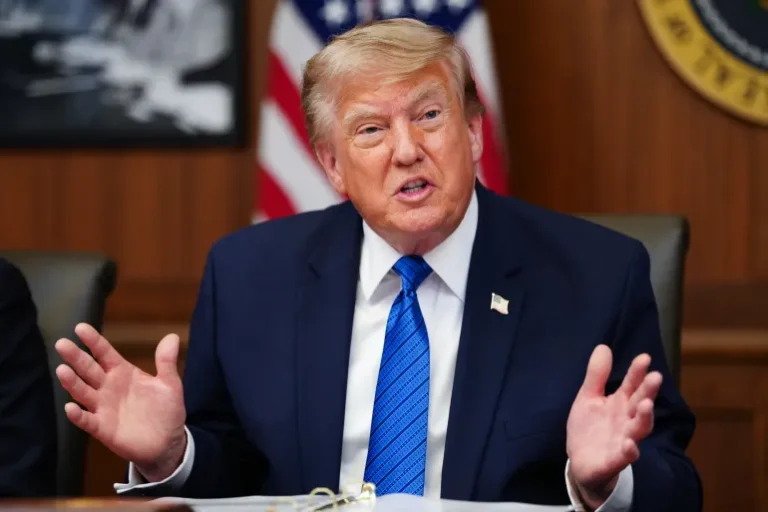
Axios reported that Mohammed bin Salman twice asked United States President Donald Trump for American strikes on the Houthis, and that Trump declined, offering intelligence and targeting support instead. A Central Command spokesman said this week that Washington was “closely monitoring” events.
Pakistan has given political and diplomatic backing without committing forces. Its soldiers are in Saudi Arabia on training duties, it holds the alliance’s top secretariat post, and it has passed Saudi concerns to Iran, which denies controlling the Houthis.
Türkiye has condemned the attacks and supported Saudi sovereignty. Its obligations under the alliance wait on parliament.
Outside the three capitals, the coverage has turned on whether the alliance will act. The Jerusalem Post called the attacks “a test of new Saudi-Turkey-Pakistan pact.”
Ynet reported that they were exposing the pact’s limits. In India, India TV asked whether Pakistan would join the war on Saudi Arabia’s side. Pakistani newspapers and channels have led on the assurances from Asif and the Foreign Office.
Three things will shape the next few weeks. Whether any member asks for consultations under the pact, which none has done so far.
Whether Türkiye’s parliament ratifies the agreement in October. And whether the fighting widens again, toward the holy cities, toward Red Sea traffic, or toward a bigger war if Washington changes its position.

Muhammad Bilal is Program and Strategic Coordination Officer at the Institute of Peace and Diplomatic Studies, Islamabad. His research interests include diplomacy, global governance and geopolitics, soft power and cultural narratives, and strategic communication. He can be reached at [email protected] or [email protected]