Pakistan has said that no immediate military response under its collective defense agreement with Saudi Arabia and Türkiye is currently under discussion following the recent escalation of Houthi attacks on Saudi territory, offering an important clarification of Islamabad’s position as regional tensions intensify.
Foreign Ministry spokesperson, Sajjad Haider Khan, said during a weekly briefing on Thursday that Pakistan remained committed to its obligations under the Makkah defense arrangement but had not begun discussions over an immediate military response.
The clarification follows comments by Pakistani Defense Minister Khawaja Asif warning that continued attacks against Saudi Arabia could make the trilateral security arrangement operational.
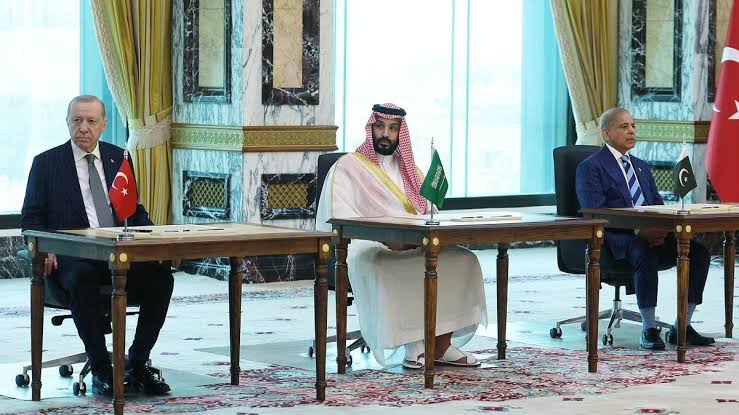
The agreement between Pakistan, Saudi Arabia and Türkiye contains a collective-defence principle under which an armed attack against one participating state is treated as an attack against the others.
Asked on Thursday how Pakistan intended to fulfil those obligations following the Houthi strikes, Khan indicated that Islamabad would act under the agreement when circumstances required it but stressed that a military response was not presently being considered. Pakistan also said there were no current plans to expand the alliance to include additional countries.
Read More: Makkah Agreement: New Geography of Deterrence Through Transnational Strategic Distribution Model
The comments come after a sharp escalation along the Saudi-Yemeni front. Houthi forces have carried out missile and drone attacks against Saudi cities, military facilities and energy infrastructure, while Saudi forces have intensified operations in Yemen.
Pakistan has sought to contain the confrontation diplomatically and has communicated Saudi concerns to Iran, urging Tehran to use its influence to restrain the Houthis. Iran has rejected claims that it controls the Yemeni movement.
Islamabad’s latest statement is therefore significant because it creates distance between Pakistan’s treaty commitment and expectations of an automatic military intervention.
The government appears to be preserving the deterrent value of the Makkah framework while retaining political room to determine what form assistance might take if attacks against Saudi territory continue.
That balance is particularly important for Pakistan. Islamabad maintains longstanding defense and economic relations with Riyadh while also sharing a border with Iran and seeking to avoid becoming directly involved in another regional conflict.
Read More: Arab League Warns Houthi Escalation Threatens Regional Stability
Pakistan has previously attempted to maintain channels with both sides during periods of Saudi-Iranian tension, making direct participation in hostilities a potentially consequential foreign-policy shift.
The current crisis could consequently become the first significant test of how the new trilateral defense framework functions in practice.
If Houthi attacks continue or expand, Islamabad may face growing pressure to clarify whether collective defense means direct military involvement, intelligence and logistical assistance, air defense support or primarily political coordination.
For now, Pakistan’s position indicates support for Saudi security without committing itself to an immediate expansion of the conflict.

Anoush Taimur is an International Relations graduate from DHA Suffa University, Karachi, currently based in Doha. Her research interests include Gulf politics, small-state diplomacy, Global South studies and conflict
mediation. Her work examines how states create influence through connectivity, institutions and strategic relationships. She can be reached at [email protected]