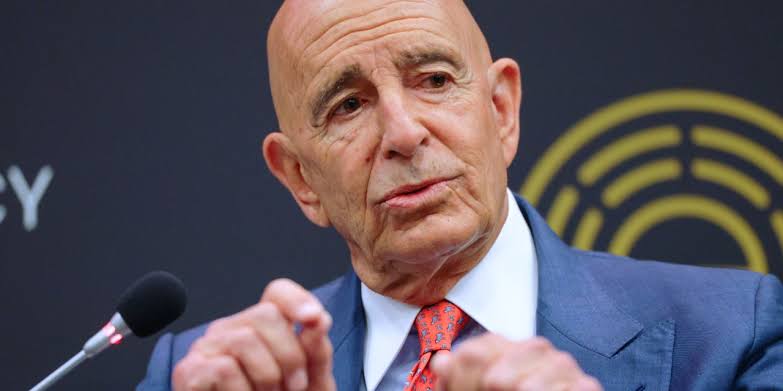
United States’ envoy Tom Barrack has urged Gulf countries to diversify their security partnerships as Washington reassesses its longstanding role in regional defense, raising questions about the future of security arrangements between the United States and its Gulf allies.
Speaking at the Global Security Forum in Doha, Barrack indicated that Gulf governments should prepare for changes in the traditional security framework that has shaped relations with Washington for decades.
His remarks came as countries across the region face growing concerns over missile and drone attacks, maritime security and the continuing confrontation involving Iran.
Barrack pointed to emerging regional defense partnerships, including cooperation between Saudi Arabia, Pakistan and Türkiye, as examples of arrangements that could play a greater role in maintaining regional stability.
The remarks reflect a broader debate over the responsibilities of the United States and its regional partners at a time when the Gulf faces increasingly complex security challenges.
Read More: GCC Calls for Role in US-Iran Negotiations, Reaffirms Collective Security Commitments
For decades, Washington has maintained a significant military presence across the region, providing security cooperation, advanced defense systems and military support to several Gulf governments.
However, continuing regional conflicts have raised questions about the extent to which American military commitments can address every security threat. Barrack’s comments suggest that Gulf states may need to develop stronger regional arrangements while continuing to maintain their existing relationships with Washington.
Such an approach could involve greater defense cooperation, intelligence sharing, joint military exercises and investment in domestic military capabilities. The growing interest in regional partnerships also reflects efforts by Gulf governments to strengthen their security without depending entirely on a single international partner.
The discussion comes as Saudi Arabia, Pakistan and Türkiye move toward formalizing their trilateral defense arrangement, while other Gulf countries continue to expand cooperation with European and Asian partners.
Read More: Putin, MBS Discuss Gulf Security as Iran-US Tensions Persist
These developments indicate a gradual diversification of regional security relationships rather than an immediate replacement of the United States as a major defense partner.
American military facilities, technology and security cooperation remain important to Gulf governments, particularly in areas such as missile defense and maritime surveillance. Nevertheless, the changing regional environment is encouraging countries to consider additional mechanisms for collective security and crisis response.
Barrack’s remarks have therefore added a new dimension to discussions over the future of Gulf security. The central question is how regional governments can strengthen their own defense arrangements while preserving international partnerships and avoiding further escalation.
As diplomatic and military developments continue to reshape the region, the balance between American support and regional security cooperation is likely to remain an important issue for Gulf policymakers.
Anoush Taimur is an International Relations graduate from DHA Suffa University, Karachi, currently based in Doha. Her research interests include Gulf politics, small-state diplomacy, Global South studies and conflict
mediation. Her work examines how states create influence through connectivity, institutions and strategic relationships. She can be reached at [email protected]