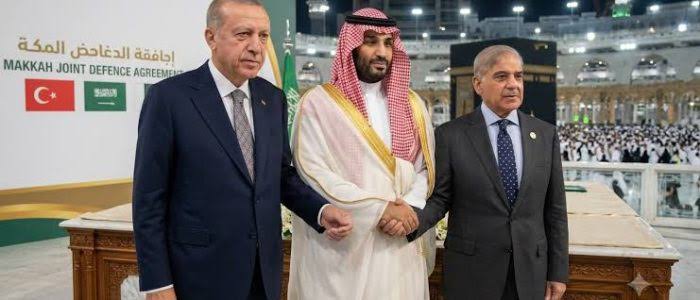
Makkah Joint agreement signed on 7th of August 2026 demonstrates a significant new security and strategic architecture in the Middle East and the Muslim World.
The mutual defense agreement declares that an armed attack against one of the three states will be regarded as an attack against all, and its stated purpose is to strengthen collective deterrence and defense cooperation technically analogous to NATO article 5 according to Turkish Foreign Minister.
Pakistan has also emphasized that the accord is defensive in nature and is not directed against any particular country. However, the pact poses a bigger strategic challenge than the conventional definition of collective defense: Can an alliance make its air and naval force stronger not just numerically, but geographically?
The question is important because modern war is becoming more precise and is being fought increasingly in the airbase and naval base, command and control center, air defense systems, logistics center, ammunition depot and other military facilities. Just winning an enemy’s entire military force does not mean a state has defeated them. It can alternatively achieve strategic paralysis by disenabling the infrastructure on which the military is based.
Read More: Pakistan Warns Makkah Pact May be Activated Following Houthi Strikes on KSA
A historical example is Libya. In 2011, during NATO’s Operation Unified Protector, the coalition flew over 26,000 sorties, of which over 9,700 were strike sorties, and struck or destroyed some 6,000 military targets. Objectives of NATO’s campaign included not only their frontline forces, but also command and control networks, ammunition stocks, air-defense and military platforms.
On the first night of the campaign, three American aircraft of the type “B-2” were dropped on Ghardabiya airfield, striking 45 targets such as hardened aircraft shelters at that base struck.
The lesson is not that any air force can be wiped out by air. Instead, when air force capacities are geographically limited and sufficiently identifiable, the critical infrastructure can be very vulnerable.
In fact, the Syrian experience is another recent example. As Bashar al-Assad’s regime collapsed in December 2024, Israel hit Syria’s military stocks on a large scale. Israeli forces hit over 350 targets within 48 hours, including air-defense systems, military airfields, weapons-production facilities, missile sites, aircraft and helicopters, tanks, hangars and weapons depots.
The episode shows a strategic value of airbases even in the context of new political and military structures. As these cases illustrate, one of the key tenets of strategic studies is that: The survivability of military force is directly related to the location as well as the level of military power a state has. The Makkah Agreement might be able to go beyond traditional mutual defense pact here.
From Collective Defense to Distributed Strategic Capability
It is not a system of foreign air bases or naval bases and not there to make any provision for the permanent presence of one member’s combat aircraft in another member’s country. It should therefore be regarded as a policy proposal rather than a stipulation contained in the agreement.
The three states might still consider a more ambitious form of transnational distributed strategic capability. The logic behind the basic concept is very simple. Rather than centralizing the core of a nation’s military capacity within its own borders, allied states might establish mutual arrangements for the use of strategic capability and equipment in times of crisis, with provision for deployment of select military assets in allied territories in accordance with political consent.
The goal wouldn’t necessarily be to set up permanent overseas bases. It could, however, also mean distributed access and contingency basing, such as access and operation of one state’s forces from facilities under the other state, and vice versa, under agreed conditions. This architecture would be a geographical duplicate.
Read More: Why Makkah Defense Pact Is Not Yet a NATO for the Muslim World
Let’s imagine a hypothetical case in which an enemy tries the air and naval power of a member state, attacking main strategic locations. If the major aircraft, strategic infrastructure, maintenance facilities, naval stations or naval dockyard, ammunition stores and command structures are all located within the state’s own territory and a successful campaign against those nodes leaves the state with substantially reduced or eliminated air or naval capability to generate power for stronger response.
What if a part of the state’s operating power could be maintained or revived by the possession of allied territory, the strategic consideration would turn quite tricky. Thus, the opponent would have a selection. It might attack just the original state’s land, leaving some of its substitutes intact in other parts of the world. It may also strike the distributed capability on friendly territory, which could escalate into a multi-battle with another nation.
It does not imply that the host state would necessarily become involved in the war. Its reaction would be subject to treaties, internal politics, rules of engagement and strategic interests. However the risk of escalation would enter into the enemy’s equation.
The crux of the proposed concept is that geographic location may cause strategic uncertainty. When there is uncertainty about the strategy, the cost of attack can be higher. And expected costs are stronger the higher the costs.
The Objective Is Not Just Deterrence
There is however a bigger difference that distributed military access would not only deter, but would have other values as well. It might also maintain the ability to retaliate and strike following an initial attack. This distinction is very important.
Deterrence has long been centered on the question of preventing an opponent from attacking. Deterrence is more convincing when a state can show that it maintains the ability to respond if it is attacked first.
Thus: Distributed military infrastructure → greater survivability → preserved force-generation capacity → credible retaliation → stronger deterrence
The idea serves dual durable strategic roles which includes making violence difficult and costly if not impossible and strategic survival at the time of violence. This may be a surviving kit for the states with weak military capabilities that can be targeted by long-range precision strike.
The three members of the Makkah Agreement have varying but possibly complementary strategic capabilities. Pakistan has significant military experience, a well-established aerospace industry, a large military force and experience operating in complex regional security settings.
Türkiye has one of the most advanced indigenous defense industrial bases in the region, with competency and capacity in the field of unmanned systems, aerospace, electronic warfare and military technology. Saudi Arabia has vast strategic geographic depth, defense infrastructure, and a huge amount of money.
The linkage is therefore an intriguing one: Financial capacity, industrial capacity, military experience, and geographic depth could be linked via more integrated defense architecture. The current agreement already includes improved cooperation in the field of defense.
Cooperation may also include joint exercises in land, sea, air and cyber domains, unmanned systems, electronic warfare, artificial intelligence and defense-industrial cooperation, Türkiye has said. The next obvious step is how much more geographic interoperability should be built into such cooperation.
Distributed Capability Is Not Without Risks
A sound approach will have to recognize its limitations. It is difficult to control and command over the sovereign land and second, to patrol the boundary. Patrolling the boundary is difficult and controlling/commanding the sovereign land is difficult.
Secondly, logistics are more challenging. Fuel, ammunition, servants, and secure communications with others must all be provided for an aircraft. Thirdly, the target state could also be a target. Fourth, the distribution of military installations can result in entrapment of the host state into an alliance – military installations in another state could involve the host state in a military conflict that he/she does not wish to engage in.
Fifthly, the question of political reliability comes to the fore. A military facility will not be of any service unless access can be provided when needed. Therefore, geographic distribution is not enough to make strategic resilience. Needs political will, interoperability, secure communication, logistics, air defense, sharing intelligence and rules of access and deployment.
Read More: Should Bangladesh Join the Makkah Defense Alliance?
The Makkah Agreement must be interpreted beyond what is considered a traditional understanding of another mutual-defense pact. The potential is more ambitious as to whether political solidarity can be built into integrated strategic resilience between Pakistan, Saudi Arabia and Türkiye.
The first stage might be a relatively benign one: Coordinating joint exercises, sharing intelligence, air-defense coordination, common training, logistics cooperation and defense-industrial integration. Reciprocal access could be the second stage, along with contingency planning.
The third might be an allied aircraft or military asset support network to be developed in case of a crisis provided sovereign approval.
The aim would not be to form an offensive bloc. Pakistan has clearly stated that the Makkah Accord is defensive not offensive towards any country. Instead, the goal would be to make it hard for an attack to create strategic paralysis, by taking out a small number of military nodes. That’s a different approach to collective defense.
The New Geography of Deterrence
The geography of military power is changing. At the turn of the industrial age, the most promising measure was the size of military, fleets and air and naval forces. Though the evolution and advancement in defense sector along with precision- strike age has given rise to other issue:
How difficult and costly it might be to destroy the infrastructure that allows those forces to fight? Having a large number of highly capable military forces concentrated in a small number of vulnerable areas may not be as resilient as having a slightly smaller force spread out in different areas with multiple layers of infrastructure.
This is an opportunity that lies in the Makkah Agreement. Pakistan, Saudi Arabia and Türkiye don’t have to follow the model of NATO. Nor do they have to establish an integrated military command in a flash.
Instead, they could build a model that would address their own strategic realities, which will include elements of collective defense, geographic redundancy, interoperability, and force survivability.
The goal for the strategy would be easy: Difficulty in neutralizing combat force, credibility in retaliation, costliness of aggression. The political doctrine of the Makkah Agreement has already been laid out which holds that an attack on one member is an attack on all. The strategic objective would be simple:
Make military power harder to neutralize, retaliation more credible, and aggression more costly. That would make collective defense more meaningful than a mere promise to assist each other: it would be geographically dispersed strategic power architecture.
*The views presented in this article are the authors’ own and do not necessarily reflect the views of The Diplomatic Insight.*

Abdul Muhaymin Farooq
Abdul Muhaymin Farooq is an Mphil scholar of Political science at the University of Punjab.