As the global economy navigates persistent uncertainty, the search for new and resilient sources of growth has become increasingly urgent. Traditional drivers such as commodity exports and industrial manufacturing are now being complemented by alternative economic frameworks that emphasize inclusivity, sustainability, and ethical finance.
In this evolving landscape, the Islamic economy has emerged not merely as a niche segment, but as a strategic pillar within the broader architecture of global economic development.
The scale of this transformation is increasingly evident. Global Muslim consumer spending across halal sectors reached approximately US$2.4 trillion in 2023 and is projected to exceed US$3.4 trillion by 2028. At the same time, Islamic financial assets have grown to nearly US$4.9 trillion, underscoring the sector’s rising systemic relevance in global markets.
These trends suggest that the Islamic economy is no longer driven solely by demand, but by the expansion of integrated ecosystems that combine finance, production, and value-based consumption.
Across emerging markets, particularly in Muslim-majority countries, the Islamic economy is gaining traction as a viable pathway to balance growth with social equity. More than just a financial system, it represents a multi-layered ecosystem encompassing halal industries, Islamic finance, and social finance instruments.
As such, its expansion is not only reshaping domestic economic structures, but also redefining how countries position themselves within global value chains.
From Domestic Expansion to a Replicable Ecosystem Model
Within this context, Indonesia’s trajectory is particularly noteworthy. As the world’s largest Muslim-majority country, it has moved beyond a consumption-driven model toward a more outward-looking and competitive Islamic economic framework. Indonesia consistently ranks among the top three countries in the Global Islamic Economy Indicator, reflecting strong performance in sectors such as modest fashion and Muslim-friendly tourism.
At the domestic level, the performance of Indonesia’s Islamic economy has also been robust. The halal value chain grew by around 6.2 percent year-on-year in 2025 outpacing overall economic growth and increasing its contribution to national output.
This expansion has been driven by key sectors such as halal food, modest fashion, and tourism, all of which are closely linked to global demand dynamics.
Yet Indonesia’s strategy goes beyond sectoral growth. Rather than treating the Islamic economy as a standalone domain, policymakers have embedded it within a broader development framework positioning it as a driver of inclusive growth that connects productivity with equity and innovation with social values.
Read More: Indonesia’s QRIS Now Can Be Used in China: Innovation or Digital Sovereignty?
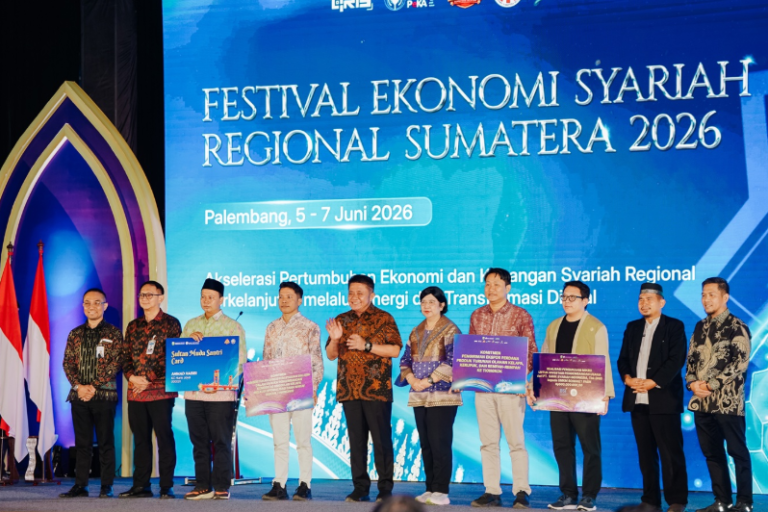
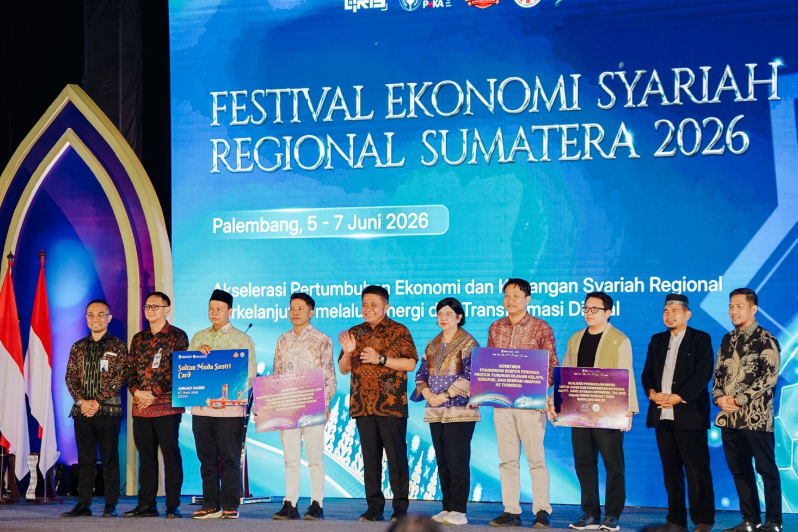
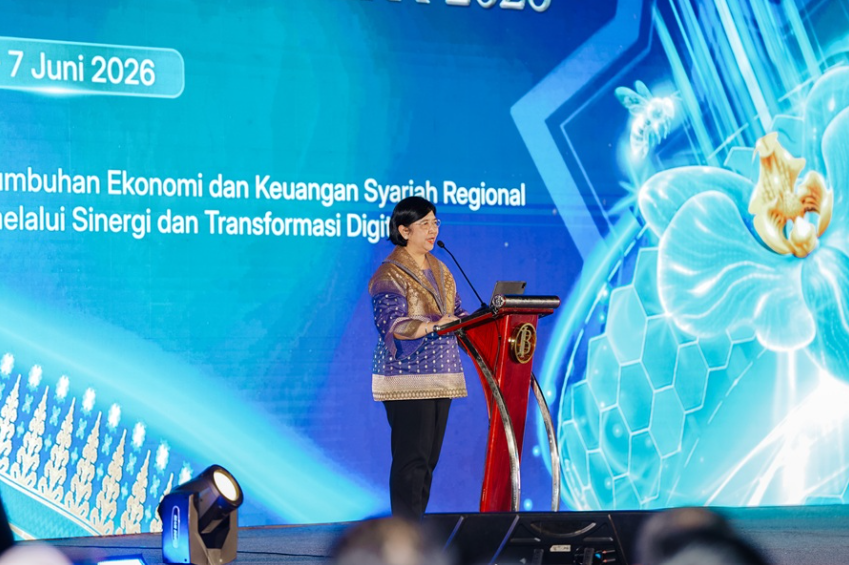
This approach is particularly visible in regional initiatives such as the Festival Ekonomi Syariah (FESYAR). While often perceived as a domestic event, FESYAR functions as more than a promotional platform it serves as a structural mechanism for ecosystem-building.
By bringing together policymakers, financial institutions, small businesses, Islamic boarding schools, and young entrepreneurs, it creates a coordinated space where production capacity, financing access, and market integration are aligned.
In practice, FESYAR represents a development model rooted in strengthening microeconomic foundations while linking them to national and global systems. Programs embedded within it ranging from halal certification acceleration to SME empowerment and the integration of social finance instruments such as waqf illustrate how localized initiatives can scale into broader economic strategies.
In this sense, Indonesia is not only developing its own Islamic economy, but also offering a replicable model for other emerging economies seeking to build inclusive and resilient economic ecosystems.
Central Bank Strategy and Limits of Incrementalism
A key yet often understated driver of this transformation is Bank Indonesia. Beyond its traditional mandate of maintaining price stability and safeguarding financial system resilience, the central bank has increasingly positioned itself as a strategic actor in the development of the Islamic economy.
Through a calibrated mix of macroprudential incentives, liquidity support, and financial market deepening, it has contributed to strengthening the structural foundations of the sector.
This reflects a broader shift in central banking, particularly in emerging economies. As global financial conditions become more volatile and interconnected, central banks are no longer confined to short-term stabilization. Instead, they are increasingly expected to support structural transformation by fostering linkages between financial systems and the real economy.
In Indonesia’s case, this involves integrating halal industries, Islamic finance, and digital infrastructure into a cohesive and mutually reinforcing ecosystem.
However, the effectiveness of this approach is not without limits. While Indonesia has made significant progress in expanding its domestic ecosystem, it still faces structural challenges in translating this into global influence. The international Islamic economy is increasingly shaped by standards, certification regimes, and cross-border institutional arrangements areas where competition is intensifying.
Read More: Indonesia’s Carbon Market, Ready for Takeoff
Fragmentation in halal certification standards, for instance, continues to constrain trade integration and reduce efficiency within global halal supply chains. For Indonesia, accelerating certification is not merely a domestic policy objective, but a strategic imperative for gaining international recognition.
Without stronger alignment with global standards, the country risks remaining a large market rather than evolving into a rule-setter.
There is also a broader coordination challenge. Developing a fully integrated Islamic economic ecosystem requires alignment across finance, industry, trade, and digital infrastructure domains that involve multiple institutions and stakeholders.
While Indonesia has made progress in fostering collaboration, maintaining policy coherence will become increasingly critical as the system grows in complexity.
Yet Indonesia’s gradualist strategy may also be its defining strength. Unlike centralized models, its approach emphasizes bottom-up ecosystem development integrating small enterprises, social finance, and community-based institutions. This creates a more inclusive foundation, which can enhance long-term resilience even if short-term outcomes appear incremental.
At the same time, Indonesia is becoming more active in international engagement. Its participation in global Islamic economic forums and efforts to promote standard harmonization signal an ambition not merely to participate, but to shape the direction of global development. The challenge, however, lies in translating engagement into influence.
A Quiet Strategy with Global Implications
What emerges from Indonesia’s experience is a pattern of gradual yet strategic transformation. Much like shifts observed in global financial governance, its Islamic economy is not being built through rapid breakthroughs, but through sustained efforts to strengthen institutions, expand ecosystems, and enhance coordination.
In an era defined by uncertainty and structural change, such an approach may prove increasingly relevant. As demand for ethical, inclusive, and sustainable economic systems continues to grow, countries that can translate local initiatives into globally connected ecosystems will be better positioned to lead.
Indonesia’s experience offers a compelling insight: the future of the Islamic economy may not be determined solely by capital strength or institutional centralization, but by the ability to build inclusive, scalable, and systemically integrated ecosystems.
Through platforms such as FESYAR, and supported by an increasingly proactive central bank, Indonesia is demonstrating how this transformation can unfold not through abrupt shifts, but through quiet, coordinated strategy.
The question, then, is no longer whether Indonesia can grow within the Islamic economy it clearly can. The more pressing question is whether its ecosystem-driven approach can evolve quickly enough to shape the rules of the global system it is helping to build.
*The views presented in this article are the authors’ own and do not necessarily reflect the views of The Diplomatic Insight.

Hari Suciono
Hari Suciono is an economic practitioner at the Bank Indonesia Representative Office in Central Kalimantan. His work focuses on regional economic dynamics, monetary policy, and financial stability, with particular attention to emerging and resource-based economies. His commentary has appeared in Indonesian national media, including Kompas.com, Kumparan, Indosiana by Tempo, and Republika.