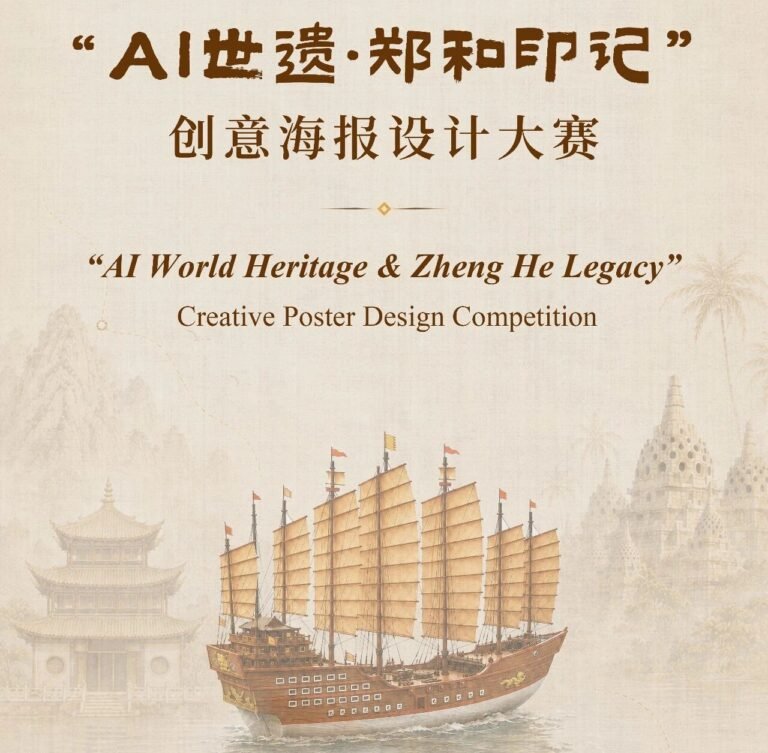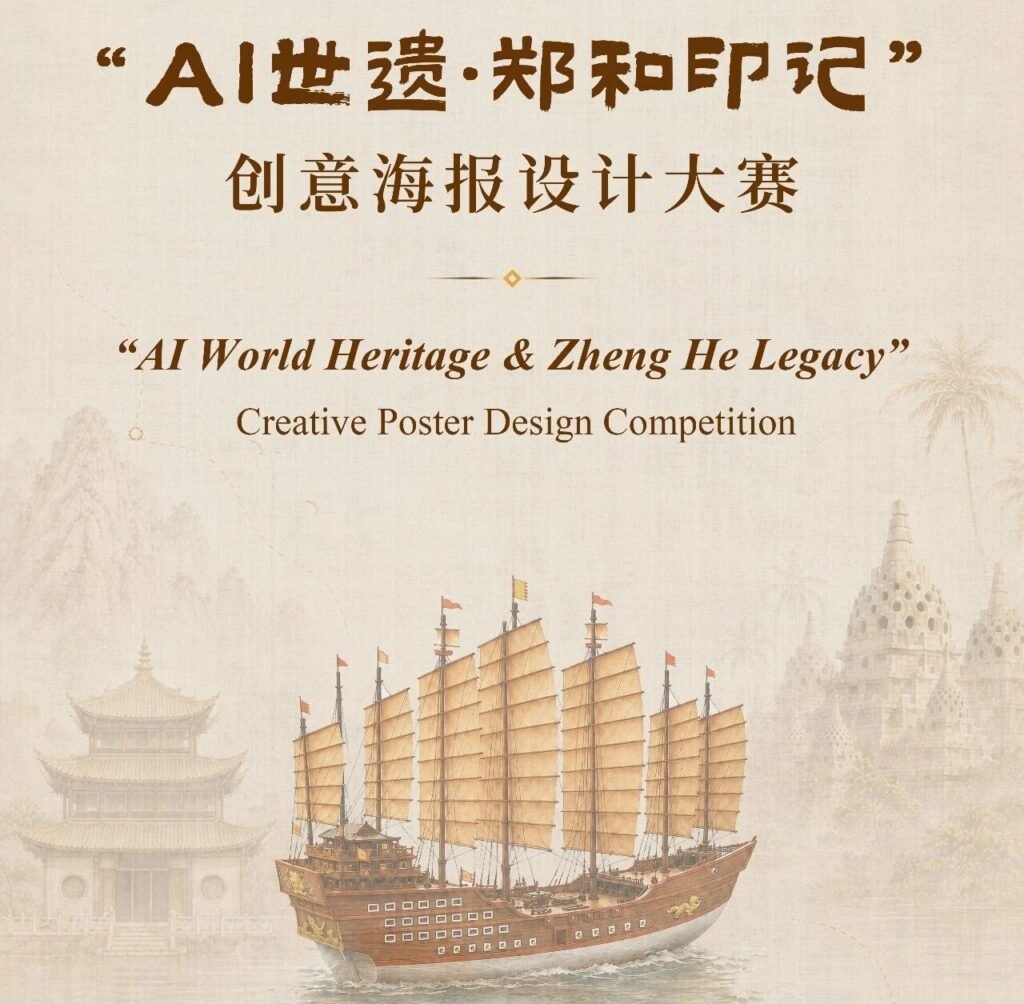
Over 600 years ago, Zheng He set out from Yunnan, his hometown, and embarked on his life as a navigator. Commanding his fleet on seven voyages to the Western Seas, he sailed through the Strait of Malacca, crossed the Indian Ocean, and reached as far as the eastern coast of Africa.
This Maritime Silk Road not only left a glorious legacy of trade and exchange but also sowed seeds of friendship and cultural interaction in the countries along the route. From Borobudur Temple Compounds in Indonesia to Sigiriya Rock Fortress in Sri Lanka, from Malacca in Malaysia to Taxila in Pakistan—Zheng He’s voyages connected a constellation of world heritage treasures, bearing witness to the impressive chapters in which different civilizations met, learned from, and enriched one another.
In order to promote the spirit of Zheng He, deepen people-to-people exchanges among the countries along the Maritime Silk Road, and highlight Yunnan’s identity as “the hometown of Zheng He,” a call for entries is now open for young people in China, Indonesia, Malaysia, Sri Lanka, Pakistan, Nepal, Bangladesh, and other countries to submit creative poster designs under the theme “AI World Heritage & Zheng He Legacy.”
The initiative aims to use digital creativity as a bridge to showcase the dialogue between world heritage and maritime memory in contemporary design.
Timeline
Event Theme: Call for entries for creative poster designs under the theme “AI World Heritage & Zheng He Legacy.”
Submission period: June 6, 2026 to July 10, 2026
Judging period: July 11, 2026 to July 25, 2026
Exhibition period: Online exhibitions will be held in China this year, and offline exhibitions will be held in Jakarta, Indonesia, and Colombo, Sri Lanka.
Design Guidelines
Each poster must feature at least one world heritage element from the participant’s own country. Designs may revolve around world heritage sites in the participant’s own country, the history of Zheng He’s voyages, or world heritage sites in other countries along the routes, creating a dialogue and resonance between them.
World heritage elements from different countries include, but are not limited to:
- China: The Great Wall; Three Parallel Rivers of Yunnan Protected Areas; Old Town of Lijiang; Chengjiang Fossil Site; Cultural Landscape of Honghe Hani Rice Terraces, among others.
- Indonesia: Borobudur Temple Compounds; Komodo National Park; Prambanan Temple Compounds; Sangiran Early Man Site, among others.
- Malaysia: Melaka and George Town, Historic Cities of the Straits of Malacca; Gunung Mulu National Park; Kinabalu Park, among others.
- Sri Lanka: Sigiriya Rock Fortress; Sacred City of Kandy; Golden Temple of Dambulla, among others.
- Pakistan: Taxila serial site; Archaeological Ruins at Moenjodaro; Fort and Shalamar Gardens in Lahore, among others.
- Nepal: Kathmandu Valley; Sagarmatha National Park; Lumbini, the Birthplace of the Lord Buddha, among others.
- Bangladesh: The Sundarbans; Ruins of the Buddhist Vihara at Paharpur, among others.
Participants are encouraged to use AI tools in their creative process, and may also combine traditional hand-drawing techniques or design software as supplementary means.
Entries can be either single posters or poster series (three or more pieces). Each participant must submit a design statement of no more than 1,000 characters explaining the source of inspiration, the application of AI technology, and the rationale behind the selection of world heritage elements.
Submission Requirements
- All entries must be submitted in digital format. If AI tools have been used in the design and creation process, the name of the AI software used must be clearly indicated. The poster layout should include a description of the work, in Chinese or English.
- For single-poster entries, participants must submit both a horizontal version (3,400 × 2,400 pixels) and a vertical version (2,400 × 3,400 pixels).
- For poster series entries (three or more pieces), each piece must have a resolution of no less than 2,400 × 3,400 pixels or 3,400 × 2,400 pixels.
- File format: JPG / JPEG / PNG.
- File size: between 3 MB and 50 MB.
- Entries may be submitted by individuals or groups. Each entry must clearly indicate the title of the work and the name(s) of the author(s).
- Participants must send their entries and the completed entry form to the official designated email address, and upload their works on social media platforms using the uniform hashtags #Zheng He Friendship Envoy and #郑和友谊使者.
- Submitted works must align with the event theme and be original. Designers bear full legal responsibility for any copyright, patent, or other intellectual property rights issues related to their works, and must ensure that the submitted works do not infringe upon any third party’s intellectual property rights. Any entries found to involve plagiarism or unauthorized appropriation will be disqualified, and the participant shall bear full legal liability for any resulting disputes. The event organizer and its partners assume no joint or secondary legal liability in such cases.
- Submitted works must not violate the laws, regulations, or other requirements of any relevant country.
- Participants should carefully read and accept the event rules. The organizer reserves the right of final interpretation of these rules.
Who Can Participate?
Young people from China, Indonesia, Malaysia, Sri Lanka, Pakistan, Nepal, Bangladesh, and other countries—including university students (international students included), young designers, cultural and creative professionals, and young people working in fields related to intangible cultural heritage and world heritage protection.
Prizes and Awards
After the submission period ends, a professional jury composed of representative inheritors of intangible cultural heritage, heads of cultural institutions, university experts, and media representatives will evaluate the entries based on cultural accuracy, technical compliance, artistic expression, and communication effectiveness.
The following awards will be granted:
- First Prize: 1 winner
- Second Prize: 3 winners
- Third Prize: 5 winners
- Excellence Award: 20 winners
Winners will receive a certificate and a creative grant as follows:
- First Prize: RMB 3,000 per winner
- Second Prize: RMB 1,000 per winner
- Third Prize: RMB 500 per winner
Works receiving the Excellence Award will be featured in offline exhibitions.
How to Enter the Contest
- The entry form (download information can be found on the event poster) and the submitted work(s) should be sent to the official designated email address: chinanewsyn@163.com. The subject line of the email must indicate: “Title of Work + Author Name(s).”
- There is no fee for participating in this event, and there is no limit on the number of works an individual or group may submit.
Copyright Ownership
- Participants warrant that they hold full and exclusive copyright in the works they submit to the organizer.
- Participants retain the rights of authorship, modification, and integrity protection of their works as stipulated in the Copyright Law of the People’s Republic of China.
- Once a work is successfully submitted, the event organizer and its partner media outlets have the right to use the submitted creative concepts and works for promotional purposes, exhibition display, website presentation, and production of promotional materials (authors’ names will be credited when used for publicity or exhibition), without having to notify the participants separately.
- Submitted works will not be returned after submission. Participants should retain their own backups.
- Participation in this event constitutes acceptance of all its rules. The event organizing committee reserves the right of final interpretation of all documents and information related to the event, as well as the right to make modifications to any matters not covered by these rules, to be exercised at its sole discretion at any time.

Established in December 2008, The Diplomatic Insight is Pakistan’s premier diplomacy and foreign affairs magazine, available in both digital and print formats.