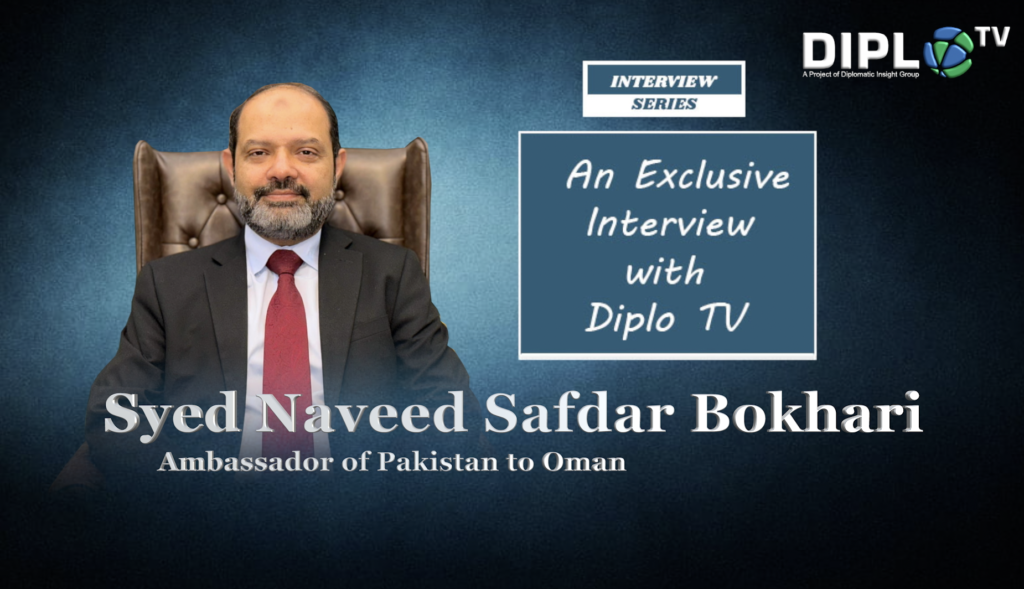
In this episode of Conversation with a Diplomat, Diplo TV sat down with H.E. Syed Naveed Safdar Bokhari, Ambassador of Pakistan to the Sultanate of Oman, to discuss a professional journey that took an unexpected turn, from practicing medicine to serving in Pakistan’s Foreign Service.
Having joined the Foreign Service of Pakistan in 2001, Ambassador Bokhari has served in a range of important positions both at the Ministry of Foreign Affairs in Islamabad and abroad. His diplomatic career has included postings in China and the United States, as well as leadership roles related to the Shanghai Cooperation Organization. Over the course of more than two decades, he has witnessed major developments in international affairs while representing Pakistan in some of the world’s most influential capitals.
The discussion also explores the role of hard work in professional success, the value of career guidance for young people, and the enduring importance of diplomacy in an increasingly complex world.
To watch the full interview, click the link below:
Q: Tell us about yourself, your journey, and how it all started. Where did you receive your education?
Syed Naveed Safdar Bokhari: Like many people in our part of the world, I came from a completely different professional background before joining the civil service. I graduated from King Edward Medical College in Lahore in 1995 and practiced medicine for a few years.
Later, I appeared in the competitive examination and joined the Foreign Service of Pakistan. Prior to joining the Foreign Service, my journey was relatively straightforward, but since then it has been a highly rewarding experience. Alhamdulillah, I have no regrets. Allah has been very kind to me, and serving as a diplomat has given me opportunities and experiences that I value greatly.
Q: You were a medical doctor by training. What motivated you to switch from medicine to diplomacy?
Syed Naveed Safdar Bokhari: Interestingly, when I graduated from medical college, I was not in favor of doctors pursuing CSS. I believed that doctors should remain committed to the noble profession of medicine.
However, life is full of surprises. A few years after graduation, circumstances led me to consider appearing in the competitive examination. I decided to give it one chance, and Alhamdulillah, I cleared both the written examination and the interview.
Joining the Foreign Service was not something I had planned during my medical college years. It was a decision that came later. Fortunately, I was allocated to the Foreign Service, which was my preferred choice, and it turned out to be one of the most important decisions of my life.
Q: Why did you choose the Foreign Service specifically?
Syed Naveed Safdar Bokhari: A major influence was my father-in-law, a retired Lieutenant General, who had interacted with ambassadors and diplomats throughout his career. He encouraged me to consider the Foreign Service and believed it would suit my abilities and interests.
I was also attracted to a profession that would allow me to use analytical skills and engage with international affairs. Looking back after more than two decades of service, I can confidently say that it was excellent advice. The Foreign Service has been an immensely fulfilling career.
Q: Diplomats spend much of their lives moving from one country to another. How do you view this lifestyle?
Syed Naveed Safdar Bokhari: The diplomatic lifestyle has both advantages and challenges.
On the positive side, you have the opportunity to see the world while representing your country with dignity and respect. You experience different cultures, societies, and political systems in a way that few professions allow.
At the same time, constant relocation can be difficult. Every few years, you have to settle into a new environment, adapt to a new culture, and build a new life. In my case, I have served in China and the United States—two important countries with very different cultural settings.
Perhaps the greatest challenge is for the family, particularly children. They develop friendships in one country and then have to leave them behind when a new posting comes along. Helping them understand these transitions is not always easy. I must acknowledge the role my wife played in this regard. She did a remarkable job supporting our children through these changes.
Another challenge is being away from family back home. There are occasions when loved ones need you, but professional responsibilities make it impossible to be there. That is one of the sacrifices diplomats make throughout their careers.
Q: Do you believe those sacrifices are worth it?
H.E. Syed Naveed Safdar Bokhari: Yes, I do. At its core, diplomacy is about protecting and promoting national interests while creating opportunities for cooperation. Diplomats work to keep channels of communication open, strengthen friendships between nations, and promote mutual understanding.
The world has experienced considerable turbulence over the past twenty-five years, and in such circumstances, the role of diplomacy becomes even more important. Building relationships, sustaining dialogue, and promoting peace are meaningful responsibilities.
Every profession has its own challenges and rewards. After more than twenty-five years in public service, I can say that the journey has been worth it.
Q: Having served in both China and the United States, were there experiences that particularly impressed you?
Syed Naveed Safdar Bokhari: Before joining the Foreign Service, I had not traveled extensively abroad, so every posting became a journey of discovery.
My first major overseas experience was in Beijing, where I arrived in 2003. It was a fascinating period because China was developing at an extraordinary pace. The scale and speed of transformation were remarkable. New buildings, roads, and infrastructure projects seemed to emerge constantly, and witnessing that process firsthand left a lasting impression on me.
My experience in the United States was different. When I arrived in Washington, D.C., in 2011, I had the opportunity to engage with government institutions, Congress, think tanks, and even attend meetings at the White House. It provided valuable insight into how a global power operates and formulates policy.
Both countries offered unique learning experiences and contributed significantly to my professional development as a diplomat.
Q: What do you miss most about Pakistan while serving abroad?
Syed Naveed Safdar Bokhari: The simple answer is everything—beginning with family.
Although I currently serve in Oman, which is relatively close to Pakistan, professional commitments mean that visits home are not always possible. Pakistan remains close to my heart, and Lahore, where I spent much of my life, continues to feel like home.
In Oman, we try to maintain that connection through community and cultural activities. With a Pakistani community of around 400,000 people, there are many opportunities to celebrate our culture, traditions, and shared identity.
Q: Pakistan has a diverse society. Do you see that diversity reflected within the Pakistani community in Oman?
Syed Naveed Safdar Bokhari: Absolutely. The Pakistani community in Oman includes people from all four provinces as well as members of different religious communities, including Christians, Hindus, and Sikhs.
One of my priorities has been to ensure inclusivity in community engagement. Whenever we organize events at the embassy or at my residence, we try to ensure broad representation. Every community brings its own traditions and cultural richness, and together they reflect the diversity and beauty of Pakistan.
Community events organized by one group often attract participation from others as well, which strengthens unity and mutual understanding within the broader Pakistani community.
Q: While serving in Oman, have you observed anything that Pakistan could learn from or adopt?
Syed Naveed Safdar Bokhari: Omani culture is actually quite close to Pakistani culture because of our historical connections. There are strong cultural and family linkages between the two countries, particularly with Balochistan and Sindh. Oman is also Pakistan’s maritime neighbor.
One thing I particularly admire is the emphasis on family time. Since Muscat is located along the coastline, families often gather together outdoors in the evenings. Parents, children, and grandparents spend quality time together.
I believe this is something that has become less common in many urban centers in Pakistan, where people are increasingly busy with their individual routines. Reviving family gatherings and shared experiences would be beneficial for our society.
Q: In your view, what defines a true diplomat?
Syed Naveed Safdar Bokhari: A true diplomat must first and foremost be a good listener.
There are many situations in diplomacy where you may hear things that you do not agree with, but reacting immediately is not always the best course of action. A diplomat must know when to speak, what to say, and how to communicate effectively.
Another essential quality is the ability to analyze developments and identify emerging trends. Diplomats serve as the eyes and ears of their governments abroad. They must accurately assess developments in the countries where they serve and communicate those insights back to their headquarters.
Strong communication skills, sound judgment, and analytical ability are all essential qualities for effective diplomacy.
Q: What are your interests outside diplomacy?
Syed Naveed Safdar Bokhari: I enjoy reading books, although I wish I had more time for it than I currently do.
I also enjoy poetry and listening to Pakistani ghazals. Among the artists I listen to are Mehdi Hassan, Ghulam Ali, and Farida Khanum. Their work continues to represent some of the finest traditions of South Asian music and poetry.
Q: What advice would you give to young people who aspire to join the Foreign Service or build successful careers?
Syed Naveed Safdar Bokhari: There are no shortcuts in life. Hard work remains the most important ingredient for success.
My advice to young people is to dedicate themselves fully during the first five to seven years of their careers. Those years are foundational and shape everything that follows.
When I joined the Foreign Service, I handled a wide range of responsibilities. I worked on administration, protocol, event management, and many other tasks that might not appear glamorous from the outside. I even took responsibility for ensuring that day-to-day operational matters at the embassy were functioning properly.
Those experiences proved invaluable because they provided a complete understanding of how institutions function. When you are willing to learn every aspect of your profession, you become better prepared to handle greater responsibilities later in your career.
Whatever profession you choose—whether diplomacy, journalism, business, medicine, or public service—there is no substitute for dedication, discipline, and hard work.
Q: Finally, what are your thoughts on initiatives such as Diplo TV?
Syed Naveed Safdar Bokhari: I believe Diplo TV is performing a valuable service.
Much of diplomacy takes place behind the scenes. People often see the outcomes but not the effort and processes that make those outcomes possible. Platforms such as Diplo TV help bridge that gap by bringing diplomats and their work closer to the public.
I also hope such initiatives encourage talented young people to consider careers in diplomacy. The Foreign Service of Pakistan is a noble and rewarding profession. It offers the opportunity to serve one’s country, engage with the world, and contribute to building stronger relationships between nations.
For those who are willing to work hard and embrace its challenges, it can be an exceptionally fulfilling career.

Established in December 2008, The Diplomatic Insight is Pakistan’s premier diplomacy and foreign affairs magazine, available in both digital and print formats.