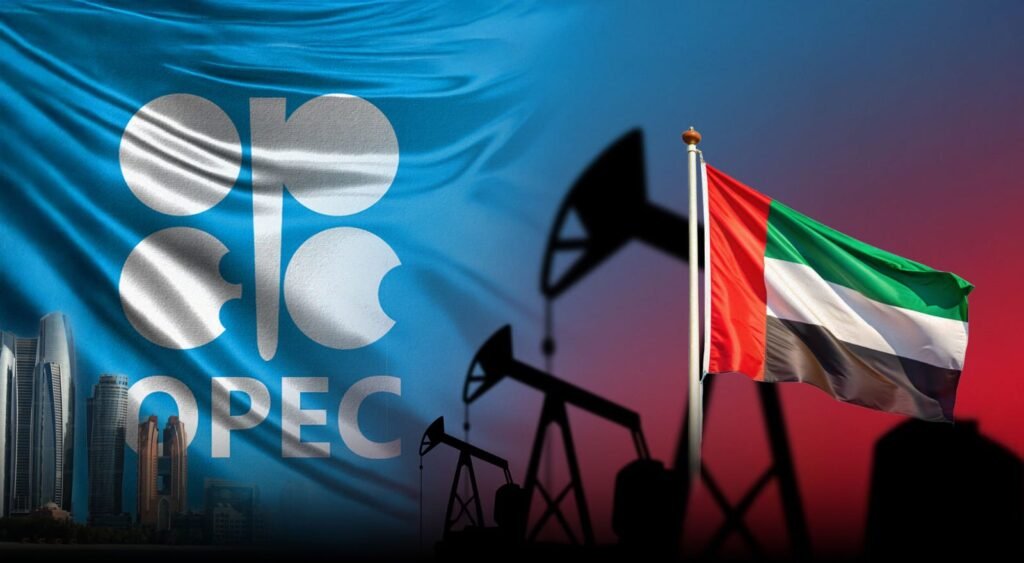
The United Arab Emirates (UAE) officially terminates its 59-year membership with the Organization of the Petroleum Exporting Countries (OPEC) after its joining on 1967 and the broader OPEC+ alliance which marks a crucial moment in the history of global energy politics.
The withdrawal has taken effect from today – 1st May 2026. This move by the group’s third-largest producer is a calculated sovereign choice that fundamentally challenges the two primary pillars of the post-1974 energy architecture, the petrodollar system and collective production discipline.
The UAE’s departure is the ultimate result of years of friction with Saudi Arabia over production quotas. Abu Dhabi has invested heavily in its state-run firm, ADNOC, to expand capacity, yet OPEC limits have repeatedly left the Emirates “leaving money on the table”.
By exiting, the UAE releases a massive spare capacity of approximately 4.8 million barrels per day (bpd). Energy Minister Suhail Al Mazrouei explained this shift, he said that the world requires more resources and the UAE aims to be “unconstrained by any groups.”
Read More: UAE Supports US–Iran Ceasefire, Emphasizes Strait of Hormuz Freedom
The goal is a definitive jump from a restricted 3.4 million bpd to a projected 5 million bpd by 2027. By challenging the petrodollar beyond production, the UAE is testing the financial status quo; in the context of the ongoing regional conflict and the resulting pressure on dollar liquidity.
The Emirati officials have hinted at using the Chinese Yuan for oil transactions, as this is not a total abandonment of the dollar but a strategic move to have alternatives.
The pricing shipments to China which already buys 35% of UAE crude in Yuan could remove significant daily petrodollar demand, hedging against the volatility of war-driven trade shocks.
Geopolitical friction and the blow to Saudi leadership
The exit deprives Saudi Arabia of a key partner in “burden-sharing.” Traditionally, Riyadh has managed prices by cutting its own production and enforcing discipline across the group. With the UAE gone, Saudi Arabia must rely more heavily on its own cuts to stabilize prices; a task that is becoming increasingly expensive.
Riyadh requires high oil prices, near $90 per barrel, to fund its ambitious Vision 2030 and the $500 billion futuristic city, NEOM. Every barrel held back represents lost revenue that could otherwise fuel domestic economic growth. Furthermore, the exit exposes a perception of Saudi dominance that has long sustained the cartel’s cohesion.
While the exit is a fundamental policy shift, immediate price swings are unlikely due to the ongoing disruption in the Strait of Hormuz. Much of the region’s oil remains blocked, with the UAE redirecting roughly 1.8 million bpd via its Fujairah pipeline.
However, once the situation normalizes, the UAE is expected to add hundreds of thousands of extra barrels to the market, leading to more volatility and potentially lower prices.
How this affects global consumers?
India and China: These nations stand to benefit from a more competitive market. For India, a weaker OPEC may eventually soften crude prices, though the short-term remains complex due to inflation and currency pressures.
The African Market: Experts warn that unconstrained UAE production which is often cheaper and “cleaner” low sulfur will put direct pressure on African barrels from Nigeria, Angola, and Algeria, who struggle with higher operating costs.
Trump Factor: This move aligns with U.S. President Donald Trump’s long-standing criticism of OPEC. The potential for a U.S and UAE financial lifeline suggests a strengthening bilateral ties outside the traditional Saudi-OPEC sphere.
Read More: The Global Energy Transition and the Reordering of Power in World Politics
The UAE is not the first country to leave OPEC; it follows Qatar (2019), Angola (2024), Ecuador (2020), Indonesia (2016), and Gabon (1995, later rejoined in 2016). However, its exit is the most significant, announced at a time when energy markets are uncertain due to the prolonged US-Iran standoff.
The Strait of Hormuz is closed, and a good deal of energy infrastructure in the Gulf has been destroyed during the war that commenced on February 28.
UAE’s departure from OPEC signals a transition from a world of collective limit to one of individual market expansion. By building optionality in currency and production, the UAE is positioning itself for a “new energy age,” prioritizing national interest and market flexibility over the aging structures of the 20th-century oil order.

Muhammad Usman Hashmi is a researcher in International Relations, focusing on climate diplomacy, global governance, and political economy in the Global South. He has contributed to policy dialogues with the Foreign Policy Community of Indonesia and serves as a Senior Research Fellow at the International Council on Human Rights, Peace and Politics. He is also associated with Rethinking Economics Islamabad, contributing to research on development and sustainability.