The Red Sea is one of the world’s most volatile maritime regions today. The escalation in attacks on merchant vessels in and around the Bab el-Mandeb Strait since the end of 2023 and into 2026 has turned this important choke point into a flashpoint.
The Houthi rebels in Yemen, in the context of wider regional dynamics associated with the conflict in Gaza and competition between Iran, the US and Israel, have increasingly attacked merchant shipping in an effort to pressure Israel and its supporters.
A predominantly regional conflict in Yemen has evolved into an international maritime security crisis. The closure of shipping lanes, insurance premiums, naval patrols and the diversion of world trade away from the Cape of Good Hope have collectively marked a shift: the creeping militarization of global shipping lanes.
This is not simply a crisis in Yemen or with the Houthis, it is a shift in the nature of maritime choke points as a tool of geopolitical strategy.
The Houthi insurgency, which emerged out of Yemen’s ongoing civil war, has transformed from a local insurgency to a regional threat that affects global shipping. Having established control over vast swaths of northern Yemen, and with missile and drone capabilities, the Houthis have shown a growing capacity to exert influence beyond Yemen’s borders. Their approach in the Red Sea is deliberate.
Read More: Houthi Militia Moves Missiles Near the Red Sea to Target International Shipping
It has three interrelated goals: First, signaling, where maritime attacks are a statement of defiance in line with broader regional conflicts, such as the Israel-Gaza conflict. Second, deterrence, seeking to increase the cost of external intervention, particularly by the US and its allies, through threats to a globally important maritime channel.
Third, domestic legitimacy, in which confrontation with the outside world enhances domestic unity and political relevance in the conflicted Yemeni political realities.
Through its attacks on merchant shipping, the Houthi movement has globalized the Yemeni conflict, linking it to broader issues of trade security.
The Red Sea crisis has highlighted the shortcomings of international maritime security. Historically, 10-15% of global trade and close to 30% of container shipments transit via the Suez Canal, making the Red Sea-Bab el-Mandeb passage one of the most critical choke points.
The heightened threat of attacks has led to a number of structural changes: Vessels are now avoiding the corridor by detouring around the Cape of Good Hope, resulting in longer routes and higher fuel expenditures. The cost of insurance to operate vessels in the Red Sea has increased due to perceived risk.
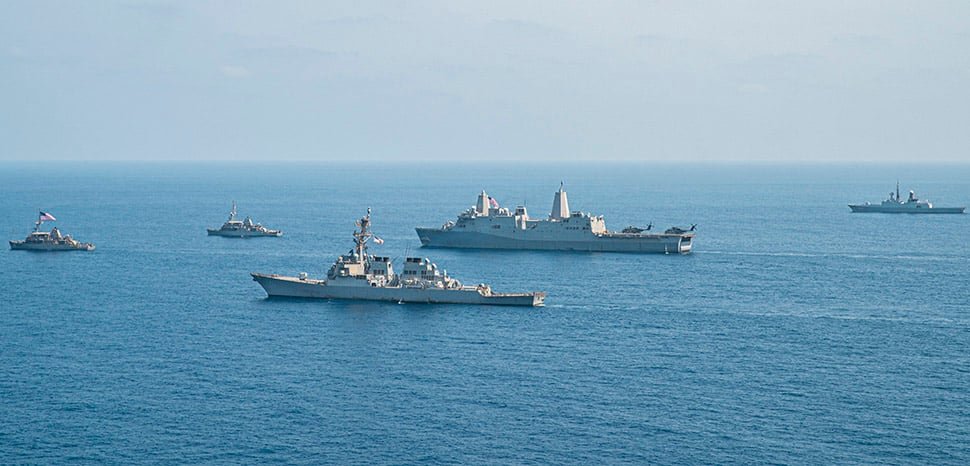
Several nations, such as the United States and its European allies, have increased their naval patrols in the area through maritime security operations. This scenario highlights the transition from commercial maritime space to securitized maritime space, where maritime trade routes are no longer apolitical economic spaces but geopolitical spaces.
The Militarization of Global Trade Routes
A major consequence of the Red Sea crisis is the militarization of maritime trade routes. Maritime choke points like the Strait of Hormuz, Malacca Strait and Suez Canal have always been important. But the present crisis marks a new era of maritime security in which non-governmental actors are playing a more prominent role. Multinational naval patrols of shipping lanes represent a return to power projection in commercial shipping lanes.
Meanwhile, the deployment of drones, missiles, and asymmetric naval warfare by the Houthis shows the geopolitical nature of contemporary warfare. There are three aspects of this militarization: First, naval build-up, where world powers maintain a greater permanent or rotational presence in important strategic waterways.
Second, commercial securitization, where maritime businesses prioritize security in their operations. Third, arms racing in the sea, where cheap missiles and drones undermine naval dominance. The end result is a fractured maritime order where freedom of navigation is increasingly reliant on force.
This Red Sea crisis is part of regional and global dynamics. Iran’s alleged support for the Houthis, American efforts to protect global commerce, and Israeli security interests are all at play in the maritime domain. For regional powers, the Red Sea is a proxy for their strategic rivalry. For major powers, it is a key junction for global trade.
This has resulted in both joint security efforts, as well as divergent priorities. Some seek to deter and contain the threat, while others see it as an opportunity for destabilizing the status quo. As a consequence, the Red Sea is no longer just a shipping route but also a geopolitical battleground where local and international interests converge.
Read More: Chokepoints of Power: Middle East Conflict and the Battle for Global Trade Routes
The Red Sea crisis is taking a growing toll on the global economy. The crisis is placing stress on global supply chains that have already been disrupted by other factors, such as the COVID-19 pandemic and the Russia–Ukraine war.
Key consequences include: increasing transport costs from alternative routes, impacts on energy and commodity supply chains across the world, fluctuations in oil and commodity prices due to transit risks, and impact on developing countries that rely on imports.
These impacts demonstrate the potential for regional tensions to result in global economic consequences in a global economy.
The crisis also exposes limitations in global maritime governance. Institutions responsible for maintaining freedom of navigation, such as international maritime law frameworks and multilateral security arrangements, are struggling to respond effectively to asymmetric threats.
Non-state actors operating in conflict zones can exploit governance gaps, while major powers often prioritize strategic interests over collective security solutions. This creates an environment where reactive military responses dominate over long-term diplomatic resolution. The absence of a unified security framework for the Red Sea region further complicates efforts to stabilize the situation.
Policy Implications and the Need for Maritime Diplomacy
Addressing the Red Sea crisis requires more than naval deployment. A sustainable solution must integrate diplomatic, economic, and security dimensions. First, regional dialogue mechanisms involving coastal states such as Yemen, Saudi Arabia, Djibouti, and Egypt must be strengthened to build a shared security understanding.
Second, de-escalation frameworks between external powers are necessary to prevent maritime incidents from triggering broader conflict escalation. Third, maritime diplomacy initiatives should focus on protecting commercial shipping as a global public good, separating trade security from geopolitical rivalry.
Finally, investment in regional stability in Yemen remains essential, as unresolved internal conflict continues to fuel maritime insecurity.
The Red Sea crisis marks a turning point in the relationship between conflict and global trade. What was once a relatively stable commercial corridor has now become a contested strategic environment shaped by asymmetric warfare, regional rivalries, and global power competition.
The militarization of trade routes signals a broader transformation in international relations, where economic globalization is increasingly intertwined with security fragmentation.
Ultimately, the stability of global maritime systems will depend on whether states can move beyond short-term military responses toward long-term cooperative security frameworks.
Without such efforts, critical choke points like the Red Sea may remain vulnerable to recurring crises, with far-reaching consequences for the global economy and international order.
*The views presented in this article are the authors’ own and do not necessarily reflect the views of The Diplomatic Insight.

Waqas Abdullah
Waqas Abdullah is a geopolitical analyst and anthropologist whose areas of expertise are Middle Eastern and Indo-Pacific politics. A Türkiye Bursları Scholar, he is pursuing a Master’s in International Relations at Selçuk University Konya. His work focuses on climate refugees, human security, and regional cooperation.