The world’s oceans carry approximately 90 percent of global trade by volume, threading through a handful of narrow passages that function as the circulatory system of the modern economy.
Geographers and strategists commonly identify around ten to eleven major maritime chokepoints and critical routing corridors across the globe, including the Strait of Hormuz, Bab-el-Mandeb, Suez Canal, Strait of Malacca, the Turkish Straits (Bosphorus and Dardanelles), the Strait of Dover, the Strait of Gibraltar, the Danish Straits, the Lombok Strait, the Panama Canal, and the Cape of Good Hope.
The last two are particularly significant as strategic alternatives. The Panama Canal links the Pacific and Atlantic Oceans and remains critical for transoceanic container trade, though not entirely irreplaceable given the existence of longer alternative routes. The Cape of Good Hope, while not a narrow chokepoint, serves as the primary bypass when both the Suez Canal and Bab-el-Mandeb are disrupted, adding up to one to two weeks and thousands of miles to any voyage.
Read More: Iran Threatens to Resume War Over Strait of Hormuz Dispute
Recent developments have reinforced this vulnerability. Attacks linked to the Houthis in the Red Sea have already forced a significant portion of global shipping onto this extended southern route, demonstrating in real time how disruption in one chokepoint cascades pressure onto others.
Each of these passages represent a geographic bottleneck where disruption whether by conflict, blockade, or political brinkmanship can send shockwaves through global energy markets, supply chains, and food systems.
Of these critical routes, three lie in or directly adjacent to the Middle East, while a fourth, the Cape of Good Hope functions as their de facto overflow valve. In an era of intensifying regional conflict, this concentration is not coincidental; it is a structural vulnerability with the potential to deepen into a broader global crisis.
The Middle East’s Stranglehold on Global Commerce
The current arc of conflict stretching from Gaza through Yemen and into the Persian Gulf has placed all three of the Middle East’s critical maritime corridors under simultaneous strain, a situation without modern precedent, and one now playing out in real time.
By early April 2026, daily transits through the Strait of Hormuz had collapsed from a normal average of around 150 vessels to just nine. Every major container shipping line; Maersk, Hapag-Lloyd, MSC, and CMA CGM had simultaneously suspended passage through both Hormuz and Bab-el-Mandeb, an event with no historical parallel.
Oil prices surged more than 50 percent in weeks, with Brent crude hitting $116 a barrel and recording its biggest monthly gain on record, while energy analysts warned that a prolonged closure amounted to a guaranteed global recession.
What makes this crisis uniquely dangerous is its breadth: it is not only energy at stake, but food security, as the Persian Gulf supplies up to 30 percent of the world’s internationally traded fertilizers a commodity with no strategic reserve system and no quick alternative supply chain. Understanding the full stakes requires understanding what each passage carries and what its closure truly means.
The Strait of Hormuz: The World’s Most Dangerous Narrows
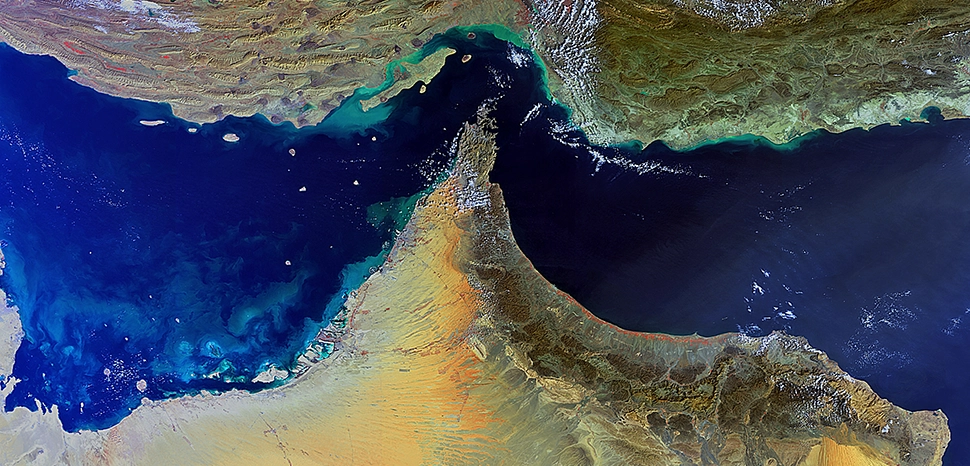
Stretching just 21 miles wide at its narrowest point between Oman and Iran, the Strait of Hormuz is the single most consequential chokepoint on Earth. Roughly 20 to 21 million barrels of oil pass through it daily nearly one-fifth of the world’s total petroleum consumption along with massive quantities of liquefied natural gas from Qatar, the world’s largest LNG exporter.
Iran has repeatedly threatened and close the Strait, most recently as tensions over its nuclear program and proxy conflicts have escalated following the broader regional fallout of the Gaza war. Were Tehran to act on this threat whether through naval blockades, mining operations, or missile attacks on tankers, the consequences would be catastrophic in scope and rapid in onset.
Global oil prices would spike within hours. Countries in Asia, particularly Japan, South Korea, India, and China, which depend on Gulf crude for the majority of their energy imports, would face immediate economic disruption. Europe, already stressed by post-Ukraine energy restructuring, would confront a secondary shock.
That hypothetical has since become reality. On 28 February 2026, the United States and Israel launched coordinated airstrikes on Iran targeting military infrastructure, nuclear sites, and senior leadership, including Supreme Leader Ali Khamenei triggering the most severe Strait of Hormuz crisis in the waterway’s history.
Read More: US-Iran Peace Talks: Disputes, Tensions and Global Implications
Iran’s Islamic Revolutionary Guard Corps (IRGC) responded with missile and drone strikes across the region and issued warnings forbidding commercial passage through the strait. Tanker traffic collapsed by over 70 percent within days. Brent crude surpassed $100 per barrel for the first time in four years.
A brief ceasefire brokered by Pakistan on 7–8 April brought a partial reprieve, but on 18 April Iran reimposed the closure in response to a US naval blockade of Iranian ports firing on Indian-flagged tankers and forcing vessels to anchor outside the strait indefinitely.
Negotiations remain deadlocked, with Washington demanding full reopening and Tehran insisting on lifting of the blockade as a precondition. The scenario analysts had long warned about is no longer theoretical; it is unfolding in real time, and its full economic toll is only beginning to be counted.
The vulnerability is structural. There is no adequate alternative routing for Persian Gulf exports. The pipeline infrastructure that bypasses Hormuz including Saudi Arabia’s East-West Pipeline has a maximum capacity of around five million barrels per day, a fraction of what passes through the strait.
A sustained closure would trigger energy rationing in importing nations, collapse of shipping insurance markets, and potentially military confrontation as consuming nations weigh the costs of inaction against the risks of intervention.
Bab-el-Mandeb: The Southern Gate
If Hormuz is the world’s energy artery, the Bab-el-Mandeb, Arabic for ‘Gate of Tears’ is the gateway connecting the Arabian Sea to the Red Sea and onward to Europe.
At only 18 miles wide, it sits between Yemen on the Arabian Peninsula and Djibouti and Eritrea on the Horn of Africa. Approximately 17,000 ships pass through it annually, carrying goods between Asia, the Gulf, and European markets via the Suez Canal.
The Houthi movement in Yemen, backed by Iran, has already demonstrated the destructive potential of this chokepoint. Beginning in late 2023 and intensifying through 2024 and 2025, Houthi drone and missile attacks on commercial shipping in the Red Sea forced dozens of major carriers including Maersk, MSC, and CMA CGM to reroute vessels around the Cape of Good Hope.
This added approximately 10 to 14 days to voyages and dramatically increased fuel and insurance costs, effectively imposing a shadow tax on global trade without firing a single shot at a warship.
The Bab-el-Mandeb situation illustrates a profound shift in modern geopolitical warfare: sub-state actors, armed with relatively inexpensive drones and anti-ship missiles supplied by state sponsors, can now threaten one of the world’s most critical trade lanes.
The cost asymmetry is staggering. A single Houthi drone costing thousands of dollars can force a shipping company to absorb millions in rerouting costs.
The Suez Canal: Vulnerability at the Intersection
The Suez Canal, connecting the Red Sea to the Mediterranean, handles roughly 12 to 15 percent of global trade by value and approximately 30 percent of global container traffic. It is the artery through which European consumers receive Asian manufactured goods and through which Asian markets receive European exports.
When the Ever-Given container ship ran aground in March 2021 for just six days, it caused an estimated six billion dollars in disruption per day.
The canal’s vulnerability is twofold. First, it is a single-lane bottleneck in the most geopolitically volatile region on earth, dependent on Egyptian political stability and regional security conditions.
Second, the Houthi campaign against Red Sea shipping targeting the southern approach through Bab-el-Mandeb has already functionally disrupted Suez traffic by making the approach corridor too dangerous for commercial insurers to underwrite at acceptable rates. The canal and Bab-el-Mandeb are thus strategically linked: threatening one diminishes the other.
Control as Currency: The 21st-Century Power Calculus
What the current crisis in the Middle East reveals is that control over geographic chokepoints has become one of the most decisive and most underappreciated currencies of 21st-century power. Great powers of previous centuries competed for land, colonies, and industrial capacity.
The competition today is increasingly over nodes and routes: who controls the passages through which the world’s energy, food, and manufactured goods must pass.
Iran understands this logic precisely. Its ability to threaten Hormuz provides Tehran with a strategic deterrent that its conventional military capacity alone could never deliver. Even without closing the strait, the credible threat of closure compels global powers to factor Iranian interests into their calculations.
Read More: Iran Closes Strait of Hormuz Again, Markets Jolt as Tensions Spike
China, dependent on Gulf oil, cannot afford to allow Hormuz to close; the United States, obligated by treaty and interest to its Gulf partners, cannot permit Iranian dominance of the waterway. Both must engage with Iran, on Iran’s terms, at least in part because of the geography.
The Yemen conflict, and the Houthi campaign it has enabled, represents a parallel development: the weaponization of geographic chokepoints by proxy actors as an instrument of regional coercion. It is a model that other state sponsors of non-state armed groups are watching closely.
Looking ahead, the convergence of conflict, climate stress on alternative routes, and the increasing precision of drone and missile technology will make maritime chokepoints more nor less contested.
The nations that secure reliable access to these passages, whether through diplomacy, military presence, or strategic partnerships, will hold a structural advantage in the emerging world order. Those that do not will find that geography, in the 21st century, remains destiny.
*The views presented in this article are the authors’ own and do not necessarily reflect the views of The Diplomatic Insight.

Aroosa Salahuddin
Aroosa Salahuddin is a Digital Diplomacy Expert and former Managing Editor of The Diplomatic Insight Magazine. She has extensive experience in media, public relations, project management, and strategic communications. With an MPhil in Strategic Studies and a specialization in Pakistan’s digital diplomacy, Aroosa has worked with influential national and international organizations. Her expertise spans advocacy, crisis communication, digital strategy, and stakeholder engagement.