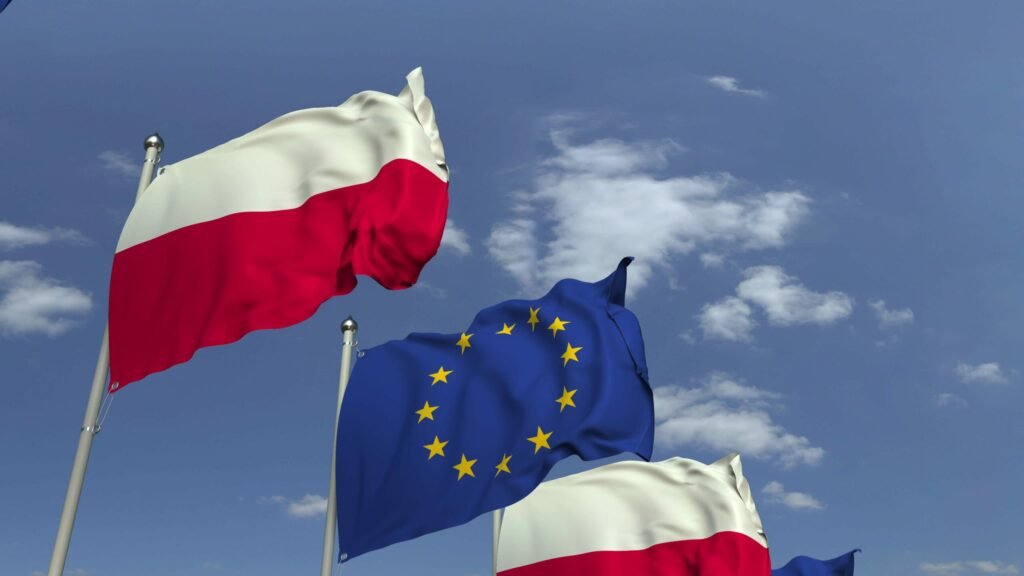
Warsaw (TDI): The Polish Ministry of Foreign Affairs (MFA) issued a landmark assessment on Friday to mark the 22nd anniversary of the nation’s entry into the European Union.
The report, titled “22 Years of Poland in the European Union,” describes the period as a phase of remarkable growth, positioning Poland as the primary economic driver of the European bloc.
Since Poland joined the EU on May 1, 2004, the country has leveraged its position within the EU to undergo a massive social and industrial transformation.
The MFA highlights that Poland’s presence in the Union is not merely a political status but the fundamental force behind is its emergence as a global economic leader.
22 lata Polski w Unii Europejskiej.
Polski sukces w liczbach. ????????????????W 22. rocznicę wstąpienia Polski do Unii Europejskiej MSZ podsumowuje ekonomiczno-społeczne efekty członkostwa Polski w Unii Europejskiej.
To bilans, który pokazuje jednoznacznie: Polska odniosła w UE sukces…
— Ministerstwo Spraw Zagranicznych RP ???????? (@MSZ_RP) May 1, 2026
The focus on structural stability and institutional security, which began after the 1989 transition, reached its peak point with EU membership, according to the report.
This strategic trajectory, supported by nearly 78% of the population in the 2003 referendum and provided the mandate for the rapid modernization that has seen Poland aligned with and, in several cases, exceed the continent’s most developed economies.
Economically, the figures released by the MFA highlight an extraordinary success. Poland’s economy has more than doubled in size over the last 22 years, achieving combined GDP growth of nearly 130% the highest recorded across the entire EU-27.
Poland has already overtaken Greece in GDP per capita, International Monetary Fund (IMF) projections estimates show that Poland will surpass Spain within the current year.
Celebrating 22 years of Poland in the EU! ????????????????✨
A journey of transformation, unity, and progress. Proud of the past, optimistic about the future!یورپی یونین میں پولینڈ کی رکنیت کے 22 سال مکمل ہونے کا جشن! ????????????????✨ pic.twitter.com/CXA0icfieh
— PLinPakistan (@PLinPakistan) May 1, 2026
Currently, the nation’s GDP has crossed the $1 trillion milestone and by December 2026, it is set to participate in the summit of the world’s 20 largest economies. The labor market transformation remains one of the most significant social achievements of this era.
As the one-third of Poland’s working population roughly five million people now holds jobs directly linked to the EU single market.
Unemployment has seen a historic decline decreasing from 19% at the time of joining to just 3% in 2025, while average wages have climbed by more than 180%.
Further, the trade dynamics have shifted toward high-value sectors, with total exports increasing sixfold and agri-food exports growing twelvefold since 2004.
Read More: Business Forum Highlights Pakistan-Poland Trade and Investment Potential
Poland has also become a regional leader in high-tech exports, now outperforming nations such as Austria and Spain in the share of advanced technological products sent abroad.
On the investment front, the European Union remains the cornerstone of Poland’s financial stability, accounting for 85% of all foreign direct investment.
Along this, Poland has transformed into a regional investor, with domestic direct investment abroad rising from just €512 million in 2004 to nearly €39 billion in recent years.
Beyond the numbers, Poland has strengthened its role as a pivotal security actor along the EU’s eastern frontier. Poland has also enhanced its defense spending reaching 4% of GDP in 2026, the nation serves as the key military and logistical pivot for regional stability.
The MFA emphasizes that the nation is now focused on a “Green Transformation” and using the Recovery and Resilience Facility (RRF). Poland is leading massive offshore wind initiatives in the Baltic Sea to secure energy autonomy.

Muhammad Usman Hashmi is a researcher in International Relations, focusing on climate diplomacy, global governance, and political economy in the Global South. He has contributed to policy dialogues with the Foreign Policy Community of Indonesia and serves as a Senior Research Fellow at the International Council on Human Rights, Peace and Politics. He is also associated with Rethinking Economics Islamabad, contributing to research on development and sustainability.