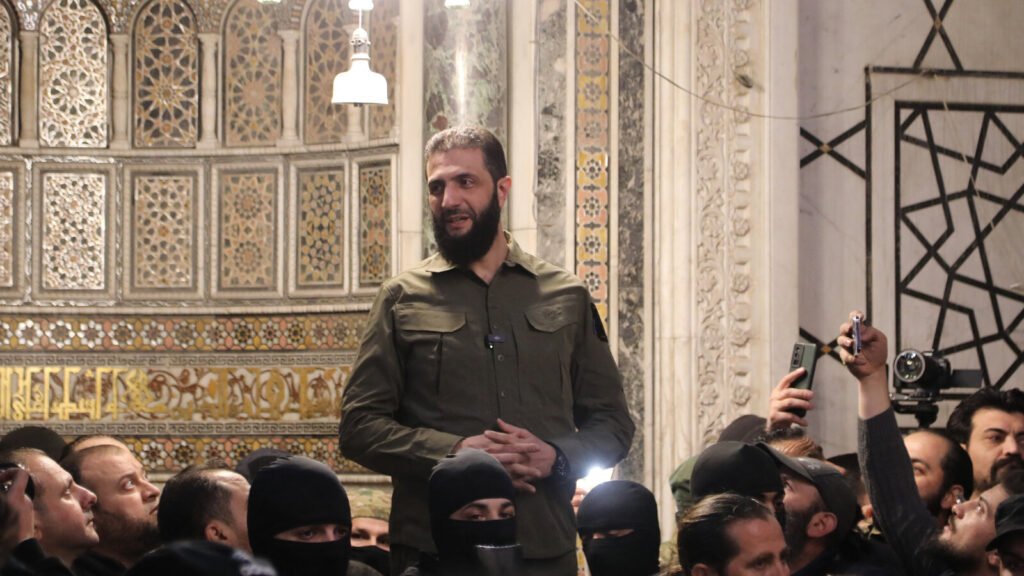
Ahmed al-Sharaa, formerly widely known by his nom de guerre Abu Mohammad al-Jolani, emerged as a central figure in Syria’s modern conflict, shaped by overlapping trajectories of insurgency, ideology, and state collapse. Born in the Israeli-occupied Golan Heights and later raised in Damascus, his early environment reflected both geopolitical tension and the social pressures of the broader Levant.
His entry into militant politics began in the early 2000s when he traveled to Iraq and joined Al-Qaeda in Iraq to fight against the US-led invasion. This phase was decisive in shaping his ideological orientation, operational networks, and long-term insurgent identity.
His subsequent detention at Camp Bucca, a facility widely regarded as a hub for militant networking and radicalization dynamics, further embedded him within emerging jihadist leadership structures.
The outbreak of the Syrian Civil War in 2011 provided the decisive turning point in his trajectory. Returning to Syria, he established the Al-Nusra Front as an affiliate of Al-Qaeda, positioning the group as one of the most organized and militarily effective opposition forces against the Assad regime.
While initially aligned with transnational jihadist ideology, al-Sharaa gradually recalibrated his strategic outlook, recognizing that sustained association with global jihadism constrained both local legitimacy and political survivability.
This strategic reassessment culminated in his 2016 break with Al-Qaeda and the subsequent formation of Hay’at Tahrir al-Sham (HTS) in 2017, which unified several rebel factions under a centralized command structure and consolidated territorial control in northwest Syria, particularly Idlib.
Genesis and Evolution of Hay’at Tahrir al-Sham
The formation of HTS marked a structural transformation from fragmented insurgency to centralized governance-oriented authority. Unlike earlier jihadist formations, HTS increasingly prioritized institutional consolidation, internal discipline, and territorial administration.
Under al-Sharaa’s leadership, the organization moved beyond purely military objectives and began constructing governance frameworks designed to stabilize controlled areas and enhance political legitimacy.
A key institutional innovation was the establishment of the Syrian Salvation Government (SSG), a civilian administrative body designed to separate military command from civil governance. The SSG was composed of technocrats, engineers, legal experts, and local administrators responsible for managing essential public services, including healthcare, education, judiciary systems, municipal infrastructure, and taxation mechanisms.
This dual structure allowed HTS to function simultaneously as a military authority and a governing entity, thereby reinforcing its control over population centers while reducing governance fragmentation.
Read More: Syria Opens First Trial of Assad-Era Officials After Regime Transition in 2024
Economically, HTS strengthened its administrative capacity through control of strategic trade routes, most notably the Bab al-Hawa border crossing with Turkey. Revenue generated from customs duties, import regulation, and cross-border trade became a crucial financial foundation for sustaining governance structures, security institutions, and public services.
Over time, this economic system contributed to the transformation of Idlib into a semi-autonomous administrative zone with proto-state characteristics.
At the same time, HTS pursued internal consolidation by suppressing rival extremist factions, including ISIS-linked cells and hardline Al-Qaeda loyalists who opposed its localized political strategy. This internal restructuring reflected a broader ideological shift from transnational jihadism toward territorially grounded governance and pragmatic political survival.
Governance, Security, and Political Rebranding
HTS governance under al-Sharaa developed into a centralized hybrid system combining military authority with administrative bureaucracy. Security functions were handled by HTS military structures responsible for internal control, border management, and counterinsurgency operations, while the SSG administered civilian governance.
This dual arrangement ensured operational coherence while allowing the organization to present a functioning civil administration to local populations.
Beyond institutional governance, al-Sharaa undertook a deliberate political rebranding strategy aimed at reshaping both domestic and international perceptions.
Over time, he distanced himself from jihadist symbolism, replacing battlefield imagery with formal political presentation, including Western-style attire and controlled media engagements. This shift was designed to reposition him as a pragmatic Syrian nationalist leader rather than a transnational militant actor.
Despite these efforts, international skepticism persisted, particularly regarding the sincerity of HTS’s ideological transformation. Nevertheless, within its controlled territories, the group increasingly emphasized order, governance delivery, and institutional functionality as sources of legitimacy rather than ideological mobilization alone.
The Collapse of Assad Regime and Territorial Reconfiguration
The Syrian conflict entered a decisive phase in late 2024 when HTS, alongside allied opposition factions, launched a coordinated military offensive against the Assad government. This campaign unfolded against the backdrop of declining external support for the regime, particularly from Russia and Iran, whose strategic constraints limited their ability to sustain the existing balance of power.
Opposition forces rapidly advanced through key urban centers, beginning in Idlib-controlled areas and expanding toward major cities such as Aleppo, Hama, and Homs, before ultimately entering Damascus. The speed and coordination of the offensive overwhelmed regime defenses and triggered the sudden collapse of state authority.
The fall of Damascus marked a structural rupture in Syria’s political order. In response, al-Sharaa issued directives aimed at preventing sectarian retaliation, looting, and widespread violence. He also attempted to reassure minority communities, including Christians, Alawites, Druze, and Kurds, that the new political framework would not institutionalize exclusion or collective punishment.
In a symbolic political transition, he formally abandoned his nom de guerre Abu Mohammad al-Jolani and reasserted his civilian identity as Ahmed al-Sharaa. This rebranding accompanied his emergence as the head of Syria’s interim governing authority, signaling a shift from insurgent commander to transitional national leader.
State Transition and Institutional Consolidation
Following the regime collapse, the immediate priority of al-Sharaa’s administration became the stabilization of state institutions and prevention of systemic fragmentation. This involved integrating multiple armed factions into a centralized security structure, restoring essential public services, and maintaining administrative continuity in liberated areas.
The transition process reflected the inherent tension between revolutionary legitimacy and state-building requirements. While HTS had developed governance capacity in Idlib, scaling this model to a national level required broader institutional inclusion, legal restructuring, and administrative expansion beyond its traditional support base.
At the same time, the challenge of maintaining internal cohesion among diverse armed groups remained significant. The process of unifying military structures under a centralized command was essential to preventing post-conflict fragmentation and ensuring long-term political stability.
The future trajectory of Syria under Ahmed al-Sharaa depends on the administration’s ability to convert military victory into durable political legitimacy. The most immediate challenge lies in designing a constitutional framework capable of balancing competing political factions, regional interests, and civil society demands.
The success or failure of this process will determine whether Syria transitions toward inclusive governance or reverts to fragmented authority structures.
Read More: One Year After Assad’s Fall, Syrian President Vows Justice, Coexistence
Economically, Syria faces an extensive reconstruction burden following years of war-induced devastation. Critical infrastructure, including housing, transportation systems, electricity grids, healthcare facilities, and educational institutions, requires large-scale rebuilding. Economic stabilization will depend heavily on international financial support, foreign investment, and potential easing of sanctions linked to HTS’s historical designation.
Geopolitically, the new Syrian leadership must navigate a complex regional environment. Relations with neighboring Turkey remain strategically significant, while security threats persist from ISIS remnants, militia fragmentation, and potential external interventions.
At the international level, skepticism continues regarding HTS’s ideological transformation and the durability of its shift toward pragmatic governance.
Ultimately, Ahmed al-Sharaa’s long-term political legacy will depend on whether he can establish an inclusive, stable, and institutionally coherent Syrian state.
The central uncertainty remains whether his leadership will evolve into a pluralistic governance model capable of reconstruction and reconciliation, or whether it will reproduce centralized and exclusionary political structures reminiscent of Syria’s previous authoritarian order.
*The views presented in this article are the authors’ own and do not necessarily reflect the views of The Diplomatic Insight.

Usman Anwar
Usman Anwar is a prospective M.Phil. scholar in Politics and International Relations. His research interests include security studies, maritime affairs, comparative politics, human rights, and climate change. His academic portfolio includes 7 published articles in reputable journals (Category Q-2 and Y) and a book review (Category Q-3). He can be reached at usmananwar2023@gmail.com