Sandwiched between two giants—China and India—Nepal has long been viewed as India’s “backyard,” its economic lifelines and political space heavily constrained by geopolitical pressures. Yet the convergence of extreme climate events in South Asia in 2026 and global energy upheavals is creating an unprecedented strategic window for Kathmandu.
When India’s Gangetic Plain faces mass fish deaths and systemic power collapse under temperatures exceeding 50°C, Nepal’s high-altitude “natural air-conditioning effect” ceases to be merely scenic—it becomes a scarce resource for survival.
Meanwhile, India’s vulnerability to energy import shocks amid turmoil in the Middle East exposes deep fragility in its supply chains, standing in sharp contrast to China’s calm confidence in energy security. If Nepal remains bound to outdated patterns of geopolitical dependence, it risks becoming a double casualty of climate displacement and great-power rivalry.
The breakthrough lies here: Nepal must evolve from a “buffer state” into a “service-exporting nation,” and China is the only viable lever to make that leap possible.
3-Phase Strategy: From Summer Retreat to “Switzerland of Himalayas”
With a per capita GDP of only about US$1,400, Nepal remains one of the least developed countries. Yet services already account for over 60% of its economy, and tourism is a natural pillar industry. Drawing on China’s strengths in infrastructure, capital, and governance models, Nepal’s rise can follow a clear three-stage trajectory:
Phase One: Building the Cool Parlor of South Asia
Core action: Infrastructure first, locking in high-net-worth Indian traffic.
Pain points as business opportunities: Summer heat in India has escalated from a natural phenomenon to a recurring social crisis. Nepalese destinations such as Pokhara and Nagarkot possess an absolute advantage as seasonal escape destinations for India’s wealthy elite.
China’s role: Nepal’s current low FDI inflow is primarily due to poor infrastructure and policy uncertainty. China should lead the development of closed-loop investments covering airports, hotels, and expressways. Leveraging Chinese experience in Tibet, Nepal’s tourist reception capacity can be rapidly upgraded.
The target is not budget backpackers, but Indian elites willing to pay a premium to flee the heat.
Read More: Visa-Free Travel Boosts China’s Holiday Tourism
Phase Two: Cultural Value-Adding
Core action: Activating the Buddhist IP and building a plateau wellness ecosystem.
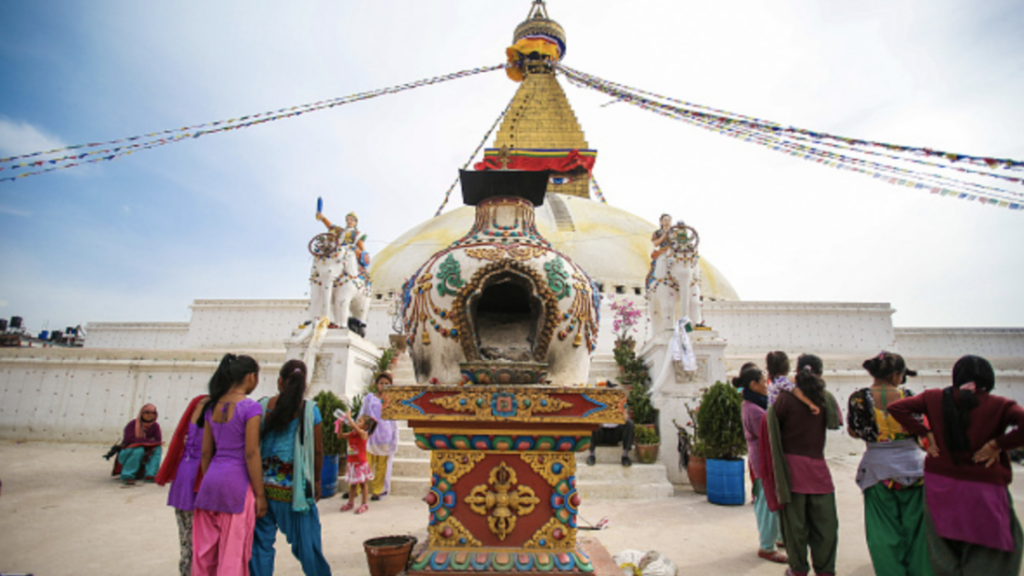
Differentiated competition: Once hardware saturation is reached, competition shifts to cultural soft power. Lumbini (the birthplace of the Buddha) and the Kathmandu Valley should be transformed—with Chinese capital and cultural-tourism operations—into global centers for Buddhist studies.
Industrial chain extension: Combining Traditional Chinese Medicine (TCM)/Tibetan medical theory with high-altitude ecology, Nepal can develop “anti-aging” and “mind–body healing” industries. This goes beyond tourism; it is the export of high-value health services, targeting clients from Southeast Asia, the Middle East, and China’s emerging middle class.
Phase Three: Becoming a High-Income Neutral Zone
Ultimate goal: Through capital accumulation and talent return in the first two phases, Nepal should draw on the Swiss model, leverage balanced diplomacy between China and India, and establish a neutral status.
By perfecting financial and legal services, it can attract regional headquarters, ultimately shedding aid dependency and becoming South Asia’s “high-altitude service hub.”
The Chinese Lever: A Governance Paradigm
China’s influence in Nepal should not replicate India’s brand of “political penetration.” Instead, it should present a more sophisticated model of “development-oriented partnership.”
Trade realities: China is already Nepal’s second-largest trading partner, with bilateral trade reaching US$2.2 billion in 2024 and growing at over 20%. However, the structure remains highly unbalanced (large trade deficit for Nepal). This asymmetry is precisely the opportunity: tourism-led services can help Nepal earn foreign exchange and rebalance its accounts.
Governance demonstration: The ecological disasters in India (e.g., fish kills in the Ganges) and governance breakdowns have, objectively, amplified the appeal of China’s “planning-oriented government.”
Nepal’s elite increasingly recognize that reliance on a partner paralyzed by crisis is strategically dangerous. Chinese investment in Nepal is, at its core, the export of a “predictable growth model.”
Read More: Nepal Envoy Promotes Holistic Wellness at Islamabad Event
The path forward is not without obstacles. Domestic political volatility in Nepal and inertial dependence on Indian energy and markets remain real risks. China must guard against two pitfalls:
Avoiding “project colonialism”: Investments must be tightly linked to local employment and skills training to prevent nationalist backlash.
Respecting diversity: Cultural leadership cannot mean cultural substitution. Delicate balance must be struck within Nepal’s pluralistic ecosystem of Hinduism and Buddhism.
Nepal stands at a historic crossroads. On one side lies a traditional ally—India—whose climate and governance crises are laying bare its decline.
On the other stands China, offering a modernization pathway built on “infrastructure + culture & tourism.” Choosing to align with China is not simply “picking sides”; it is choosing a replicable survival logic resilient to climate shocks.
If the strategy is well executed, a decade from now Nepal will no longer be a mere sliver on the map, but the “Pearl of the Himalayas”—a retreat for the wealthy, a pilgrimage site for devotees, and a sanctuary for seekers of wisdom.
That would mark not only Nepal’s victory, but also the best exemplar of China shaping a “development-oriented” influence in South Asia.
*The views presented in this article are the authors’ own and do not necessarily reflect the views of The Diplomatic Insight.

Professor. Jiang Hong Shen
Professor. Jiang Hong Shen is a contributing analyst at the Australian Academy of Innovation.