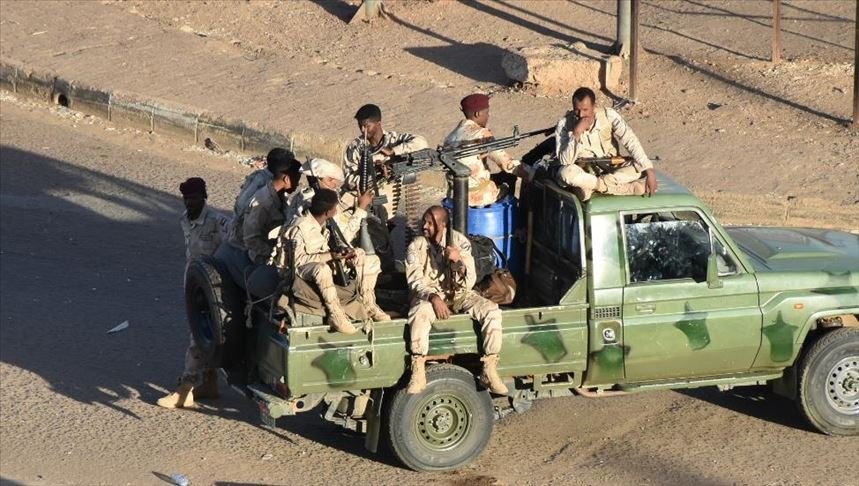
As Sudan’s war returns to the regional spotlight following the drone attack on Khartoum International Airport, the conflict appears to be entering a more complicated phase—one in which military operations increasingly intersect with regional accusations, diplomatic maneuvering, and broader geopolitical calculations.
Within this evolving landscape, Ethiopia has once again emerged as a central actor in discussions surrounding the Sudanese conflict. Its relevance stems not only from geographical proximity, but also from Sudanese allegations suggesting that routes linked to drone operations may have crossed or utilized Ethiopian territory.
Although Addis Ababa has officially denied these accusations, the timing of the claims—coinciding with the meeting between Sudanese Sovereignty Council Deputy Chairman Malik Agar and Ethiopian Prime Minister Abiy Ahmed in Djibouti—has reignited debate over Ethiopia’s positioning in Sudan’s war and the delicate balance between mediation efforts and strategic interests.
This article examines Ethiopia’s evolving posture through a broader geopolitical lens, exploring allegations surrounding drone operations, diplomatic engagement, the lingering impact of border disputes and the Grand Ethiopian Renaissance Dam (GERD), and the wider implications of Sudan’s conflict on the Horn of Africa’s regional balance.
Khartoum Airport Attack and the Transformation of War
The targeting of Khartoum International Airport by drones reflects a significant shift in the nature of Sudan’s war—from conventional battlefield confrontations toward a conflict increasingly shaped by unmanned systems and long-range strikes.
International reporting, including coverage by Reuters, suggests that the Sudanese conflict has become more technologically complex, with increasingly opaque supply lines and overlapping regional interests that make tracing military support networks far more difficult.
Against this backdrop, Sudanese authorities claim to possess information linking certain operational drone routes to Ethiopian territory. Ethiopia, however, has firmly rejected these allegations, describing them as unsubstantiated and unsupported by publicly available evidence.
At the same time, Khartoum appears to be moving toward greater internationalization of the conflict by raising the issue before the United Nations Security Council, particularly in relation to attacks targeting civilian infrastructure and state institutions.
Read More: The Complexity of Sudan-Egypt Relations and the Balance of ‘Frenemies’
Ethiopia continues to maintain that its position is centered on preserving Sudan’s unity and supporting a political solution, while denying any involvement in military support for either side of the conflict.
Yet many regional observers argue that Ethiopia’s role cannot be understood in isolation from the broader geopolitical dynamics of the Horn of Africa, where security concerns, economic ambitions, and regional rivalries remain deeply interconnected.
Several international analyses suggest that Sudan’s war has gradually evolved into a theater where competing regional interests overlap, accompanied by recurring accusations regarding indirect support or facilitation provided to various actors throughout different stages of the conflict.
While these interpretations do not amount to definitive evidence, they nevertheless illustrate the depth of regional entanglement surrounding Sudan’s crisis and the difficulty of separating the war from its wider geopolitical environment.
Regional Interests: Ethiopia, the UAE, and Sudan
Another important dimension shaping the current landscape is the growing relationship between Ethiopia and the United Arab Emirates, particularly in economic, investment, and security sectors across the Horn of Africa.
Some geopolitical analyses suggest that this expanding network of regional interests has indirectly influenced how different actors engage with the Sudanese crisis, both politically and diplomatically.
At the same time, international reports and political debates have circulated allegations regarding support or logistical facilitation provided to the Rapid Support Forces (RSF) during various phases of the war—claims that remain highly contested and politically sensitive.
More broadly, Sudan’s war has revealed a changing regional order in which pragmatic interests increasingly outweigh traditional alliances. Regional actors now appear more focused on preserving internal stability and securing strategic influence than adhering to fixed political alignments.
The meeting between Vice President of Sudan’s Sovereignty Council Malik Agar and Ethiopian Prime Minister Abiy Ahmed in Djibouti should therefore be understood less as a breakthrough and more as an attempt to manage rising tensions between the two countries.
Ethiopia recognizes that the continuation of Sudan’s war without a viable political horizon poses direct risks to regional stability, whether through cross-border insecurity, refugee flows, or the expansion of armed groups.
Sudan, meanwhile, faces its own constraints. Given the scale of the ongoing internal conflict and mounting economic and political pressures, Khartoum has limited capacity to engage in additional regional confrontations.
Al-Fashaga and the Historical Context of Tension
Relations between Sudan and Ethiopia have long oscillated between cooperation and tension, particularly over the disputed Al-Fashaga border region, which witnessed intermittent military escalation and sharp political rhetoric in recent years.
Despite these tensions, however, both countries repeatedly avoided full-scale confrontation and maintained channels of communication and diplomacy, reflecting a mutual understanding of the sensitivities created by geography and intertwined interests.
This historical pattern makes a direct military confrontation between the two sides unlikely under current conditions, even amid growing tensions linked to Sudan’s war.
From a strategic perspective, the likelihood of direct military conflict between Sudan and Ethiopia remains relatively low, despite escalating accusations and political friction.
A more probable scenario is the continued management of disagreements through diplomatic channels, regional mediation mechanisms, and international institutions. Both sides understand the immense cost of escalation in a region already suffering from profound instability and fragile security conditions.
Read More: Kenya Must Not Support the RSF Militia in Sudan
Sudan’s War and the Reshaping of the Horn of Africa
What Sudan’s war reveals today extends beyond Sudan itself. The conflict increasingly reflects a broader reconfiguration of power dynamics across the Horn of Africa.
Regional states—including Ethiopia—are navigating a highly fluid environment in which national security concerns intersect with economic interests, energy competition, water politics, and shifting alliances.
Within this context, Sudan is no longer merely experiencing an internal civil war; it has become part of a wider regional equation shaped by overlapping strategic calculations and evolving geopolitical realities.
The meeting between Malik Agar and Abiy Ahmed in Djibouti, alongside the growing controversy surrounding drone operations, reflects the defining feature of the current moment: the management of tension rather than its resolution.
Ethiopia appears to be carefully balancing its regional ambitions with domestic priorities, while Sudan seeks to confront an increasingly complex internal war without opening additional external fronts.
Ultimately, Sudan’s conflict is becoming a major test for the Horn of Africa’s ability to manage its fragile regional balance in an era where interests are increasingly interconnected, and the boundaries between domestic and regional security are becoming progressively blurred.
*The views presented in this article are the authors’ own and do not necessarily reflect the views of The Diplomatic Insight.

Abdelazim Allahgabo
Abdelazim Allahgabo is a multimedia journalist, TV correspondent, and editorial columnist. A creative professional with a diverse skill set, he is also an experienced voiceover artist, photographer, and designer. Abdelazim focuses on covering Sudanese affairs, blending his journalistic reporting with a sharp perspective in his editorial writing.