When people debate Palestine, they almost always debate the wrong thing. They debate borders drawn in 1948 or 1967. They debate the legal status of settlements. They debate who has historical claim to which hill, which village, which stretch of coastline.
These are real questions, and important ones. But they are not the questions that makes Palestine the defining issue of our time; especially for billions of people who have never set foot in the Middle East.
The question that makes Palestine so combustible, so morally urgent for the Global South, for Muslim-majority nations, for emerging economies from Jakarta to Johannesburg, is not about land at all. It is about whether international law means anything.
Whether the rules apply to everyone. Whether the world order we were promised after 1945 actually exists, or whether it was always a selective arrangement designed to protect some and abandon others.
The post-World War II international order was built on a set of explicit promises. The United Nations Charter promised the sovereign equality of all nations. The Universal Declaration of Human Rights promised that every human being possessed inherent dignity regardless of race, religion, or nationality.
The Geneva Conventions promised that civilians would be protected in war. The International Court of Justice was built to hold states accountable under international law.
These were not aspirational statements. They were the founding architecture of the modern world, the framework that every nation, large and small, was supposed to operate within.
For the Global South, these promises arrived at a particular moment, the era of decolonization, when Asian and African nations were finally shedding the structures of European imperial control. The new international order seemed to offer something genuinely different, a world where size and power did not automatically determine who had rights and who did not.
Where a small nation’s sovereignty would be protected the same way. Palestine has become the test case for whether that promise was ever real.
The international Court of Justice ruled in July 2004 that Israel’s separation wall in the occupied West Bank violated international law and must be dismantled. It was not dismantled. The ICJ’s advisory opinion in July 2024 went further, declaring Israel’s occupation of Palestinian territories unlawful and calling on all states to end support for it. The response from the most powerful Western states was largely to continue as before.
The United States General Assembly has passed hundreds of resolutions affirming Palestinian rights over decades. Most have been ignored or blocked at the Security Council level by the veto powers of permanent members.
When Russia invaded Ukraine in 2022, the Western world moved with remarkable speed, sanctions, arms transfers, diplomatic isolation, ICC arrest warrants. The contrast with the response to Palestinian suffering was not lost on the Global South.
It was the subject of explicit comparison by leaders from South Africa, Brazil, Indonesia, Malaysia, and dozens of other nations who pointed out, calmly but pointedly, that the speed and scale of response seemed to depend less on the nature of the crime than on the identity of the victim.
The is not anti-Western sentiment for its own sake. It is a precise and specific observation that the rules of the international order appear to be applied selectively. And when rules are applied selectively, they are not really rules, they are preferences dressed up as principles.
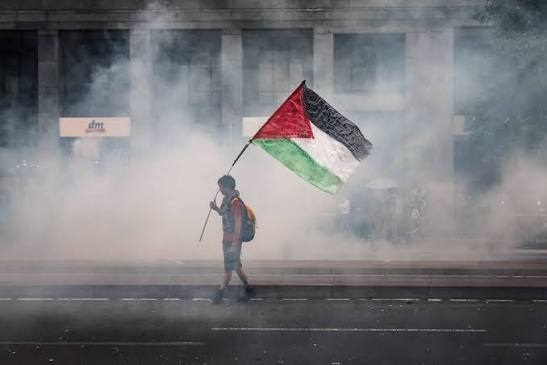
For Muslim-majority nations in Southeast Asia and beyond, Palestine is not a distant geopolitical abstraction. It is a daily reality, present in Friday sermons, in school curriculum, in street protests, in political debates, and in the foreign policy calculus of governments that must answer to publics for whom Palestinian suffering is a matter of deep personal and religious conviction.
Malaysia has maintained one of the most consistent positions in the world, refusing to recognize Israel, barring Israeli nationals from entry, and continuing to speak on Palestine at every multilateral forum regardless of diplomatic pressure from Washington.
Prime Minister Anwar Ibrahim has repeatedly framed Malaysia’s stance not as hostility toward any people, but as a principled refusal to normalize what he regards as ongoing occupation and oppression.
Indonesia, the world’s largest Muslim-majority country, has been equally consistent in its diplomatic support for Palestinian statehood, even as it navigates a more complex relationship with the United States under President Prabowo Subianto.
The tension visible in Indonesia’s initial response to the Khamanei funeral, hesitation followed by reversal under public pressure, illustrated precisely how powerful public sentiment on these issues remains, even when governments might prefer more flexibility.
This is not simply religious solidarity, though this is genuinely part of it. It is also a shared identification with a people who have been stateless, displaced, and living under occupation for generations. Across the Global South, that experience resonates.
Many of today’s developing nations carry their own histories of colonialization, displacement, and struggles for self-determination. Palestine looks to many of them, like a chapter from their own past that has not yet ended.
Here is the core issue that Palestine forces into the open; if a people can be occupied for decades, if their territory can be settled and their movement restricted and their statehood denied, and if the international community’s response is essentially to manage the situation rather than resolve it, what does that say about the international order?
It says that the order works differently for different people. That sovereignty is protected when powerful states choose to protect it. That international law is enforced when powerful states choose to enforce it. And that the institutions built after 1945, the UN, the ICJ, the ICC, are constrained by the same power imbalances they were supposed to transcend.
For the Global South, this is not an abstract concern; it is deeply practical one. If international law does not protect Palestine, it provides a weaker guarantee for everyone else. If the Security Council can be paralyzed indefinitely by a single veto, then the UN’s authority is conditional rather than universal.
And if the world’s most powerful nations can selectively apply the rules of the international order based on their own strategic interests, then what exactly is the order for?
A genuine resolution of the Palestinian question, one that delivers a viable, sovereign Palestinian state with secure borders, grounded in international law and the decisions of international bodies, would not just end a decades-long conflict. It would send a signal of profound importance to the rest of the world.
It would signal that international law is not simply a tool of the powerful. That the promise made in 1945 apply universally. That the institutions built to protect the weak from the strong can actually do what they designed to do.
That signal matters for every small nation navigating a world of great power competition. It matters for every people whose territory is disputed or whose sovereignty in under pressure.
It matters for the credibility of the very concept of a rules-based international order, a concept that serves everyone’s long-term interests, including those of the powerful nations that have most consistently failed to apply it here.
Palestine is not just about Palestine. It never was. It is about whether the world we say we want is the world we are actually willing to build. The Global South has been watching, and it has drawn its own conclusions.
*The views presented in this article are the authors’ own and do not necessarily reflect the views of The Diplomatic Insight.*