On September 12, BRICS leaders adopted a 140 paragraph declaration by consensus in New Delhi. Four months earlier, their foreign ministers had failed to agree on even a joint statement in the same city. Iran and the United Arab Emirates stood on opposite sides of an ongoing conflict. This time, both endorsed the text.
The next test of BRICS is not whether its members can agree on another declaration, but whether that agreement can support diplomacy beyond the group. For China, Washington, the United Nations, and APEC offer three different opportunities to demonstrate that cooperation need not require strategic alignment.
How the declaration was reached matters as much as what it says. It condemns “unilateral coercive measures” and expresses serious concern about attacks on nuclear facilities under International Atomic Energy Agency safeguards, without naming the countries responsible. This is a common language for cooperation, not a collective mandate.
BRICS members share an understanding that their cooperation is not directed against anyone. Washington should therefore not regard the grouping as a hostile bloc, nor should Beijing mistake agreement on principles for strategic alignment. Either misreading would risk squandering an opportunity for broader cooperation.
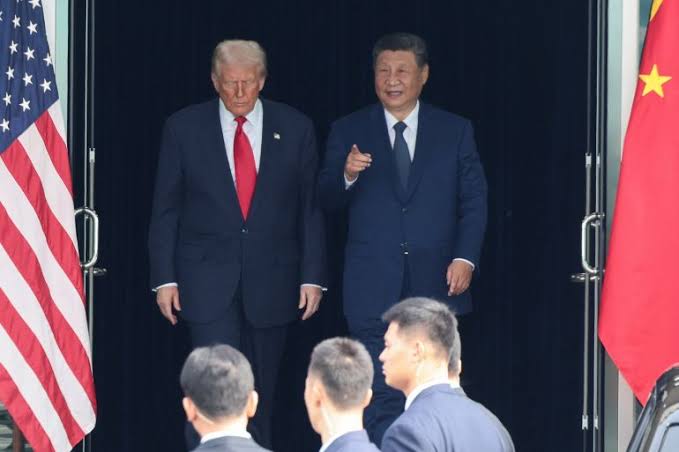
US President Donald Trump has said President Xi Jinping will visit Washington on September 24. The UN General Assembly’s general debate opens on September 22, and China will host APEC leaders in Shenzhen in November. Each occasion will test whether agreement among partners can support wider, harder won cooperation.
Washington’s first question is whether the meeting will happen. Beijing has not confirmed the date and has reportedly warned that new US arms sales to Taiwan beforehand could prompt cancellation.
Should the meeting go ahead, the consensus reached at the BRICS summit would strengthen China’s case, not serve as a bargaining chip. BRICS has long criticized unilateral coercive measures, but Washington has continued to impose sanctions.
The UAE’s endorsement is particularly significant. A US security partner repeatedly targeted by Iran still backed the same text. That does not place Abu Dhabi in Beijing’s camp. It shows that cooperation within BRICS can coexist with close ties to Washington.
Cooperation of this kind does not require partners to organize their US relations around Chinese preferences. Yet Trump has labelled BRICS “anti-American,” despite the grouping’s commitment to inclusive cooperation, a position reaffirmed by India, this year’s chair, in stressing that BRICS is not directed against anyone.
China’s strongest argument is not “I have friends,” but that stable Sino-US relations serve every country unwilling to choose between them. Beijing would gain credibility by bringing its partners’ concerns into the discussion while respecting their right to speak for themselves.
In New York, the test shifts from argument to legitimacy. The declaration supports a greater role for Brazil and India at the UN, including its Security Council. Countries outside BRICS will judge these proposals by whether they gain a meaningful voice, not simply another invitation to endorse agreements among larger powers.
The declaration calls for transparent UN appointments and explicitly addresses this year’s selection of the next secretary-general. For China, the test is whether it can help build support for a broadly acceptable candidate.
Principles require consistency too. Sovereignty, civilian protection and diplomacy will carry little weight beyond BRICS if they are invoked against rivals but never applied to partners.
Shenzhen presents another challenge. China moves from a gathering of emerging economies to hosting an economic forum that includes the US and its regional allies. APEC’s economic mandate does not shield it from geopolitical rivalry. It makes preserving cooperation across strategic divides more important.
Artificial intelligence offers a practical starting point. It features in the BRICS declaration, and Trump has said it will be discussed with Xi. APEC already has an AI initiative for 2026–2030. Shenzhen could build on it through joint training and capacity building projects supported by both advanced and developing economies.
A stabilizing Xi–Trump meeting would ease that task. Postponement or disappointment would make preserving APEC’s cooperative space more important, not less. Beijing should not make the forum’s success contingent on bilateral relations. Nor should Washington turn every Chinese initiative into a loyalty test for regional partners.
There is no automatic passage from New Delhi to Washington, New York and Shenzhen. Support must be won afresh at every stage. Keeping countries at the same table is a start, not an end in itself. The value of that cooperation lies in what they can achieve together.
China assumes the BRICS chairmanship next year. Its strongest claim to leadership would be to help countries with different strategic relationships work together, not to make those relationships converge.
*The views presented in this article are the authors’ own and do not necessarily reflect the views of The Diplomatic Insight.*

Wang Jiang
Wang Jiang is the deputy director and professor of the Institute of China’s Borderland Studies at Zhejiang Normal University.