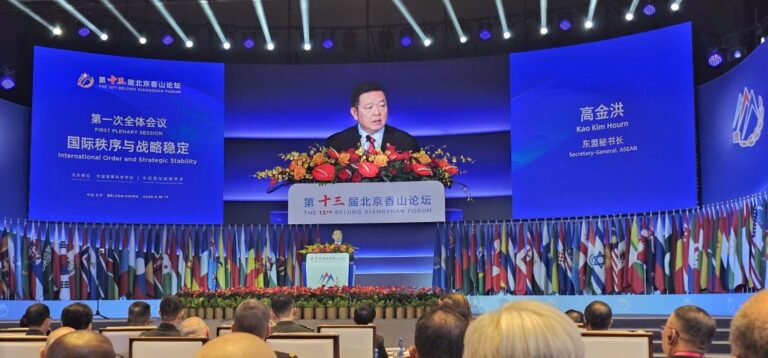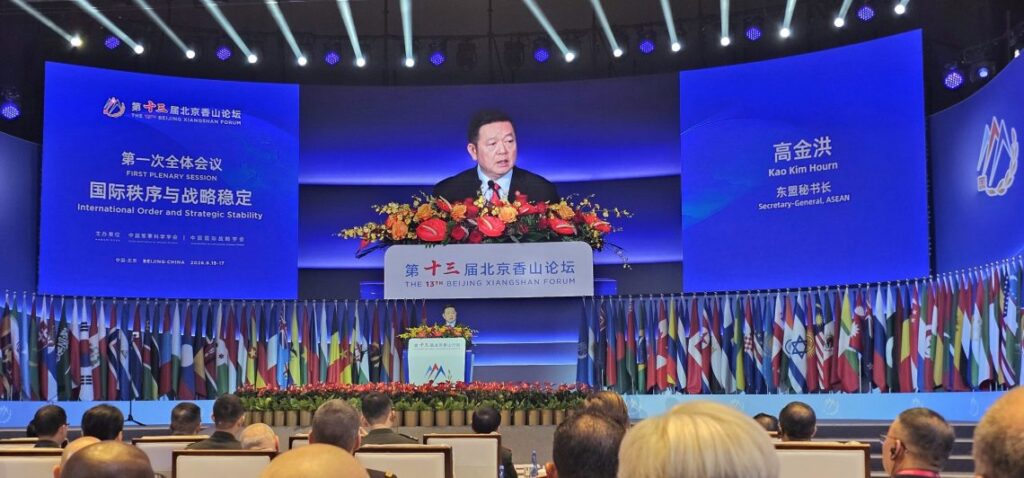
Beijing (TDI): ASEAN Secretary-General Dr Kao Kim Hourn has called for greater strategic restraint, open communication and respect for international law to strengthen stability amid intensifying geopolitical competition and growing pressure on the international order.
Speaking at the first plenary session of the 13th Beijing Xiangshan Forum in Beijing on Wednesday, Kao said strategic stability could not depend solely on military balance, but also required “strategic reassurance” built through dialogue, responsible management of competition and confidence-building measures.
He said the international system was undergoing profound changes as power became more dispersed, strategic competition intensified and multilateral institutions and international norms faced growing pressure.
Kao identified three major trends contributing to the changing environment: shifts in the global distribution of power that are outpacing institutional adaptation, increasing pressure on multilateral institutions and international law, and growing strategic mistrust that is narrowing the space for cooperation and increasing the risk of miscalculation.
For Southeast Asia, Kao said, these developments were of direct concern because the region lies at the intersection of major strategic and economic currents, including vital sea lanes, global supply chains and rapidly developing technological networks.
Read More: China Pledges Greater Cooperation With ASEAN Nations
He said ASEAN had a direct interest in maintaining an international order that was peaceful, stable, open, inclusive and rules-based, anchored in the UN Charter and international law.
“Strategic stability cannot rest on military balance alone,” Kao said, arguing that states also need confidence that competition would be managed responsibly, communication channels would remain open and international law would continue to guide state conduct.
He stressed that strategic competition did not necessarily have to develop into confrontation, provided countries exercised restraint, respected international law, maintained dialogue and strengthened mechanisms for crisis management.
Kao also highlighted sovereign equality, territorial integrity, non-interference and the peaceful settlement of disputes as key principles underpinning a stable international order.
The ASEAN Secretary-General said the bloc’s experience demonstrated the value of consultation, consensus, confidence-building and sustained engagement even when member states and external partners had significant differences.
He highlighted ASEAN-led mechanisms including the East Asia Summit, ASEAN Regional Forum, ASEAN Defense Ministers’ Meeting-Plus and Expanded ASEAN Maritime Forum as platforms that help maintain communication, build confidence and reduce the risk of miscalculation.
Kao said ASEAN Centrality should not be viewed as a claim to regional primacy, but as a commitment to keeping the regional architecture open, transparent and inclusive.
Read More: Egypt Seeks Closer ASEAN Ties Amid Regional Tensions, Sudan Conflict
He said ASEAN sought to act as a convener and platform where countries could engage constructively despite unresolved political and strategic differences.
Kao also called for a broader approach to strategic stability, noting that contemporary security challenges extend beyond traditional military threats.
Climate change, cyber threats, transnational crime, pandemics, food and energy insecurity and the military applications of emerging technologies can all contribute to geopolitical tensions and create new avenues for escalation, he said.
Addressing these challenges requires cooperation across political, security, economic, technological and social spheres, he added.
He also referred to the ASEAN Outlook on the Indo-Pacific, which provides a framework for cooperation in areas including maritime affairs, connectivity and sustainable development.
“The Indo-Pacific should be a region defined by dialogue and cooperation rather than rivalry,” Kao said, stressing the importance of shared interests in building long-term trust and stability.
Kao said major powers carried a particular responsibility because their decisions have a significant impact on the wider strategic environment.
He proposed practical measures including reliable crisis-communication channels, greater transparency over strategic intentions and military activities, advance notification of major exercises where appropriate, professional conduct during military encounters and sustained military-to-military dialogue.
Such measures can reduce misperceptions and prevent incidents from developing into larger crises, he said. At the same time, Kao stressed that responsibility for upholding multilateralism and international law was not limited to major powers.
He said every country had both the ability and responsibility to contribute to a more inclusive international order. Kao concluded that while the international order would continue to evolve, its future direction remained open to influence.
Through restraint, dialogue, respect for international law and inclusive cooperation, he said, a more multipolar world could produce greater stability rather than unpredictability.
ASEAN, he added, was ready to work with China and other partners toward an international order in which every state has a voice, sovereignty is respected and cooperation can continue even amid strategic competition.