Islamabad (TDI): Pakistan’s Federal Minister for Health, Syed Mustafa Kamal, called for a major shift in Pakistan’s healthcare priorities, urging greater emphasis on prevention and the promotion of traditional medicine.
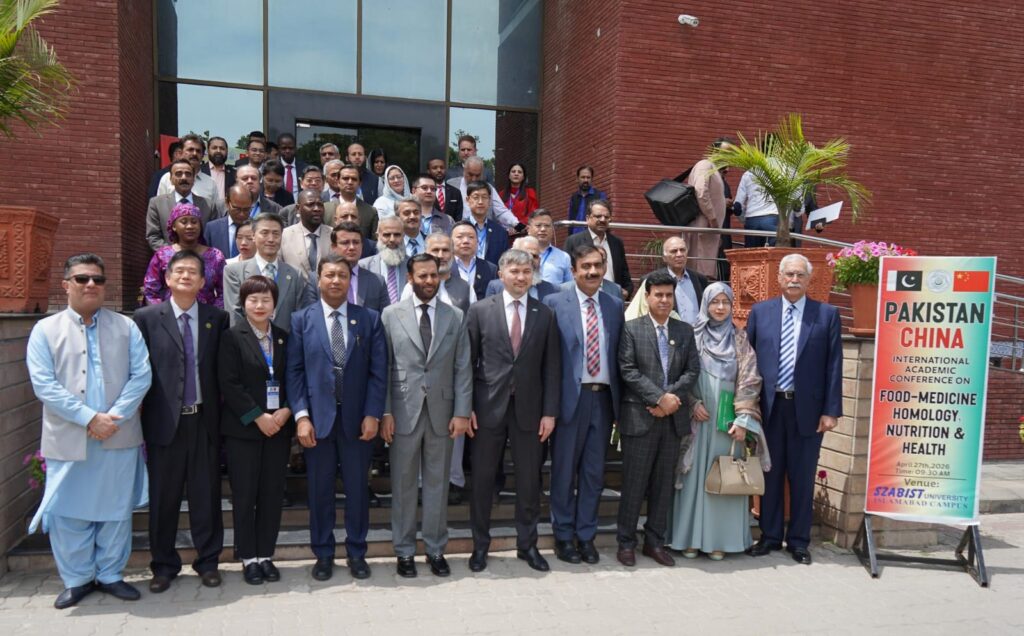
He made these remarks while addressing a high-level Pakistan–China conference held at Shaheed Zulfiqar Ali Bhutto Institute of Science and Technology (SZABIST).
Addressing the inaugural session of the Pakistan–China International Conference on Food-Medicine Homology, Nutrition, and Health, the minister described the gathering as a “timely initiative” on a subject of growing global relevance.
He stressed that Pakistan must move beyond a treatment-focused healthcare model toward one that prioritizes disease prevention and overall well-being.
“Healthcare systems should aim to keep people healthy rather than only treating them after illness,” Kamal said, urging OIC-COMSTECH to take a leading role in promoting traditional and herbal medicine across member states.
The minister expressed optimism that Pakistan could emerge as a global leader in herbal medicine, noting the country’s rich indigenous knowledge and biodiversity.
However, he acknowledged that the sector has lagged behind due to insufficient institutional support, lack of structured development, and weak marketing strategies.
Read More: President Zardari Awards Sitara-i-Pakistan to Chinese Cardiologist Pan Xiangbin
The conference brought together scientists, policymakers, regulators, and industry experts from Pakistan and China to deepen collaboration in health sciences, nutrition, and traditional medicine.
Speaking at the event, Muhammad Iqbal Choudhary highlighted the concept of food-medicine homology, emphasizing food’s dual role in nutrition and disease prevention.
He described Pakistan-China cooperation as a model of scientific diplomacy, combining China’s expertise in traditional medicine with Pakistan’s natural resources.
Chinese scientist Liu Xinmin underscored more than two decades of collaboration between the two countries, citing joint research centers, training programs, and regulatory progress in herbal and pharmaceutical products. He termed the conference a reflection of “deep-rooted scientific brotherhood” between the nations.
The event also featured remarks from officials including Obaidullah and representatives of the Sindh health department, alongside academic leaders from SZABIST. Proceedings began with the national anthems of both countries and a recitation from the Holy Qur’an.
Technical sessions followed the opening, focusing on medicinal plant research, clinical trials, food safety regulations, and nutrition-based healthcare solutions; areas seen as critical to future collaboration.
The conference is expected to pave the way for joint research initiatives, technology transfer, and the development of cross-border pharmaceutical and nutraceutical industries, reinforcing Pakistan’s ambition to modernize its healthcare system through preventive and traditional approaches.
Sohail Majeed
Sohail Majeed is a Special Correspondent at The Diplomatic Insight. He has twelve plus years of experience in journalism & reporting. He covers International Affairs, Diplomacy, UN, Sports, Climate Change, Economy, Technology, and Health.