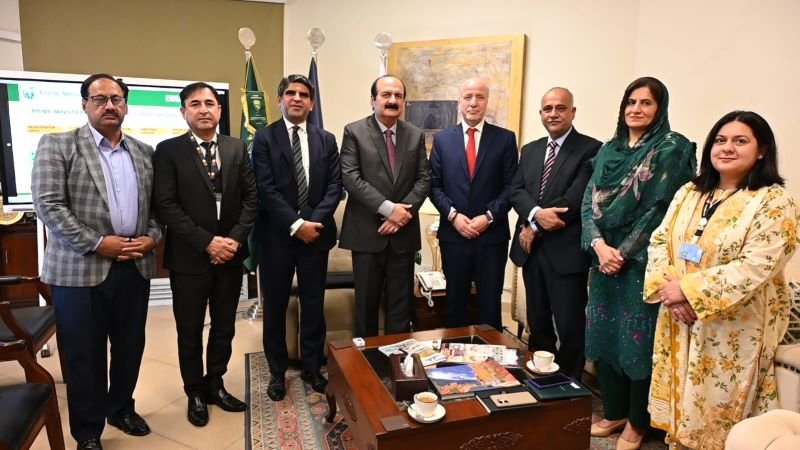
Islamabad (TDI): A meeting at the Prime Minister’s Office brought together key stakeholders to advance Pakistan’s youth policy framework through the adoption of the Youth Development Index (YDI), a globally recognized tool for measuring youth well-being.
The session was chaired by Rana Mashhood Ahmad Khan, Chairman of the Prime Minister’s Youth Program (PMYP), and included representatives from the United Nations Population Fund (UNFPA) and the Pakistan Bureau of Statistics (PBS).
Among the participants were Dr. Luay Shabaneh, UNFPA Representative, Dr. Naeem uz Zafar, Chief Statistician; and Rabia Awan, Director General at PBS.
The meeting focused on leveraging the YDI to enhance evidence-based policymaking for Pakistan’s youth population, aged 15–29.
The YDI serves as a comprehensive framework to assess youth development across multiple dimensions, including education, health, employment, and civic participation.
Chairman Mashhood highlighted that the upcoming YDI 2026 exercise presents a strategic opportunity for Pakistan to align national youth policies with international development commitments while grounding them in reliable, disaggregated data.
He emphasized that the index would enable detailed analysis at provincial and district levels, helping policymakers identify disparities among youth populations.
Read More: D-8 Secretary-General Emphasizes Sport’s Role in Empowering Youth and Women
This, he noted, would support more equitable allocation of resources and ensure that interventions effectively reach vulnerable and underserved groups.
The YDI is also expected to strengthen accountability by improving monitoring and evaluation of youth-focused programs
Underscoring the need for contextual relevance, Mashhood pointed out that Pakistan’s customized YDI framework incorporates indicators reflecting the country’s unique socio-economic and security challenges.
These include youth reproductive health and the impacts of terrorism, conflict, and climate-induced disasters. Such an approach broadens the scope of youth development beyond economic metrics to include safety, resilience, and social well-being.
The Chairman further highlighted the alignment of the YDI with the Sustainable Development Goals (SDGs), particularly in areas such as education, health, gender equality, decent work, and reduced inequalities.
This alignment reinforces Pakistan’s commitment to global development standards while strengthening its transition toward data-driven governance.
With nearly two-thirds of Pakistan’s population under the age of 30, Mashhood described youth as the country’s most valuable demographic asset.
He stressed that the YDI is not merely a statistical tool but a strategic instrument for long-term reforms, institutional strengthening, and holistic youth empowerment.

Sohail Majeed
Sohail Majeed is a Special Correspondent at The Diplomatic Insight. He has twelve plus years of experience in journalism & reporting. He covers International Affairs, Diplomacy, UN, Sports, Climate Change, Economy, Technology, and Health.