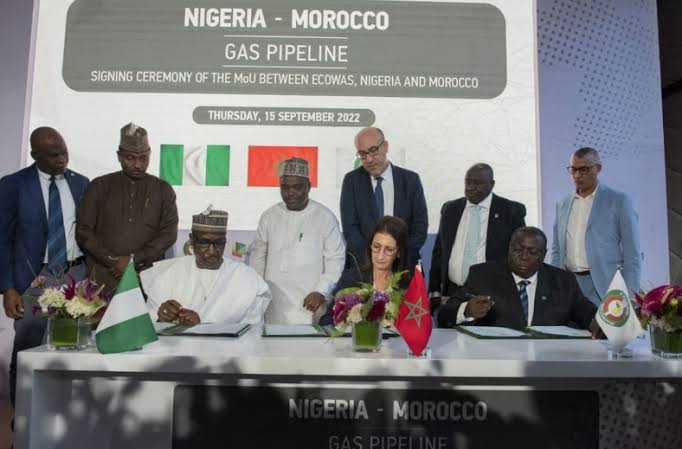
West African heads of state signed a landmark intergovernmental agreement, formally endorsing the Nigeria-Morocco Atlantic Gas Pipeline, a nearly 6,900-kilometer energy corridor that would carry natural gas from the Niger Delta across 13 countries to Morocco and onward to Europe.
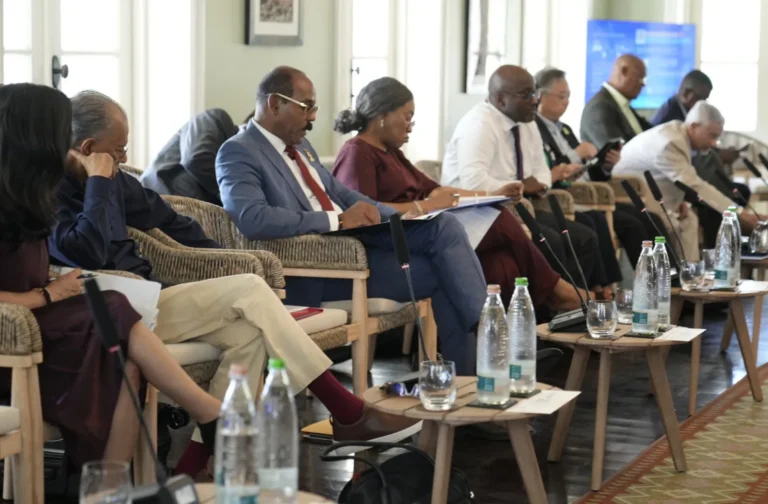
The signing took place in Freetown, Sierra Leone, on Sunday, on the sidelines of the 69th summit of the Economic Community of West African States (ECOWAS).
ECOWAS chair and Sierra Leonean President Julius Maada Bio hailed the deal, telling delegates the bloc had “already signed the West Africa-Morocco gas pipeline” and that gas supplies would soon reach member states.
The agreement gives regional political backing to a project first proposed a decade ago by Morocco’s King Mohammed VI and Nigeria’s then-president Muhammadu Buhari, who died in 2025.
Nigerian President Bola Tinubu has continued to champion the initiative, which is being jointly developed by Morocco’s National Office of Hydrocarbons and Mines (ONHYM) and the Nigerian National Petroleum Company Limited (NNPC Ltd).
Read More: Iraq and Syria Revive Cold War-Era Pipeline, Agreement Signed in Washington
The pipeline would have capacity to move up to 30 billion cubic meters of gas annually, when completed. Roughly half of that volume, 15 billion cubic meters, is earmarked for Moroccan and European markets via an existing pipeline connecting Morocco to Spain, while the rest would supply domestic markets across West Africa.
The project, estimated at $25 billion, is designed to use a hybrid offshore-onshore route along the Atlantic coast. Sunday’s agreement clears the way for the project’s next steps, including setting up a dedicated Project Company headquartered in Casablanca and a Pipeline Higher Authority based in Abuja, ahead of investor mobilization and a Final Investment Decision.
ONHYM and NNPC said the main engineering, environmental and technical studies have been completed, allowing the project to move into its operational development phase.
A separate, final agreement is still to come; Morocco and Mauritania are expected to sign a bilateral deal at a later ceremony in Morocco, in the presence of Nigeria’s president, to formally bring Mauritania into the project.
Beyond feeding European markets, the pipeline is meant to function as a regional development corridor, expanding electricity generation, supporting industrialization and helping integrate economies across West Africa.
For Morocco, the project reinforces its ambition to serve as an energy bridge linking Africa and Europe; for Nigeria, it offers a new outlet for gas reserves and a vehicle for deeper regional influence.

Sohail Majeed
Sohail Majeed is a Special Correspondent at The Diplomatic Insight. He has twelve plus years of experience in journalism & reporting. He covers International Affairs, Diplomacy, UN, Sports, Climate Change, Economy, Technology, and Health.