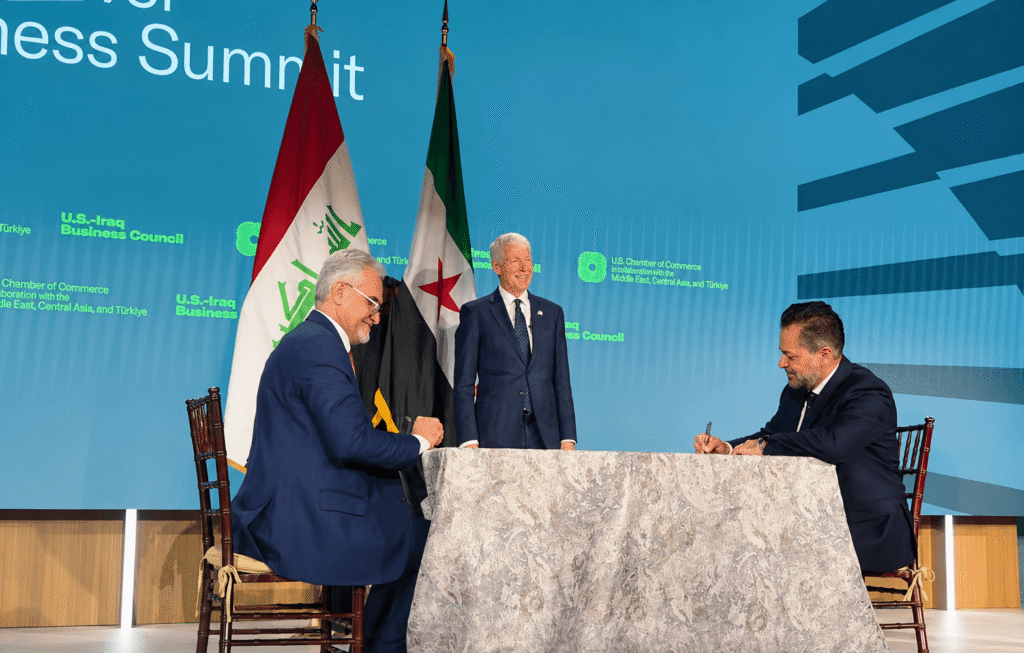
Iraq signed dozens of agreements with Western energy companies in Washington on Friday, headlined by a deal to resurrect a decades-defunct pipeline that would let Baghdad ship crude to the Mediterranean without passing through the Strait of Hormuz.
The memorandums of understanding were unveiled at a US-Iraq business summit hosted by the US Chamber of Commerce, as the US-Israel war against Iran has severely disrupted shipping through the Strait of Hormuz, the corridor through which a large share of the world’s seaborne oil normally passes.
The centerpiece agreement, signed by Bassem Abdul Karim Nasr, head of Basra Oil Company, on behalf of Iraq, and Youssef Qablawi, CEO of the Syrian Petroleum Company, on behalf of Syria, with US Energy Secretary Chris Wright in attendance, commits both countries to rehabilitating the long-idle Iraq-Syria crude pipeline.
Read More: Trump Welcomes Iraqi PM to White House, Pledges Economic Partnership & Troops Withdrawal
The line runs from the oil-rich Kirkuk region in northern Iraq to Syria’s Mediterranean port of Baniyas, and has been out of service since it was damaged during the 2003 US invasion of Iraq.
Iraq’s state news agency reported that US energy giant Chevron would carry out the project, and the US State Department said it welcomed the plan, noting a “US-led international consortium” would handle the technical and financial work.
Once rehabilitated, the department said, the pipeline would have an initial transport capacity of 2 million barrels of crude oil per day, and described it as a critical energy corridor linking Iraqi oil production to Mediterranean export markets.
Framing the ambition bluntly, US Ambassador to Türkiye Tom Barrack said Iraq’s new pipeline agreements would build a program that would “make the Strait of Hormuz an afterthought.”
Prime Minister Zaidi’s historic visit to the United States included billions of dollars in concluded deals with U.S. companies at the @USChamber today. We celebrate leading U.S. companies deepening their partnerships in the Iraqi market. @POTUS said it best: our relationship with… pic.twitter.com/Dx7Rx8SAKk
— U.S. State Dept – Near Eastern Affairs (@StateDept_NEA) July 17, 2026
Beyond the pipeline deal, Chevron signed two additional agreements with Iraq aimed at boosting oil production, according to the company’s business development president. Iraq’s government also formalized an agreement with Elon Musk’s Starlink to operate in the country.
In total, Iraqi officials’ initial agreements with US firms – spanning energy, healthcare and technology – were reported to be worth more than $60 billion.
Iraqi Prime Minister Ali al-Zaidi told the Washington summit, through a translator, that Iraq was pursuing an “open-door policy” and would not make it difficult for any company with a project to engage with Baghdad.
The signings come against a volatile regional backdrop, with fighting between the US, Israel and Iran continuing to threaten Gulf shipping lanes and energy infrastructure across the wider Middle East.