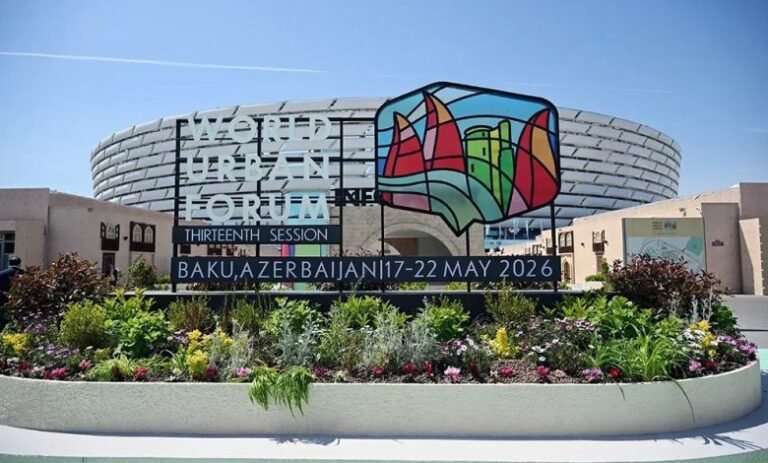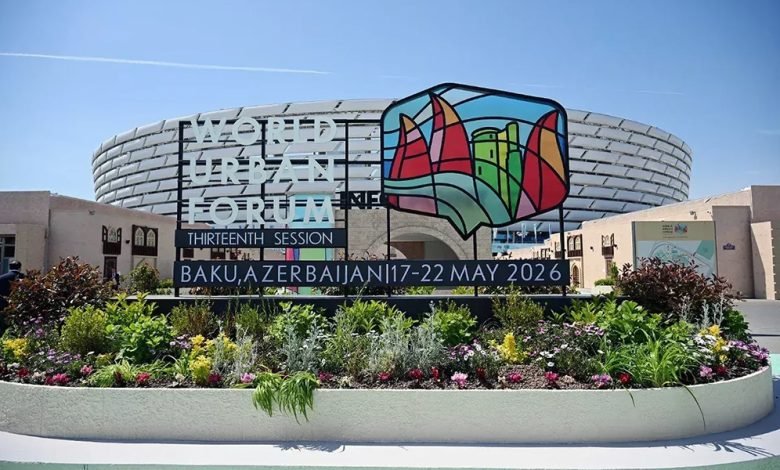
Baku (TDI): Pakistan’s Federal Minister for Climate Change and Environmental Coordination, Musadik Malik, addressed the World Urban Forum 2026 in Azerbaijan, on Sunday, urging world leaders to stop treating the climate crisis as an environmental problem and start recognizing it as a fundamental failure of justice.
Malik told delegates that climate change was no longer merely an environmental challenge but a “crisis of justice” disproportionately affecting poor and vulnerable communities in cities across Pakistan.
The minister grounded his argument in the lived realities of Pakistan’s urban poor. He recalled the image of a child standing with a torn notebook beside his father after their home had been washed away in floods, warning that “two generations of efforts” could be erased in a single disaster when housing stock lacks resilience.
Pakistan’s urban population now stands at nearly half of the country’s 240 million people, of whom around 55 million live in slums with inadequate housing and crumbling civic infrastructure.
Federal Minister Dr. Musadik Malik delivered Pakistan’s statement at #WUF13 in Baku today, stating that climate change is fundamentally a “crisis of justice.” pic.twitter.com/0Ku2C8md9q
— Senator Musadik Office (@Team_Musadik) May 17, 2026
“Slums are not a policy category; slums are a life category,” he said. “Real people live in these slums;” households of six to eight sharing two rooms, without reliable electricity, sanitation, or safe access to schools and hospitals.
The minister pointed to a 2024 heatwave in Karachi, where temperatures climbed to 47 degrees Celsius, as stark evidence of how climate shocks fall hardest on those least able to cope.
Citing data from a welfare organization that transported bodies to hospitals, he noted that approximately 560 people died over a single seven-day period during the heatwave.
“Who died? The poor died. The most disenfranchised died,” he told the forum. “Not the affluent living in apartments with air conditioning.”
Read More: Uzbek President Mirziyoyev Attends World Urban Forum in Baku
Flooding in recent years has killed around 6,000 people, injured or permanently disabled nearly 20,000 others, and displaced approximately 40 million.
The cascading consequences reach into classrooms: when children miss school for 90 days as a result of disasters, the cumulative loss amounts to roughly 1.8 billion school days.
Malik reserved particular criticism for the way affordable housing is conceived by policymakers. “We should not build housing for investors; we should build housing for the people,” he said, calling on global leaders to ensure the “Baku Call for Action” confronts urban inequality and housing speculation head-on.
He closed with a challenge to delegates: “At the end, when we talk about housing, the real question is — housing for whom? Do we truly mean everyone?”