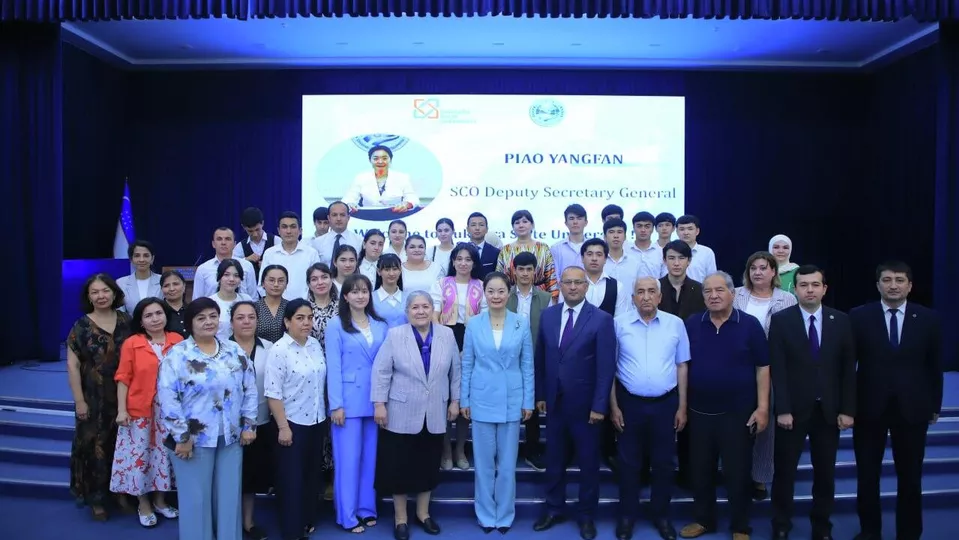
Bukhara (TDI): As the Shanghai Cooperation Organization celebrates a quarter-century of existence, its Secretariat is taking its anniversary message directly to university campuses, and Uzbekistan’s ancient city of Bukhara is the latest stop on that tour.
Last week, on Friday, a delegation from the SCO Secretariat visited Bukhara State University to engage young audiences across member states ahead of major milestone commemorations.
Deputy Secretary-General, Piao Yangfan, addressed students and faculty as part of a series of “open lectures” dedicated to the SCO’s 25th anniversary, covering the organisation’s history, its achievements over the past two and a half decades, and the Secretariat’s plans for upcoming anniversary events.
During a question and answer session, Piao fielded questions from the audience on youth and cultural-humanitarian cooperation initiatives within the SCO, as well as the organization’s role in reforming the global governance system.
On the sidelines of the lecture, Piao met with the university’s administration to discuss the current state and future prospects of cooperation in the field of education.
Read More: SCO Secretary General Highlights China’s Global Governance Vision at IPDS Webinar
The meeting signals a continued SCO interest in deepening institutional ties with academic bodies across Central Asia, where the next generation of regional policymakers and professionals is being trained.
Bukhara State University is one of Uzbekistan’s largest multidisciplinary higher education institutions, founded in 1930. It currently operates six faculties and 26 departments, offering 35 academic programs to more than 20,000 students.
The choice of Bukhara carries symbolic weight. One of the oldest cities on the ancient Silk Road, it sits at the heart of the very Eurasian connectivity the SCO has long championed.
Bringing the organization’s leadership to lecture halls underscores a deliberate strategy; that as the SCO turns 25, it is investing not just in summits and declarations, but in the awareness and buy-in of ordinary citizens, across its sprawling membership.
Founded in 2001, the SCO has grown from a six-member regional security bloc into a major multilateral organization encompassing much of Eurasia, with members including China, Russia, India, Pakistan, and several Central Asian states.