“If the Tajik language serves as the custodian of the rich and enduring scientific and literary heritage and the historical memory of our people, then the celebration of Nowruz preserves the living traditions, rituals, and national culture”
~Emomali Rahmon
The globalization of the ancient festival of Nowruz and its international celebration demonstrate that this traditional festival has been recognized by many peoples of the world as a valuable cultural heritage. Therefore, it is fitting to note the statement of the Founder of Peace and National Unity – Leader of the Nation, President of the Republic of Tajikistan, His Excellency Emomali Rahmon: “Nowruz is one of the greatest and most beloved holidays of the Tajiks, which has come down to us from ancient times as a valuable legacy of our noble ancestors.
The ideas, worldview, and beliefs associated with Nowruz, as well as with other Aryan festivals such as Sada, Tirgon, and Mehrgon, have become an important part of the national identity of the Tajiks over the centuries.”
Nowruz is considered one of the oldest holidays in the world, and the word “Nowruz” itself means “new day” in Persian. In the Pahlavi language, this word appeared in the form “nukruk” or “nughruz,” which indicates the antiquity of this tradition. In Arabic sources, the term is used in two forms: the Persian “Navruz” and the Arabic “Nayruz.”
The term Nowruz refers to the “beginning of the year” and the celebration of the “Aryan New Year”, which has been celebrated among Tajiks and other Persian-speaking peoples since ancient times. According to historical sources, the tradition of celebrating Nowruz dates back approximately seven thousand years.
Spring brings renewal to nature, and those who live in the mountains regions and engaged in agriculture, horticulture, livestock breeding, and poultry farming clearly feel its its arrival. With the coming of spring, the hillsides turn velvety green, and as evening falls, the landscape is adorned with colorful blossoms.
Read More: Nowruz: An Age-Old Holiday Celebrated in Tajikistan
Nowruz symbolized the awakening of nature, the triumph of light over darkness, warmth over cold, good over evil, and youth over old age. With the arrival of the first days of spring, when Nowruz flowers- such as black-eyed peas, daisies, wallflowers, and violets- begin to bloom, people, especially children, welcome the season with joy and enthusiasm.
These vibrant flowers herald the arrival of spring and the beginning of a new life. Young people and teenagers visit the homes of their fellow villagers in groups, singing songs to congratulate them on the arrival of spring, and presenting them with flowers.
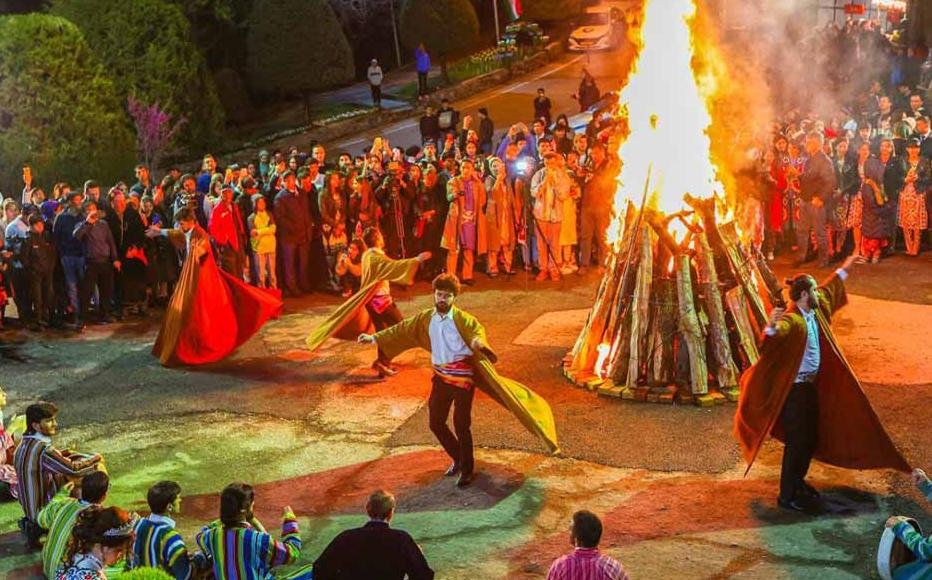
In Tajikistan, Nowruz celebrations traditionally begin on March 21, the day of the vernal equinox, and continue for 13 days. The ceremonies are rich in colorful and meaningful symbols, and the festive tables, known as “haft shin” and “haft sin,” feature a variety of symbols items.
One of the most notable rituals of Nowruz is the preparation of sumanak, a sweet pasta made from wheat sprouts. The sprout itself symbolized the rebirth of nature, beauty, and the vitality of life. Sumanak is traditionally prepared on the eve of Nowruz, and sometimes several days in advance. The preparation process is time-consuming and is usually carried out collectively. In some regions, making sumanak is accompanied by a ceremonial celebration.
Women and girls gather around a pot, singing, dancing, and playing until the dish is ready, creating a festive atmosphere. They carefully adorn their faces and wear traditional festive attire, using usma, henna, kalam, various of gaz, and natural dyes. Women skillfully weave ornaments and braid their hair, complementing their outfits with satin shirts and blouses, as well as bracelets, earring, and necklaces, paying attention to proportion and beauty in their adornment.
Today, Nowruz is celebrated in many countries and regions around the world, including Iran, Azerbaijan, Afghanistan, and the countries Central Asia. It is also widely celebrated by Kurdish, Turkish, Uyghur, and Persian-speaking communities around the world. This ancient festival is observed by more than 300 million people and has become an important symbol of cultural heritage and unity among diverse peoples.

Madina Ibragimova
Madina Ibragimova is a junior research fellow at the Department of the United States and Canada of the Institute for Asian and European Studies, National Academy of Sciences of Tajikistan.