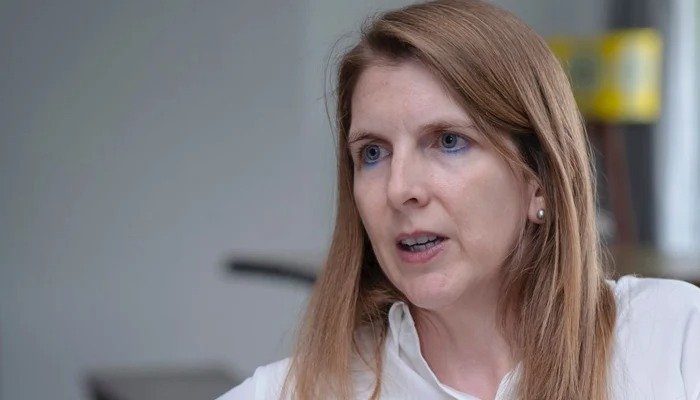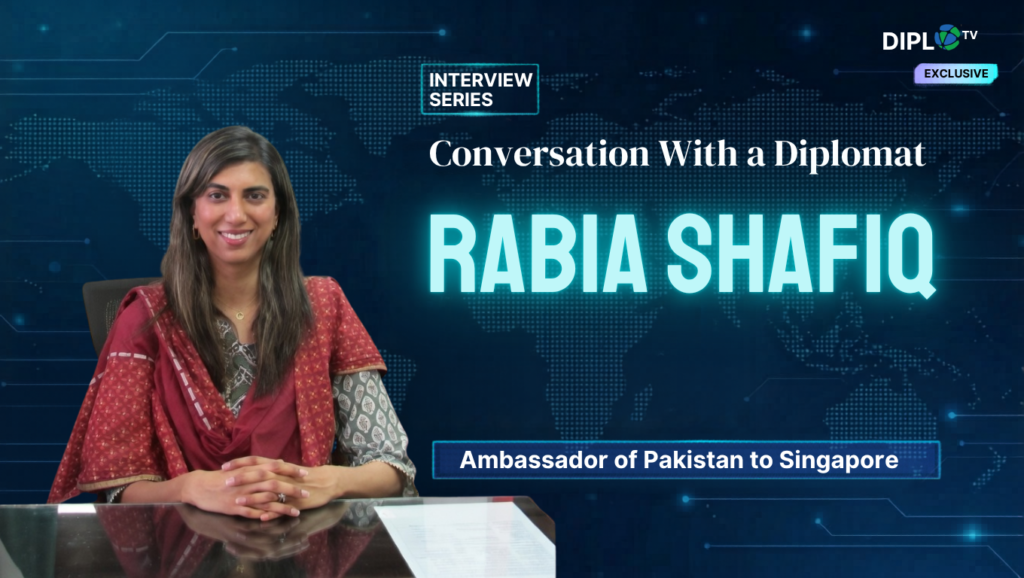
In this episode of Conversation with a Diplomat, we feature Her Excellency Rabia Shafiq, the High Commissioner of Pakistan to Singapore. With a distinguished career in the Foreign Service of Pakistan, she shares insights into her diplomatic journey, the evolving nature of global engagement, and the experiences that have shaped her perspective as a representative of Pakistan on the international stage.
Rabia Shafiq, High Commissioner of Pakistan to Singapore, represents this spirit of diplomacy with distinction. Having joined the Foreign Service of Pakistan in 2001, she has held key diplomatic assignments in Paris, Ankara, and Chicago. Since June 2024, she has been serving as the High Commissioner of Pakistan to Singapore, where she continues to play an important role in strengthening bilateral relations.
She holds a Master’s degree in Public Administration from Quaid-i-Azam University, Islamabad, and a postgraduate diploma in Diplomatic Studies from the University of Oxford. In this conversation, she reflects on her motivations, experiences, and insights into the evolving nature of diplomacy.
To watch thefull interview, click the link below!
Beyond the formal demands of diplomacy, what motivates you at a deeper level?
Rabia Shafiq: I think every individual is motivated by something, whether in their personal or professional life. For me, it has always been a constant drive to learn—particularly new things. Curiosity, asking questions, and engaging with people from different cultures are very important. Listening to people’s stories tells you a great deal about what motivates them and the journeys they have undertaken. These are the factors that continue to inspire me.
Can you recall a story that has deeply moved you?
Rabia Shafiq: It is difficult to recall just one story, but generally, stories that resonate are those where individuals act with a sense of purpose and service for others.
I remember meeting a woman from Lahore in Singapore who was deeply passionate about children’s education. She shared how she once visited a nearby settlement carrying stationery, food, and small gifts for children. While many children gathered around her for food and sweets, one young child stood aside and pointed toward the stationery instead. That moment inspired her to focus on education. She later established a school that has now grown significantly and educates underprivileged children. I found that story very powerful.
What challenges in your early career helped shape your resilience?
Rabia Shafiq: Rather than a single moment, it is a series of experiences. As a young officer, you face high-pressure situations, tight deadlines, and long working hours. Since diplomacy involves dealing with multiple time zones, there are no fixed working hours.
These challenges teach adaptability. One cannot be rigid in this profession. I was once told that diplomacy is not just a profession—it is a lifestyle. Over time, I came to fully understand what that means. Your professional responsibilities do not end when you leave the office; they become a continuous part of your life.
What inspired you to join the Foreign Service?
Rabia Shafiq: It was not an early decision. I initially pursued a corporate path and worked in a bank, but I realized that it did not align with my temperament.
I was always interested in global politics, and I began my professional journey around 2001—a time of significant global change. Events such as the post-9/11 environment and developments in the region, particularly in Afghanistan, highlighted how global affairs directly impact countries like Pakistan. Gradually, my interest developed, and over time, I felt that this path chose me.
Do women bring a distinct perspective to diplomacy?
Rabia Shafiq:Yes, I believe they do. Women often bring strengths in consensus-building, conflict prevention, and listening. These qualities are very important in diplomacy.
It is also essential for women to have representation at decision-making tables because many global issues affect women differently. Their perspectives are therefore critical.
How do you manage the balance between personal and professional life?
Rabia Shafiq: It is a constant challenge. Diplomacy adds another layer because of frequent relocations across countries.
One key aspect is time management. Time is the rarest commodity we have, and managing it effectively is crucial. Additionally, having a supportive family and professional network makes a significant difference.
What have you found particularly noteworthy about Singapore’s society?
H.E. Rabia Shafiq: Singapore is a very diverse society where people from different backgrounds live harmoniously. This is not accidental—it is the result of deliberate policies.
For example, in government housing, people from different ethnicities are placed within the same residential spaces to encourage interaction and cohesion. Similar approaches are followed in schools and communities. This fosters understanding and social harmony, which is something many countries can learn from.
What advice would you give to aspiring diplomats?
Rabia Shafiq: One important skill today is the ability to distinguish fact from misinformation, given the overwhelming amount of information available.
Secondly, reading is essential. It helps build informed opinions and strengthens analytical thinking. Opinions should always be grounded in knowledge and supported by logical reasoning.
It is also important to understand that diplomacy involves patience. Unlike the private sector, results in bureaucratic systems take time. One must be prepared for a gradual and continuous process.
What defines a true diplomat?
Rabia Shafiq: A true diplomat creates opportunities. It is about opening pathways—whether in education, trade, or employment—that benefit people. For countries like Pakistan, with a large youth population, this responsibility is particularly important.
What are your ongoing goals?
Rabia Shafiq: Learning is a continuous process and should never stop. Whether through exposure to different cultures or developing specialization in specific areas, growth remains an ongoing pursuit.
I also feel strongly about supporting women and creating more inclusive professional environments where they can pursue their goals effectively.
What advice would you give to women in leadership roles?
Rabia Shafiq: I believe that merit ultimately prevails. If you know your work and understand how to deliver results, nothing can stop you.
It is important to avoid shortcuts and focus on hard work and gaining experience. Building relevance and expertise is essential. When you bring value to the table, recognition follows.
What message would you like to give to our audience?
Rabia Shafiq: The world is changing rapidly, and it is important for people—especially young individuals—to stay informed and engaged with global developments. Awareness and understanding are essential in navigating this evolving landscape.

Established in December 2008, The Diplomatic Insight is Pakistan’s premier diplomacy and foreign affairs magazine, available in both digital and print formats.