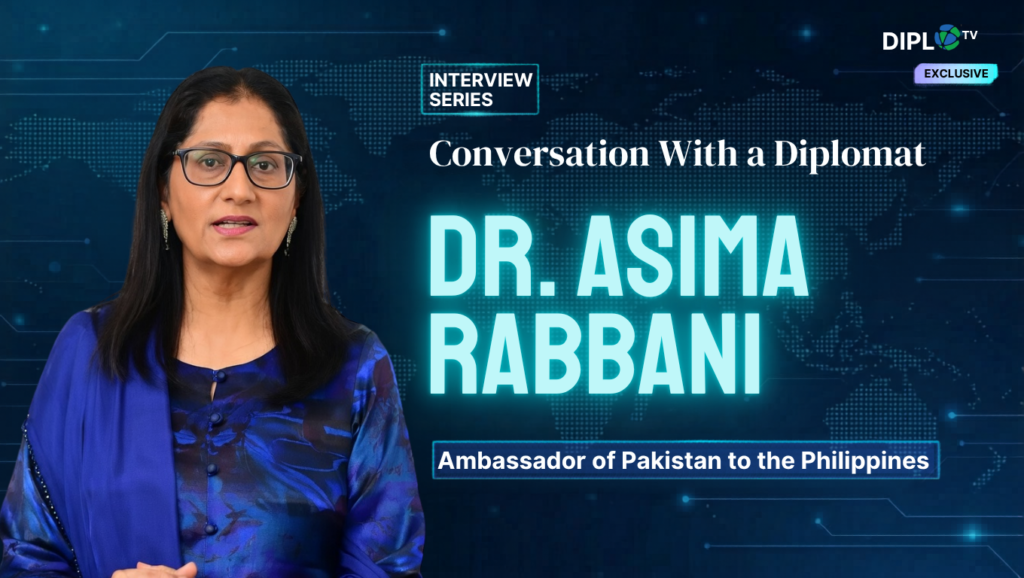
In this episode of Conversation with a Diplomat, we turn our focus to the evolving practice of quiet diplomacy, an approach defined not by public spectacle, but by trust, dialogue, and thoughtful engagement. At a time when international relations are shaped by rapid change and complex global challenges, diplomacy continues to rely on individuals who navigate these dynamics with patience, insight, and a commitment to service.
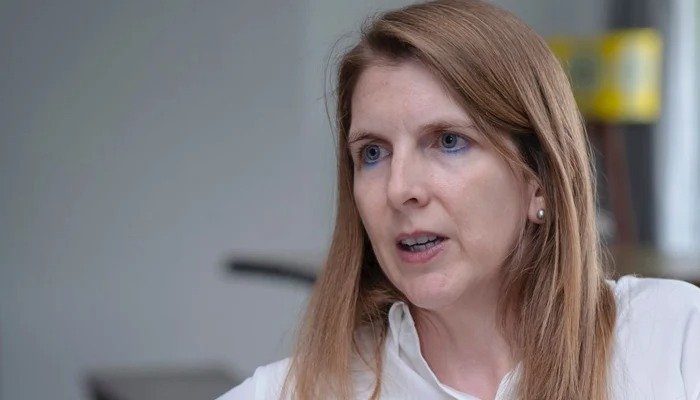
We are joined by Her Excellency Asima Rabbani, Ambassador of Pakistan to the Philippines, a seasoned career diplomat with more than two decades of experience in the Foreign Service of Pakistan. Her distinguished journey spans multilateral diplomacy, economic engagement, and bilateral relations, alongside key leadership roles at headquarters and diverse diplomatic postings across the world.
In this interview, she reflects on her personal journey, academic evolution, and the experiences that have shaped her approach to diplomacy and public service.
To watch the full interview, click the link below!
Diplomacy is a demanding profession. Before we talk about your career, could you tell us about your personal journey and what truly drives you?
Every diplomat has a life outside diplomacy as well. For me, what has always been important is learning—learning new things, new cultures, and understanding what is happening in the world.
Even as a child, I used to wake up excited to read the newspaper and learn about global affairs. My best friend was my grandfather, who was a journalist. I would spend long hours speaking with him about global politics, and those conversations shaped my early thinking.
What continues to drive me is the desire to make a difference—to contribute in some meaningful way to society and to improve the lives of people. That motivation guided me toward public service.
Could you share your educational background and how your academic journey evolved?
As a child, I was deeply interested in mathematics and logic. I was naturally drawn to numbers, which led me to pursue a Master’s degree in Computer Sciences.
However, while I enjoyed programming, I realized it did not fully align with my long-term interests. At that time, I also found that career opportunities in the field were limited, and I began to reconsider my direction.
Around that time, some of my peers were preparing for the civil service examination. I decided to attempt it, and from the beginning, I was clear that I wanted to join the Foreign Service of Pakistan.
Later, I pursued further academic studies, including a Master’s in International Relations and Diplomacy in Australia, and eventually a PhD in Philosophy focused on international relations, particularly collective security and the challenges posed by non-state actors.
You mentioned pursuing further studies while already serving in the Foreign Service. How was that experience?
It was one of the most challenging periods of my life. I was working full-time and also managing my responsibilities as a mother of young children.
There were moments when I was barely managing everything—attending classes, submitting assignments, and taking care of my children. I often had very little sleep.
However, I also enjoyed it deeply because I was studying for my own intellectual growth. It helped me regain my student spirit and academic energy, which I had missed.
I promised myself that I would never let that intellectual curiosity fade. Even later in my career, whenever I felt things becoming too routine or bureaucratic, I would return to academic engagement to re-energize myself.
Was there a defining moment when you decided to join the Foreign Service?
There was no single defining moment. I initially pursued computer science, but I realized that it was not something that fully excited me.
My interest in global politics had always been there. Eventually, I decided to take the civil service examination, and I was fortunate to join the Foreign Service.
What attracted me most was the opportunity to understand the world—different cultures, systems, and global dynamics—and to see how Pakistan fits into that broader picture.
Looking back, what mindset helped you grow in the early stages of your career?
The most important mindset was self-belief—the idea that I can do it.
There were many situations where people would say something was very difficult, but when I actually approached it with focus and effort, it was not as difficult as it seemed.
I believe that if you work hard, stay focused, and give proper time to your responsibilities, nothing is impossible. That mindset has guided me throughout my career.
What are your personal or professional ambitions at this stage of your career?
I would not call them ambitions in the traditional sense of career advancement or postings.
For me, the most important goal is to contribute—however small that contribution may be—to society and to my country.
I have always tried to make a difference in whatever capacity I have served, and that remains my focus moving forward as well.
How have you balanced your professional responsibilities with family life?
It has been very challenging. There have been phases in my career where balancing both was extremely difficult, especially when my children were young.
At one point, I was managing full-time work while also taking care of very young children, sometimes with very little sleep.
The challenge continues even now because of frequent postings and physical distance within families. However, I believe that life itself is a challenge for everyone, whether in diplomacy or any other profession.
You learn to adapt, and you find ways to manage.
What are your key priorities in your current posting in the Philippines?
One of the main priorities has been reviving structured engagement between Pakistan and the Philippines, which had slowed due to the COVID-19 pandemic.
We have worked to revive the Joint Economic Commission and are preparing for upcoming bilateral political consultations. Engagement through regional platforms is also important.
On the economic side, we are focusing on strengthening trade and investment cooperation. We are also facilitating business exchanges between the two countries.
Another important area is rice trade, particularly given the historical connection through IRRI’s IR8 rice variety, which originated in the Philippines and was introduced to Pakistan decades ago. Today, Pakistan is among the major rice exporters, and we are working toward strengthening formal trade arrangements.
We are also supporting the Pakistani community in the Philippines, including professionals, investors, and workers, many of whom require consular assistance and engagement.
What cultural or social aspect of the Philippines stands out to you the most?
One of the most notable aspects is the strong sense of community. People support each other very strongly, regardless of circumstances.
There is also a sense of specialization in their development approach. Instead of spreading resources across many sectors, they have focused on key areas such as nursing, hospitality, and overseas employment.
They have also developed strong participation in global value chains, particularly in services like business process outsourcing, which contributes significantly to their economy.
These are important lessons in strategic focus and community cohesion.
What message would you like to give to young people aspiring to join the Foreign Service?
Those who want to join the Foreign Service should prepare for the civil service examination with dedication and choose their subjects carefully.
But beyond entry, I would say that diplomacy is a rewarding career with continuous opportunities for learning and growth.
If I were given a second chance, I would still choose the Foreign Service.
Finally, what message would you like to share with young viewers and aspiring diplomats?
I would say: do not underestimate the power of your character.
Skills can be learned and degrees can be earned, but integrity, curiosity, and empathy are choices you make every day.
The world is changing rapidly, and while it may feel uncertain, uncertainty also creates opportunity.
Never stop learning, never lose empathy, and never think your contribution is too small. Real change often comes from steady, principled individuals rather than loud voices.
Even rocket science is not rocket science—you just need focus, hard work, and determination.

Established in December 2008, The Diplomatic Insight is Pakistan’s premier diplomacy and foreign affairs magazine, available in both digital and print formats.