As 2026 sets in, Southeast Asia is poised on the cusp of a transformative year. The region’s leaders and peoples face a convergence of political transitions, economic shifts, and strategic tests that will shape the trajectory of Southeast Asia in 2026. On one hand, ASEAN has just welcomed its 11th member and showcased its convening power on the world stage. On the other hand, unresolved crises from internal conflicts to great-power rivalry threaten to undermine regional stability. The following ten developments, spanning politics, economy, society, and the environment, are the key issues to watch in Southeast Asia in the year ahead.
ASEAN’s Unity Tested by Crisis and Change
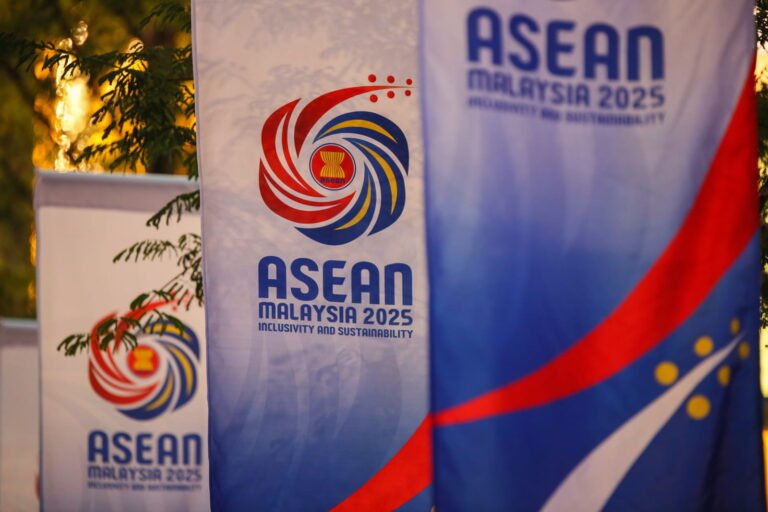
Southeast Asia’s regional bloc, ASEAN, begins 2026 at a crossroads. In late 2025, ASEAN formally admitted Timor-Leste as its 11th member, a milestone expanding the bloc’s inclusivity. At the same time, longstanding norms of consensus and non-interference, the so-called “ASEAN Way”, face unprecedented strain from overlapping crises. The Philippines assumes the ASEAN Chairmanship in 2026, a symbolically significant choice since it marks the 10th anniversary of Manila’s 2016 legal victory over China in the South China Sea arbitration.
This means maritime disputes and international law will be at the forefront of ASEAN’s agenda, putting the spotlight on whether the bloc can present a united front on contentious issues. Indeed, ASEAN’s unity will be stress-tested by sharply diverging member interests on the South China Sea and on Myanmar’s civil conflict. Myanmar’s post-coup civil war grinds on with “no political resolution in sight”, and the junta’s unilateral election plans (discussed further below) have deepened ASEAN’s internal rifts.
Even intra-ASEAN frictions have flared: border clashes between Cambodia and Thailand escalated into sustained armed confrontations in 2025, defying a U.S.-brokered ceasefire that lasted less than two months. All of this unfolds just as ASEAN launches a new long-term vision (the ASEAN Community Vision 2045) aimed at a “resilient, innovative, dynamic, and people-centred” future. Whether ASEAN can maintain its relevance and cohesion amid these trials is a central question for 2026. The coming year will show if ASEAN’s much-vaunted norms can adapt to a harsher strategic environment or if the bloc’s limitations in managing crises will be laid bare.
Thailand’s Snap Election and Political Uncertainties
After a turbulent few years in Thai politics, Thailand is headed for an early general election on February 8, 2026. This snap election comes well ahead of schedule, following the dissolution of Parliament in December 2025 by Prime Minister Anutin Charnvirakul. Anutin, who leads the conservative Bhumjaithai Party, only became Prime Minister in September 2025 under unusual circumstances: he took over a fragile coalition after the previous government faltered amid legal troubles and parliamentary deadlock.
Crucially, Anutin’s rise was enabled by an agreement with the opposition People’s Party (the successor to the reformist Move Forward Party) that he would pursue constitutional reforms and call fresh elections within four months. Mounting disagreements over those promised reforms led Anutin to dissolve the House preemptively, aiming to “return power to the people” and outmanoeuvre a looming no-confidence vote. The upcoming election will thus be a referendum on Thailand’s unresolved political questions: the balance of power between civilian government and the military, and the fate of the military-drafted 2017 constitution.
Read More: China Steps in as Mediator as Cambodia and Thailand Work Toward Lasting Calm
The campaign is unfolding against a backdrop of surging nationalism fueled by an ongoing border conflict with Cambodia, which flared up again in late 2025 after a breakdown of a ceasefire. By invoking the defence of Thai sovereignty amid these clashes, Anutin hopes to rally voters and distract from domestic discontent. The conflict has been costly – at least 28 people were killed in border fighting in December alone, and has allowed the embattled prime minister to “drape himself in the flag” of patriotism.
How this volatile mix of nationalism and reformist fervor plays out at the ballot box will be critical. The election’s outcome will determine if Thailand moves toward genuine democratic reforms or reverts to the cycle of unstable coalitions and military influence that has defined its politics in recent years. Southeast Asian observers are watching closely, as the results will shape Thailand’s stance on regional issues and its internal stability over the next few years.
Vietnam’s Leadership Transition at the 14th Party Congress
In January 2026, Vietnam’s ruling Communist Party will convene its 14th National Congress, a pivotal event that occurs only once every five years. From January 19 to 25, about 1,600 party delegates will gather in Hanoi to select the country’s top leadership and set Vietnam’s policy roadmap through 2030. This Congress comes at a sensitive time for Vietnam’s one-party regime. Longtime General Secretary Nguyễn Phú Trọng, who steered the party for over a decade, passed away in mid-2024, leading to the rise of a new party chief, Tô Lâm.
General Secretary Tô Lâm (68) is expected to seek a second term, after using his brief tenure to launch anti-corruption reforms and expand the powers of the internal security apparatus. The Congress will determine if he continues at the helm or if a new generation of leaders takes charge. Beyond personnel, Vietnam’s delegates will formalise ambitious targets and policies aimed at propelling the nation into high-income status by mid-century. Notably, a draft Party report indicates Vietnam is targeting an eye-catching 10% annual GDP growth for the 2026–2030 period, a goal far above recent performance.
Such optimism reflects Vietnam’s desire to capitalize on its reputation as one of Asia’s fastest-growing economies, while grappling with headwinds like high U.S. tariffs on its exports. The Congress is also expected to reaffirm Vietnam’s strategic doctrine of balancing major powers, maintaining its “bamboo diplomacy” of flexibility between China, the U.S., and others, thereby ensuring continuity in foreign policy. In sum, the outcomes of Vietnam’s Party Congress will set the tone for the country’s political and economic trajectory.
New leadership appointments and policy blueprints will influence everything from Vietnam’s approach to foreign investment and trade to its stance on regional security issues. Given Vietnam’s growing role in ASEAN and its booming economy, these internal decisions in early 2026 will be closely watched across Southeast Asia and beyond.
Myanmar’s Crisis Amid Civil War
Myanmar enters 2026 in turmoil, as the country’s military junta attempts a dubious political reset. In late December 2025, the military regime initiated a phased “general election,” the first since the coup of 2021. Voting on December 28 was followed by plans for additional polling rounds on January 11 and January 25, 2026, a staggered approach reflecting the regime’s tenuous control over a country engulfed in civil war. Critics, however, have widely condemned this election as a sham.
Only about one-third of Myanmar’s townships were able to open polling stations, with vast swaths of the nation too insecure for voting due to ongoing armed conflict. By the junta’s own admission, at least 65 townships (over 20% of the country) were outright excluded from the polls, leaving millions of citizens disenfranchised. Independent observers reported extremely low turnout in many areas, suggesting the military’s tightly controlled vote lacked public buy-in.
Moreover, all credible opposition has been effectively eliminated: the National League for Democracy (NLD) of Aung San Suu Kyi was banned and its leaders jailed, so the junta’s allied Union Solidarity and Development Party faced no real competition. The United Nations, Western governments, and human rights groups have denounced the exercise as “not free, fair or credible,” calling it a “theatre of the absurd performed at gunpoint.”
Read More: China, Laos, Myanmar, Thailand Vow Stronger Joint Crackdown on Cross-Border Crimes
The human toll of Myanmar’s post-coup civil war underscores what’s at stake: since 2021, an estimated 90,000 people have been killed and 3.5 million displaced amid the military’s brutal crackdown on resistance. General Min Aung Hlaing, the junta leader, insists that the vote will pave a path to stability and has even touted it as a step toward national reconciliation. Yet on the ground, violence rages on, the military continues to bomb civilian areas and clash with ethnic and pro-democracy forces daily. The likely outcome of the staged election is a rubber-stamp legislature dominated by the junta’s proxies, offering little hope for an inclusive political solution.
For 2026, the world’s attention will remain on Myanmar’s crisis, watching whether the junta’s attempt to feign legitimacy will only deepen the conflict or provoke new international responses. ASEAN, which has struggled to respond effectively, will face renewed pressure to rethink its approach as Myanmar’s war destabilizes the region with refugees and cross-border insurgencies.
South China Sea: Rising Tensions at Sea
The South China Sea (SCS) dispute will be a flashpoint issue in 2026, with geopolitical and legal ramifications for Southeast Asia. A full decade has now passed since the landmark July 2016 arbitral tribunal ruling that invalidated China’s expansive SCS claims, and yet the waters are “more contested, not less,” according to regional observers. In 2025, tensions between the Philippines and China reached new heights, and this trend is likely to carry into 2026. Under President Ferdinand Marcos Jr., Manila has pivoted back toward its US alliance and taken a firmer stance on its maritime rights, leading to a sharp downturn in Philippine-China relations.
A series of at-sea confrontations underscored the volatility of the dispute: in late 2024 and 2025, Chinese Coast Guard and maritime militia vessels repeatedly harassed Philippine boats near contested reefs and shoals. For instance, Chinese ships used water cannons and carried out dangerous manoeuvres against Philippine resupply vessels at Second Thomas Shoal and Scarborough Shoal, causing collisions and injuries. In one October 2025 incident, Manila accused a Chinese vessel of ramming a Philippine boat and again blasting it with water cannon near a Philippine-occupied island.
These flashpoints have prompted the Philippines to respond with both diplomacy and defense measures: new maritime patrols and security partnerships were launched, including joint naval drills with the United States, Japan, and even fellow ASEAN claimants like Vietnam. Indeed, Southeast Asian states are increasingly banding together. In August 2024, the Philippine and Vietnamese coast guards held their first-ever joint exercise, signalling tighter cooperation among China’s smaller neighbours. As 2026 unfolds, all eyes will be on whether Beijing’s and Manila’s actions escalate or moderate.
The Philippine chairmanship of ASEAN offers Manila an opportunity to rally a collective ASEAN approach to the SCS, potentially leveraging the symbolism of the arbitral award’s 10th anniversary to press for respect of international law. However, China has thus far shown no hint of softening its position; it continues to reject the 2016 ruling and militarize its occupied features. The South China Sea will remain a barometer of great-power influence and ASEAN unity in 2026. Any further incidents or efforts toward a long-delayed China-ASEAN Code of Conduct will have significant implications for regional stability and for the principle of a rules-based order in Asia.
Major-Power Competition and ASEAN’s Balancing Act
Southeast Asia in 2026 will be the stage for intensifying great-power competition, as the United States and China (among others) vie for influence in the region. The geopolitical context has evolved into what some analysts call a “G2 flux,” with neither Washington nor Beijing in uncontested primacy. For ASEAN countries, this has meant doubling down on a delicate balancing act. On the one hand, China remains deeply engaged economically and diplomatically: 2026 will mark five years since ASEAN and Beijing upgraded their ties to a Comprehensive Strategic Partnership (CSP), triggering a planned review and “stocktaking” of that partnership.
China (along with Australia, which also has a CSP with ASEAN) will be first in line for this five-year review, offering a chance to “raise the bar” on cooperation or redefine relations. Beijing is reportedly preparing an array of commemorative activities to charm Southeast Asian nations, focusing on science, technology, and people-to-people exchanges, even as it asserts itself as the “most leading partner” for regional development. On the other hand, the United States, under the new administration, has adopted a more assertive, transactional approach that Southeast Asian economies cannot ignore.
Read More: ASEAN’s Enduring Relevance in a Shifting Global Geopolitical Landscape
By late 2025, “new waves of U.S. tariffs and economic security measures” were reshaping trade with all major Southeast Asian economies, posing downside risks for export-dependent states. The return of US protectionism, along with strategic initiatives like Indo-Pacific military cooperation, forces ASEAN countries to negotiate terms with a Washington that is actively competing with China for regional sway. Countries like the Philippines have drawn closer to the U.S. for security support (as seen in the South China Sea disputes), while others like Cambodia and Laos remain more aligned with China, illustrating a spectrum of alignments within ASEAN.
Furthermore, other powers are stepping up engagement: Japan and India are bolstering defense and economic ties with Southeast Asia, and the European Union is working toward upgrading its relationship with ASEAN to a CSP by 2027, the 50th anniversary of their partnership. All these external actors intersect in ASEAN-led forums, which the region’s states use as buffers to avoid choosing sides. The key question for 2026 is whether ASEAN can maintain its prized “centrality” amid this great-power tug-of-war.
The bloc’s ability to speak with one voice will be tested in events like the East Asia Summit or ASEAN Regional Forum, especially if crises (South China Sea incidents, Myanmar’s conflict, etc.) demand a response. Success would mean ASEAN continues to leverage competition to its advantage – attracting investment and diplomatic support from all sides. Failure could see the region become more overtly polarized, undermining the collective bargaining power of Southeast Asian nations.
Economic Outlook: Resilient Growth Amid Global Headwinds
Economically, Southeast Asia enters 2026 with cautious optimism tempered by external uncertainties. The region has shown notable resilience in 2025, even in the face of a global slowdown. Several ASEAN economies outperformed expectations: Vietnam is projected to be ASEAN’s fastest-growing economy in 2026, with the Philippines and Indonesia also near the top of the growth charts. These countries have been buoyed by robust domestic demand and strategic investments, helping offset weak global trade.
For example, front-loaded exports, electronics manufacturing, and foreign direct investment (FDI) were engines of growth in 2025, compensating for dips in consumer spending in some markets. Going into 2026, domestic consumption is poised for a rebound across much of Southeast Asia as inflation moderates and central banks begin easing monetary policy. Analysts note that lower inflation and interest rate cuts should lift household spending, especially in economies like Indonesia, the Philippines, and Thailand, where central banks are expected to reduce benchmark rates in line with the US Federal Reserve’s loosening.
However, this positive outlook comes with big caveats. One major risk is the fragility of global trade under new protectionist pressures – the U.S.–China trade war dynamic remains a wild card, with high U.S. tariffs (around 20% on many Southeast Asian goods) still in place on countries including Indonesia, Vietnam, and Thailand. A re-escalation of tariff disputes or tech export controls could “ripple across Asian manufacturing and tech supply chains,” possibly denting ASEAN’s export revenues. Indeed, by late 2025, the US had imposed additional tariffs targeting Southeast Asian imports, and “new economic security measures” from Washington are compelling the region to adjust its trade strategies.
Read More: Islamabad Courts ASEAN for Investment in SEZs Under CPEC
Meanwhile, China’s economic deceleration and overcapacity issues pose another external challenge – Southeast Asian economies must brace for reduced Chinese demand in sectors like commodities and tourism if China’s growth slows further. Despite these headwinds, there are bright spots. Intra-regional trade is rising, partly thanks to supply-chain realignments (the “China+1” strategy) that have benefited Vietnam, Malaysia, and others. And ASEAN is forging ahead with deeper integration: the bloc plans to launch its 2026–2030 ASEAN Economic Community (AEC) Strategic Plan, aiming to address digital transformation, supply-chain security, and development gaps within the region.
This new blueprint will seek to harmonize regulations and spur investment, reinforcing ASEAN’s appeal as a single market. Overall, Southeast Asia’s economic trajectory in 2026 will hinge on balancing resilience with caution. Governments will focus on stimulating domestic growth – for instance, Indonesia’s new administration is raising public welfare spending to boost consumption while hedging against global volatility. How well the region navigates inflation risks, potential recession in key export markets, and its own structural reforms will determine if growth targets are met or missed in the year ahead.
Investment and Technology Trends: The Digital Boom
A significant trend to watch in 2026 is the acceleration of investment in Southeast Asia’s high-tech and digital sectors. The region is fast becoming a pivotal arena for the next phase of the tech revolution, from artificial intelligence (AI) to advanced manufacturing. Analysts predict that 2026 will be the year AI moves from experimentation to operational infrastructure across Southeast Asia. Already, global tech giants and regional governments are pouring capital into the digital economy. Notably, “a significant chunk” of new FDI into ASEAN is being driven by investments in data centers, AI research facilities, and cloud computing infrastructure, fueled by both U.S. and Chinese tech firms.
American hyperscale tech companies plan to ramp up capital expenditures by over 30% in 2026, which translates into real projects on the ground. Malaysia and Thailand have emerged as prime beneficiaries of this wave: for example, the Chinese tech firm ByteDance has committed to a US$8.8 billion investment in Thailand over five years, while data-centre provider Stack Infrastructure is building a massive 220 MW server farm in Johor, Malaysia, slated to see its first phase completed by late 2026. These developments underscore both economic opportunity and strategic considerations.
As countries host major data hubs and 5G networks, issues of digital sovereignty and cybersecurity come to the fore – Southeast Asian governments are keen to harness tech for growth but also wary of dependency on foreign tech powers. Local policy is adapting: Indonesia and Vietnam have been incentivising “national champions” in tech, and Singapore and Malaysia are refining data governance frameworks to attract investment while protecting consumers. Beyond big-tech infrastructure, Southeast Asia’s startup and venture capital ecosystem could see a revival in 2026.
After a sluggish period in 2024–25, the launch of an ASEAN Private Markets Council in late 2025 is raising hopes for a more vibrant venture capital and private equity scene. Industry players report “cautious optimism” that sectors like fintech, healthtech, and green energy will attract new funding in the coming year. Meanwhile, state-backed investors are also stepping up: Sovereign wealth funds in the region are playing a more active role by co-investing in strategic industries. Indonesia, for instance, created a second state fund (Danantara) in 2025 and is eyeing stakes in major tech mergers, while Malaysia’s Khazanah has made moves to secure stakes in rare-earth processing and other high-value sectors.
Even Brunei, the smallest ASEAN economy, is charting a path beyond oil and gas by prioritizing growth in ICT, services, and tourism as part of its Vision 2035 plan. (Brunei’s economy is forecast to grow a modest 2.6% in 2025–26, so diversification is crucial for its long-term sustainability.) In summary, 2026 is set to be a year where digital transformation in Southeast Asia kicks into high gear. The influx of technology investments and the rise of homegrown innovations will not only boost economic growth but also redefine the region’s strategic landscape, making Southeast Asia a key node in the global tech supply chain and a battleground for digital influence between major powers.
Climate and Environmental Challenges
Climate change and environmental pressures will demand urgent attention in Southeast Asia throughout 2026. The region has long been recognized as one of the most climate-vulnerable in the world, and the events of late 2025 delivered a stark reminder of that reality. In the autumn of 2025, extreme monsoon floods swept across multiple Southeast Asian countries, killing more than 1,750 people and causing over $25 billion in damage. Hardest hit were parts of Thailand, Malaysia, and Indonesia (notably Sumatra), where intense cyclonic storms and torrential rains led to catastrophic flooding and landslides.
This disaster – one of the costliest climate-related catastrophes of the year globally – highlighted how “climate risk is no longer distant but immediate and extreme” for the region. Cities and rural communities alike saw homes and infrastructure washed away, exposing how underprepared Southeast Asia remains for such events. In 2026, governments will be under pressure to bolster climate resilience: improving flood defences, investing in early warning systems, and aiding affected populations. At a strategic level, the ASEAN countries are also grappling with the need to transition towards sustainable energy and land-use practices.
Many Southeast Asian economies still rely heavily on fossil fuels (coal and gas for power, oil for transport) and unsustainable agricultural practices (such as slash-and-burn farming) that exacerbate environmental problems. The return of El Niño conditions in late 2023–2024 raised concerns about the revival of transboundary haze – those choking smoke clouds from Indonesian forest fires that periodically blanket Malaysia, Singapore, and beyond. If dry conditions persist into 2026, preventing another haze crisis will be a key test of regional cooperation on environmental issues. Encouragingly, Southeast Asian nations have begun coordinating more on climate action.
At the global COP30 climate summit in 2025, developing countries (including those in ASEAN) secured commitments for increased adaptation finance. Still, the pledged funds fall far short of the estimated needs, meaning local initiatives will be crucial. Several ASEAN members have set ambitious “net-zero” emissions targets – e.g. Malaysia by 2050, Indonesia by 2060, Vietnam by 2050 – and 2026 will need to see concrete steps like scaling up renewable energy capacity and phasing out coal plants. Transition policies are underway: Indonesia and Vietnam, for instance, are working with international partners on Just Energy Transition Partnerships (JETP) to retire coal plants in exchange for financial support.
Additionally, climate adaptation is moving up the agenda, with plans for resilient infrastructure and community-based adaptation in flood-prone and coastal areas. Ultimately, environmental challenges in 2026 will test Southeast Asia’s ability to act collectively and proactively. Whether it’s disaster response to floods and typhoons, preventing man-made haze pollution, or accelerating the green energy shift, the stakes are high. The human and economic costs of inaction were starkly illustrated by 2025’s disasters. In the year ahead, success will be measured by how much the region “closes the gap” on climate preparedness and sustainable development, a necessity if Southeast Asia is to safeguard its future in the face of intensifying climate impacts.
Culture, Tourism, and Soft Power on the Rise
Amid the serious political and economic challenges, 2026 will also be a year in which Southeast Asia showcases its soft power and cultural vitality on the global stage. A series of high-profile events and initiatives across the region aim to boost international tourism, cultural exchange, and the global image of ASEAN countries after the doldrums of the pandemic years. In an unprecedented move, Thailand will host the famed Tomorrowland music festival in 2026 – the first time this world-renowned electronic dance music event lands in Southeast Asia.
Staging Tomorrowland signals Thailand’s ambition to position itself as a regional entertainment and cultural hub, tapping into a young, global audience. Neighboring Malaysia, meanwhile, has designated “Visit Malaysia Year 2026” as a major tourism campaign. Throughout the year, Malaysia is planning extensive programs, festivals, and marketing efforts to attract visitors, hoping to revive its tourism industry with a fresh brand and new destinations after years of stagnation. The focus on tourism is shared across the region: by 2026, virtually all Southeast Asian countries will have fully reopened to international travel, and they view tourism as a quick driver of jobs and growth.
Singapore, for example, is elevating its signature sporting event – the Formula 1 Singapore Grand Prix – with an upgraded street circuit and expanded festivities for the race scheduled in September 2026. The Singapore F1 night race has long been a jewel in the city-state’s events calendar, and the enhancements will further reinforce Singapore’s profile as a global city for sports and entertainment. Even in the tech sphere, cultural reputation matters: Vietnam is set to host a major regional tech convention, Directions ASIA 2026, in Ho Chi Minh City, underlining the country’s growing role in Asia’s innovation ecosystem. Such events not only bring in business but also position Vietnam as an emerging tech hub with a dynamic, youthful image.
Across these endeavors, the underlying theme is that Southeast Asian nations are leveraging “soft power” tools, culture, events, and people-to-people engagement, to bolster their international standing. Governments are keenly aware that influence is not won by diplomacy and economics alone; showcasing the region’s rich cultures and modern vibrancy is equally important. We see this in smaller ways too, such as film and media: Southeast Asian films and TV dramas have gained international audiences via streaming platforms, and countries like Indonesia and the Philippines are supporting their creative industries to reach global markets.
Likewise, sports diplomacy will be visible, for instance, with Indonesia and Thailand preparing bids for international tournaments, or the Southeast Asian Games continuing to foster regional pride. For 2026, expect a renewed energy in Southeast Asia’s cultural scene and tourism sector. The success of these soft-power initiatives will be measured by tourist arrivals (potentially returning to or exceeding pre-pandemic numbers) and by the intangibles of global perception. If Southeast Asia can project stability, creativity, and hospitality through these events, it will complement the region’s economic and political goals by attracting investment and goodwill.
In sum, even as policymakers tackle daunting challenges, they are also consciously crafting a narrative of a Southeast Asia that is open, thriving, and “world-ready”, a narrative that the world will be invited to experience firsthand in 2026.
*The views expressed in this article are the authors’ own and do not represent TDI. The contributor is responsible for the originality of this piece.

Harry Myo Lin
Harry Myo Lin is a Myanmar-born peacebuilder, political analyst, and writer currently based in Vienna, Austria. Recognized by Time Magazine in 2019 as one of the “Young Leaders Shaping the Decade,” he has worked extensively on interfaith dialogue, human rights, and conflict transformation across Asia. He currently consults with international organizations and writes on diplomacy, governance, and Southeast Asian affairs.