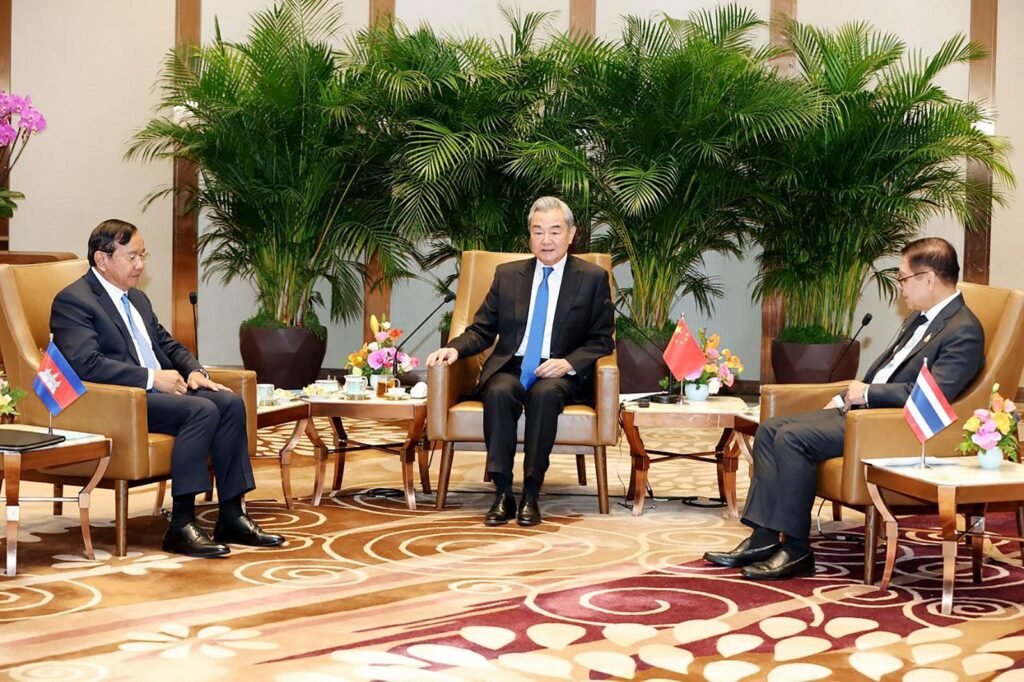
Yunnan (TDI): China has moved to the forefront of regional peacebuilding efforts by bringing together the foreign ministers of Cambodia and Thailand for high-level talks, reinforcing Beijing’s growing role as a mediator in Asia’s simmering disputes.
The trilateral meeting, hosted in China’s southwestern Yunnan province, came just days after Cambodia and Thailand signed a renewed ceasefire agreement aimed at ending weeks of deadly border clashes that left more than 100 people dead and displaced hundreds of thousands.
By convening the talks close to Southeast Asia rather than in Beijing, China signaled a direct, regionally grounded approach to de-escalation.
Read Also: China Pledges Aid to Cambodia, Supports Ceasefire with Thailand
Chinese Foreign Minister Wang Yi used the meeting to urge both sides to sustain the ceasefire, rebuild trust, and prioritize regional stability. Stressing China’s role as a “friend” to both countries, Wang warned that a return to conflict would serve no one’s interests and called for continued dialogue to prevent tensions from reigniting.
Thai Foreign Minister Sihasak Phuangketkeow acknowledged that while all issues have not yet been resolved, the talks marked meaningful progress.
He emphasized that maintaining the ceasefire and restoring confidence between the two neighbors remain the immediate priorities.
Cambodia’s Foreign Minister Prak Sokhonn echoed that optimism, expressing confidence that the ceasefire could hold and open the door for previously agreed mechanisms to resolve disputes.
According to statements released by Chinese, Cambodian, and Thai authorities, the three sides reached a shared understanding to uphold the ceasefire without backtracking, continue diplomatic engagement, and gradually normalize relations
China also offered immediate humanitarian assistance for civilians displaced by the fighting, underscoring its bid to combine diplomacy with on-the-ground support.
Read Also: Thailand, Cambodia Agree to Ceasefire After Weeks of Deadly Border Clashes
Beyond the border dispute, the talks also touched on broader regional cooperation, including joint efforts to combat transnational crimes such as online scams and telecom fraud, an issue affecting all three countries.
The Yunnan meetings highlight Beijing’s broader ambition to play a constructive third-party role in regional conflicts as its global influence grows.
By facilitating dialogue between two Southeast Asian neighbors at a critical moment, China is positioning itself not only as an economic powerhouse, but also as a diplomatic actor seeking stability through mediation rather than confrontation.

Minahil Khurshid holds a master’s degree in Peace and Conflict Studies from CIPS, NUST. She has a strong interest in current affairs, geopolitics, and policy analysis.