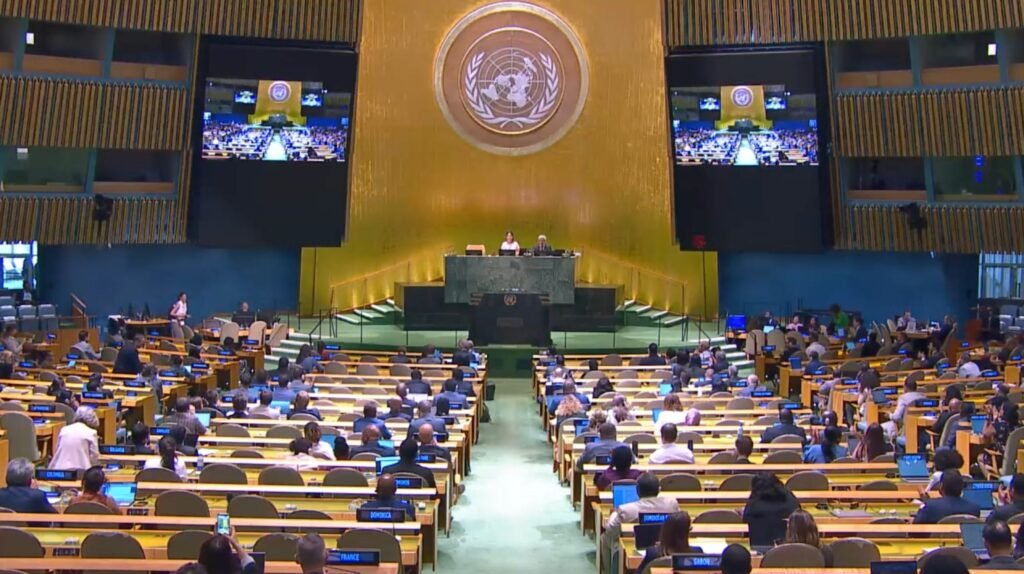
New York (TDI): The United Nations General Assembly voted to formally endorse a landmark ruling by the International Court of Justice, cementing the principle that protecting the planet from climate change is not merely a political choice but a binding obligation under international law.
The resolution, adopted on Wednesday, hailed by UN Secretary-General António Guterres as “a powerful affirmation” of international law, climate justice, and science, marks a turning point in how the global community frames the fight against the climate crisis.
Guterres said the resolution makes clear that member states have a responsibility to protect their own people from what he called an “escalating climate crisis.”
The move follows a watershed moment last year. In July 2025, the ICJ ruled that states have an obligation to protect the environment from greenhouse gas emissions, a decision the Secretary-General described at the time as “a victory for our planet.”
#BREAKING
UN General Assembly ADOPTS resolution welcoming the advisory opinion of the International Court of Justice on the obligations of States in respect of climate changeRESULT
In favor: 141
Against: 8
Abstain: 28 pic.twitter.com/cYAJ94weQT— UN News (@UN_News_Centre) May 20, 2026
The court also found that if states breach these obligations, they may be legally required to halt the wrongful conduct, provide guarantees it will not recur, and make full reparation, depending on the circumstances.
While ICJ advisory opinions are not legally binding, they carry considerable moral and legal weight in shaping international norms.
Wednesday’s General Assembly resolution builds on that foundation; calling on all UN member states to take every possible step to avoid causing significant damage to the climate and environment and to follow through on their existing pledges under the Paris Agreement.
Read More: Pakistan Calls for Balanced Climate Action at UN Meeting
Governments are also urged to ensure that climate policies protect the rights to life, health, and an adequate standard of living.
The resolution was prepared by Vanuatu and several other countries, and was adopted with 141 votes in favor, 8 against, and 28 abstentions.
Those voting against were Belarus, Iran, Israel, Liberia, Russia, Saudi Arabia, the United States, and Yemen. For Secretary-General Guterres, the message was unambiguous.
He declared that those least responsible for climate change are paying the highest price, and that the path to climate justice runs through a rapid, just, and equitable transition away from fossil fuels toward renewable energy. “The world’s highest court has spoken,” Guterres said. “Today, the General Assembly has answered.”