The experience of dying through shallow water drowning represents a unique form of cruel suffering. A person who needs help discovers he can reach the shore, but the people who stand there choose to force him back into the water.
This is the state of intra-African xenophobia today. The situation serves as a complete breakdown of the African Union’s founding charter. The African Union’s founding charter transforms into a document of beautiful fiction because of this moral failure, which destroys the reality of Pan-Africanism.
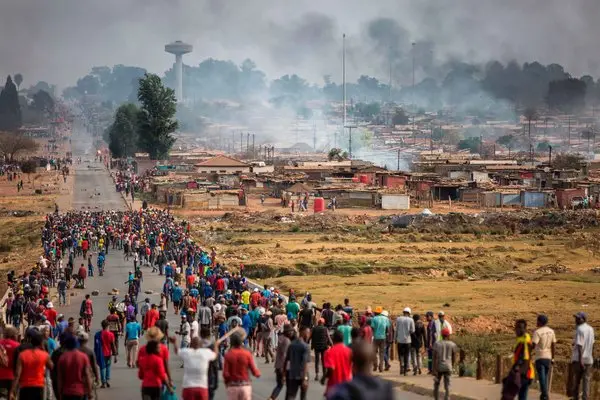
The ongoing pattern of xenophobic violence in South Africa serves as the most apparent demonstration of the drowning shore theory. Dratwa reports that South Africa experienced xenophobic attacks which resulted in 694 deaths and 5,648 looted shops and 128,849 displacements from 1994 until August 2025.
Between 2022 and 2024 Xenowatch recorded 255 cases of xenophobic discrimination which resulted in 57 deaths and 6,134 people being displaced and 810 shops being looted. The events are not separate incidents because they function as indicators of an established systemic problem.
The colonial state system needs to be studied because it provides the necessary understanding for researchers who want to investigate the reasons behind African people attacking their fellow Africans.
Read More: African Liberation Day: Has the Continent Truly Been Freed?
African people did not create the borders which separate their continent because those borders were established without their input and were designed to serve purposes other than their needs.
A study examining OAU and AU border policies from 1963 to 2024 found a strong statistical correlation between colonial border preservation and increased territorial disputes with African countries experiencing 2.3 times more border-related conflicts than other regions.
The artificial boundary-constraints between African countries have resulted in intra-African trade remaining below 20 percent of total African trade while European countries maintain a 69 percent trade rate with their neighboring nations.
The apartheid state once declared black South Africans “foreign” to their own cities through the Group Areas Act and pass laws.
Today, some South Africans declare other Africans foreign to the continent itself. Anti-immigrant movements such as “Operation Dudula” (a Zulu word meaning “violently chase away”) have normalized hatred for foreigners; with the group registering as a political party and campaigning alongside other anti-foreigner parties in the May 2024 elections.
Early in January 2024, members of Operation Dudula and the Patriotic Alliance went to the Beitbridge border post; some armed with guns to prevent Zimbabweans without valid documents from entering the country.
Economics of Scapegoating
The legitimate pressures that drive this resentment remain unchanged. The 2021 unemployment rate in South Africa reached 32.6 percent which resulted in a job market with intense competition because most South Africans viewed foreign workers as threats to their limited job possibilities. But scapegoating the Somali shopkeeper or Zimbabwean construction worker will not result in new job creation or construction of new homes.
The economic damage is mutual and severe. Xenophobic attacks reduce VAT collections; lead to less income and poverty for property owners; and reduce economic development prospects. Countries such as China, Australia, and the United Kingdom have warned their citizens not to travel to South Africa because of xenophobic attacks, directly threatening the tourism sector.
Nigeria and South Africa have been at loggerheads over xenophobic attacks on Nigerian citizens with Nigeria recalling its diplomats from Pretoria and radical student movements attacking South African businesses like MTN in retaliation.
Read More: African Union Convenes Peace Summit in Gabon
The African Union has shown a predictable lack of response strength. The 2018 Protocol on Free Movement of Persons remains mostly unexecuted. The Protocol has been signed by 32 out of 55 AU Member States and only four nations have ratified it which include: Rwanda, Niger, Mali, and São Tomé and Príncipe.
The Protocol requires 15 ratifications to enter into force. The three main African economic powers Egypt Nigeria and South Africa do not appear on the list of countries that have signed the agreement.
The African Union reports document various obstacles which include security issues, high xenophobia perceptions, absence of standardized legal systems, deficient institutional capacity, and lack of funding. The AU study found that “politicians are reluctant to discuss with their constituencies about the relaxing of border regimes, fearing it may be perceived as allowing ‘foreigners’ to enter their countries and compete with the locals for the limited resources and jobs.”
The Fading Voice
The essential core of Pan-Africanism can only exist through its basic understanding of racial solidarity. It was a material analysis of how African and diasporic peoples were systematically disempowered by global structures and how that disempowerment could be reversed through coordinated political and economic action.
When we reduce it to flag-waving at AU summits or performative outrage at Western racism while ignoring violence within our own borders, we strip it of its analytical power. We make it useless.
There is a particular grief in watching a dream dismantled by those who should be its guardians. Violence against Zimbabwean traders in Soweto; medical treatment denial of Nigerian students in Johannesburg; and the arson attack on Somali shops in Western Cape all serve as more than individual crimes.
They are assaults on the very possibility of African unity. “A sincere cry in deep water is voicing no more.” The Pan-African calling for African unity becomes a useless voice not because the idea is flawed, but because we have chosen to make it so through our silence, our complicity, and our active participation in the degradation of our own brothers and sisters.
This matters because Xenophobia is not a South African problem; it is an African problem with global consequences. Nearly 80 percent of migration in Africa occurs within the continent. When we close our borders to each other, we close our economies to growth. Intra-African remittances significantly boost GDP per capita, ease household constraints, and improve human capital.
Xenophobia also undermines the African Continental Free Trade Area (AfCFTA), as the AU Free Movement Protocol is explicitly linked to its implementation, without free movement of people, goods and services cannot flow effectively. Most critically, xenophobia betrays Pan-Africanism itself; the ideology that sustained anti-colonial struggles cannot survive if Africans become the perpetrators of exclusion.
Way Forward
The path forward demands coordinated action. The AU Free Movement Protocol needs to be ratified as the first step. The phased approach which includes entry, residence and establishment provides security solutions through its immediate implementation of ECOWAS’s 90-day visa-free system.
The second step requires that xenophobic violence be treated as a “hate crime” which targets nationality through criminalization with prosecution and restitution for victims. The third step requires public education to demonstrate that migrants do not create unemployment and do not use up public resources but instead create economic benefits.
The fourth step requires that all economic factors which include unemployment and housing shortages and service failures be addressed because these conditions enable xenophobia to thrive. The creation of jobs combined with social safety-net programs stops processes which lead to zero-sum competition.
Civil society networks which include the West African Observatory on Migrations need resources to support their work in promoting integration.
Read More: Togo Opens Its Doors: West African Nation Scraps Visas for All Africans
The current visa system should expand its accessibility because 28 percent of African travel now operates without visa requirements which has increased from 20 percent in 2016 while Ghana, Rwanda, Kenya and other countries allow free entry to all Africans. The successes which we achieved must be duplicated.
Furthermore, truth and reconciliation must be implemented to address African violence while South Africa needs public education about xenophobia through an apartheid-based approach which will help to achieve reconciliation. People need to recognize each other before they can achieve togetherness. Without acknowledgment, there is no unity.
The water is not as deep as it seems. The shore is visible. But those standing on it must decide whether to extend a hand or to throw another stone. The African Union will not save us. Only we can save each other. And the first act of salvation is to stop setting fire to our own house and calling it neighborhood watch.
The voice of Pan-Africanism is not useless. It is muffled by our own hands. If we remove them (if we choose solidarity over suspicion, law over lynching, and unity over division) that voice will rise again. Not as a cry in deep water, but as a call across the savannah, the desert, and the city streets: We are one. We have always been one. And we will rise as one, or not at all.
*The views presented in this article are the authors’ own and do not necessarily reflect the views of The Diplomatic Insight.

Peseo Lao Pio
Peseo Lao Pio is from Tanzania, and is a highly skilled ICT professional with an interest in global politics and economic change in Africa. His devotion to the development of the continent is the reason he pursued a Master’s degree in Political Science at Universitas Islam Internasional Indonesia (UIII). Pio brings extensive real-world experience to community welfare initiatives. He has worked as a mobile teacher for street children, contributed to critical environmental conservation projects, and held the role of community facilitator with VSO International. He was awarded the prestigious Best Student Award during his undergraduate studies for exceptional performance which demonstrates a consistent record of excellence in all his professional and humanitarian activities.