Rwanda presents an opportunity for Pakistani businesses looking to diversify beyond traditional markets that goes beyond simply exporting Pakistani products to Africa.
The more significant proposition is whether Pakistani companies can use Rwanda as a base for production, distribution and regional expansion. Rwanda and Pakistan mutual trade potential cannot be restricted to imports and exports, but another prospect is direct business to business partnership and investments in Rwandan businesses
Rwanda recorded USD 2.62 billion in registered investments across 799 projects in 2025, while foreign direct investment inflows reached USD 872.9 million in 2024, according to the Rwanda Development Board and Rwanda’s Foreign Private Capital Survey.
Rwanda is also actively seeking investment in manufacturing, agriculture, ICT, logistics, construction and financial services. For Pakistani businesses, this creates an opportunity to combine Rwanda’s investment environment with Pakistan’s existing manufacturing and export capabilities and establish a longer-term commercial presence in East Africa.
The clearest opportunity is textiles, garments, leather and footwear. Pakistan already has a substantial textile and apparel manufacturing base, while Rwanda has identified garments, textiles and leather among its priority manufacturing opportunities.
Read More: Here’s Why Rwanda Is Pakistan’s Gateway to Africa
Rwanda’s manufacturing strategy is increasingly focused on value addition, and its Export Development and Business Department specifically identifies textiles and leather among sectors requiring development.
Pakistani companies could therefore explore several models, from supplying fabrics and finished products to establishing garment, footwear or leather-processing operations in Rwanda. The opportunity is particularly relevant for manufacturers willing to move beyond exports and establish local production, contract manufacturing or distribution partnerships.
Such operations could allow Pakistani firms to build relationships with African buyers while using Rwandan businesses as local management. This will reduce a lot of human resources and logistics costs if there will be business to business partnerships.
Pharmaceuticals, medical instruments, food processing and agricultural technology offer another strong area of potential. Pakistan already has substantial capabilities in these sectors: chemical and pharmaceutical exports reached US$1.3 billion during July–April FY2025, while Pakistan’s surgical goods and medical instruments remain an established export industry.
Rwanda, meanwhile, identifies pharmaceutical manufacturing, medical equipment, food processing, agricultural mechanization, irrigation and cold-chain infrastructure as investment opportunities.
Agriculture contributes around 25% of Rwanda’s GDP and employs about 64.5% of the population, creating significant demand for productivity-enhancing technologies and value-added processing. Pakistani pharmaceutical and medical-device companies could therefore explore distribution, packaging, formulation and eventually manufacturing, subject to local regulatory requirements.
Similarly, Pakistani manufacturers of agricultural machinery, irrigation systems, pumps, food-processing equipment and packaging could enter through local distributors before considering assembly or production. Rwanda’s food-crop production grew 5% in 2026, while its agriculture sector expanded by 4% in the second quarter of 2026, reinforcing the potential for investment in agricultural value chains.
For Pakistani food businesses, the opportunity is therefore not limited to exporting rice or processed foods; investment in local processing, packaging and cold-chain facilities could allow companies to participate directly in Rwanda’s value chains and serve regional markets.
Construction materials, engineering goods and ICT services represent another commercially relevant group of opportunities. Rwanda’s industry grew 18% in the second quarter of 2026, with construction expanding by 24% and manufacturing by 10 percent. Within manufacturing, metal products, machinery and equipment increased by 51%, while non-metallic mineral products rose by 22% and textiles and leather products by 13%.
These figures indicate expanding demand for industrial inputs, machinery and construction-related products, creating opportunities for Pakistani manufacturers of cement-related products, ceramics, glass, metal products, engineering equipment and other construction inputs. Pakistan’s own cement production increased 9.1% during July-March FY2026, demonstrating an existing industrial base that could support overseas expansion.
At the same time, Rwanda’s information and communication services grew by an impressive 29% in Quarter 2 2026, while financial services expanded by 4%, creating space for Pakistani software houses, fintech companies, business-process outsourcing firms and digital-service providers. This makes Rwanda relevant not only to Pakistan’s traditional exporters but also to its growing technology, engineering and services sectors.
Government facilitation could significantly reduce the barriers for companies entering each other’s markets. Pakistan and Rwanda have already identified trade and investment, information technology and agriculture as areas for deeper cooperation, and Pakistan has proposed initiating a Preferential Trade Agreement with Rwanda.
Both governments could build on this by establishing a Pakistan–Rwanda business council or sector-specific joint working groups, organizing regular business delegations and investment forums, sharing sector-specific market information and creating direct links between chambers of commerce and investment agencies.
Pakistan’s diplomatic missions and trade institutions could help identify Rwandan distributors, industrial partners and procurement opportunities, while Rwanda’s Development Board already provides investor facilitation, partner matching, sector information and a One Stop Centre for investment-related services.
Read More: Rwanda Coffee Festival 2026 Opens Trade Avenues in Pakistan
Faster customs procedures, clearer standards recognition, improved trade information and eventually preferential trade arrangements could further reduce the transaction costs facing businesses.
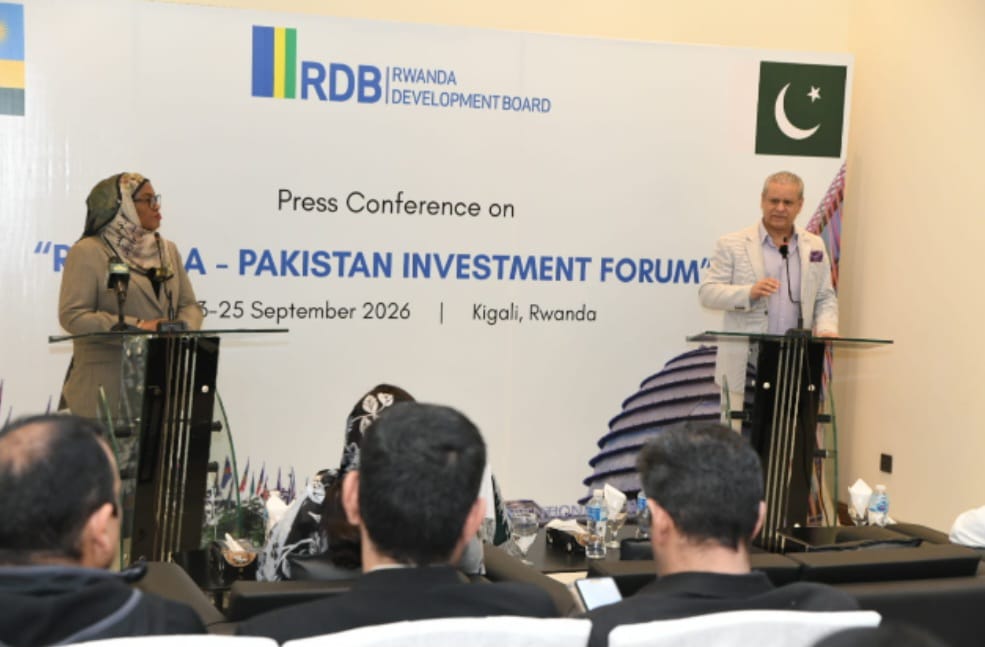
The upcoming Rwanda – Pakistan Investment Forum in Kigali from September 23 to 25, 2026 provides a timely platform for Pakistani businesses seeking to diversify beyond traditional markets and establish a stronger presence in Africa.
The Pakistani business delegation will engage with Rwandan government institutions, investors, business leaders and private-sector representatives, with discussions covering trade, investment, joint ventures, technology cooperation and manufacturing.
The forum can help Pakistani companies move beyond conventional export relationships by identifying local partners, distributors and investment opportunities in sectors such as textiles, pharmaceuticals, agriculture, manufacturing and technology.
Rwanda’s High Commissioner, Harerimana Fatou, has also encouraged Pakistani companies to view Rwanda not only as a growing market but as a potential base for production, joint ventures and expansion into wider African markets.
With direct government and business engagement, the forum could therefore help convert bilateral economic interest into concrete commercial partnerships and investment projects.