Since Russia’s full-scale invasion of Ukraine in February 2022, the five republics of Central Asia have skillfully navigated a complex geopolitical landscape, balancing their ties with Moscow while deepening engagement with other major powers. None of them have recognized Russia’s annexation of Crimea, Donbas or the other occupied Ukrainian territories. Kazakhstan’s government stated within months of the invasion that it would not recognize the illegitimate territorial formations produced by Moscow’s referendums, a position President Kassym-Jomart Tokayev restated from a stage at the St Petersburg International Economic Forum in June 2022 with Vladimir Putin seated beside him. Putin responded by invoking the two countries’ shared history within what he called “historic Russia,” a formulation with unmistakable echoes of his own justification for invading Ukraine.
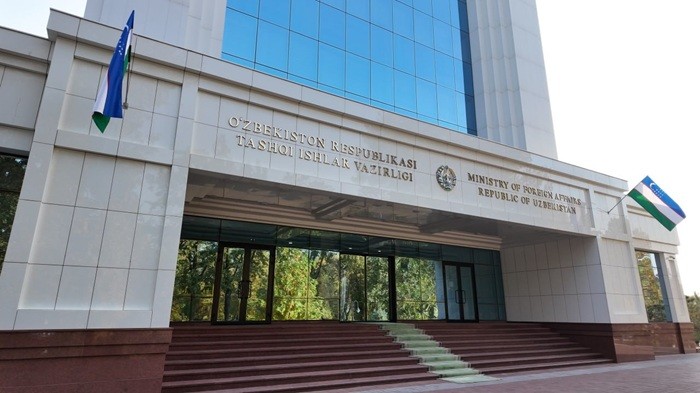
Yet none of the five states has broken with Russia either. Kazakhstan still sends the great bulk of its oil exports through Russian pipelines, and remittances from Central Asian migrant labourers in Russian cities remain a vital source of household income across the region. At the same time, Astana and Tashkent have thrown themselves into a flurry of courtship elsewhere, for instance, Chinese investment along the so-called Middle Corridor, American critical-minerals diplomacy through the C5+1 format, Turkish-led cooperation through the Organization of Turkic States and a newly minted strategic partnership with the European Union. The question worth asking is whether this careful balancing act amounts to something new in the practice of small-state statecraft, or whether it is simply the latest iteration of a much older game.
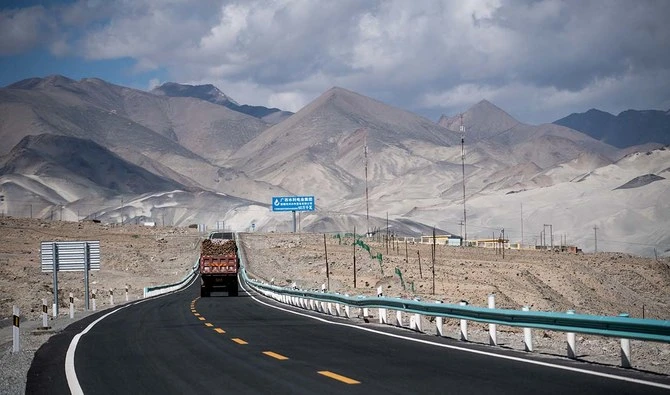
The scale of the reorientation is real enough. Freight volumes along the Trans-Caspian International Transport Route, the Middle Corridor that runs from China through Central Asia, across the Caspian and the Caucasus, to Turkiye and on to Europe, have grown roughly fourteen-fold since 2021, from around 350,000 tonnes to close to five million tonnes in 2025, including a single-year surge of some 62 per cent in 2024; the World Bank forecasts the route could carry eleven million tonnes annually by 2030. In April 2025 the European Union held its first ever summit with the five Central Asian presidents, in Samarkand, and unveiled a €12 billion Global Gateway package, split roughly between the Trans-Caspian corridor, critical raw materials, and energy and climate projects. Washington has pursued a parallel track, with the first leaders-level C5+1 summit taking place in New York in September 2023, and a second following in Washington in November 2025 that yielded rare-earth and critical-minerals agreements with Kazakhstan and Uzbekistan.
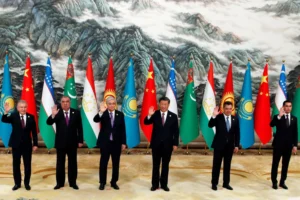
China, for its part, hosted its own Central Asia summit in Xi’an in May 2023, months before Washington’s first leaders-level gathering, and has continued to fold the region into the Belt and Road Initiative through rail links, Caspian port investment and a critical-minerals partnership with Uzbekistan. Layered onto all this is Ankara’s steadily deepening role through the Organization of Turkic States, which now functions as a forum for policy coordination among Kazakhstan, Kyrgyzstan, Uzbekistan and observer Turkmenistan.
The pattern is not confined to trade; it shows up in the small print of individual encounters too. Three months after the St Petersburg exchange, at the Shanghai Cooperation Organization summit in Samarkand in September 2022, Xi Jinping took the opposite tack, offering Kazakhstan explicit assurance of Chinese support for its independence, sovereignty and territorial integrity, and opposition to outside interference in its domestic affairs. Astana did not have to choose between these two messages. It simply absorbed both, using Beijing’s reassurance as leverage against Moscow’s pressure while continuing to trade, transit oil and host Russian conscripts fleeing mobilization.
A sceptic might object that the comparison with Khiva, Bukhara and the Kazakh hordes flatters the present too much. Today’s Central Asian states are sovereign, UN-recognized, and shielded, however imperfectly, by a body of international law that simply did not exist for nineteenth-century khanates facing annexation by treaty of dubious consent. Kazakhstan’s borders are not Khiva’s walls, and its foreign ministry can invoke the principle of territorial integrity in a way no khan ever could. This distinction is fair, yet it understates how thin that shield has proven in practice, since Kazakhstan’s own officials have had to contend publicly with Russian commentators questioning whether their country has ever possessed statehood, and sovereignty on paper has not stopped Moscow from treating northern Kazakhstan’s Russian-speaking population as a lever, nor Beijing from treating Central Asian resources as an extension of its own supply chains. International law furnishes a vocabulary these states lacked in 1800, but the underlying vulnerability to more powerful neighbours, and the need to hedge rather than choose, has not disappeared with it.
Read More: Kazakhstan’s Chairmanship: Strengthening Central Asia’s Nuclear-Weapon-Free Zone
It would be easy to read all this as evidence of a wholly new doctrine, forged in the shock of 2022 and given form through summitry and investment vehicles that scarcely existed a decade ago. Kazakhstan’s Nazarbayev-era doctrine of a multi-vector foreign policy, restated more recently under Mirziyoyev in Uzbekistan, is often presented as the founding text of this supposed innovation, constituted by an explicit commitment to cultivate relations with Russia, China, the United States and Europe simultaneously, while declining permanent alignment with any one of them. But the vocabulary of multi-vectorism, coined within Kazakhstan’s foreign-policy establishment in May 1992, describes a habit of statecraft considerably older than the republics that now practise it.
For the better part of two centuries before Russian conquest was completed in the 1870s and 1880s, the khanates of Khiva and Bukhara, and the successive Kazakh hordes of the steppe, survived by refusing to commit themselves wholly to any one of the great powers pressing in on them. Kazakh khans sought Russian protection against Dzungar incursions in the early eighteenth century while continuing to negotiate and trade in directions that kept open some relationship with the Qing empire, once the Qing had crushed the Dzungars and pushed its authority to the edge of the Tianshan. Khiva and Bukhara balanced nominal deference to Persia, opportunistic dealings with British agents operating out of Afghanistan and India during the Great Game, and wary accommodation of an advancing Russian empire, extracting what advantage they could from each relationship while binding themselves permanently to none.
This was the nature of survival in what one historian of Russia’s steppe frontiers has termed an “un-Kantian” international environment, one in which treaties were provisional and the appearance of loyalty to a patron could be reversed the moment circumstances changed. The steppe polities that endured longest were those that mastered this, understanding that permanent alignment with a single suzerain was itself the greater danger.
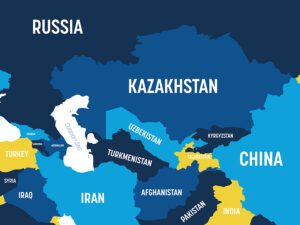
Against this long view of history, the post-2022 realignment of Kazakhstan and Uzbekistan looks less like an innovation than a rediscovery. What is new is the institutional scaffolding: standing formats such as C5+1, a formal EU strategic partnership, and the financial scale of the Global Gateway package and the rare-earths agreements with Washington did not exist for Bukharan emirs or Kazakh khans, who had to improvise their diplomacy afresh with every shift in the regional balance. What is not new is the underlying calculation, which is that survival on the steppe has always depended on ensuring that no single power ever gains exclusive purchase over one’s territory, resources or loyalty. Kazakhstan’s careful refusal ever to condemn or endorse Russia’s war, its studied textual ambiguity, performs the function that its predecessors’ shifting tributary relationships performed two centuries ago. It keeps every door open at once.
Read More: Central Asia in Contemporary International Relations: From Peripheral Region to Strategic Actor
This matters for how outside powers ought to read the region. Washington, Brussels, Beijing and Moscow are each inclined, for their own reasons, to interpret warming ties with Central Asia as evidence of a durable strategic shift in their favour. The longue-durée view suggests otherwise. If multi-vectorism is truly inherited steppe statecraft rather than a circumstantial post-Soviet innovation, then no single bloc should expect Kazakhstan or Uzbekistan’s present tilt to harden into permanent alignment. The hedging is not a temporary phase to be waited out until Astana or Tashkent finally chooses a side. It is, and has probably always been, the end game.

Kumail Hasan
Kumail Hasan is an author who writes on international order, strategic competition, and the political economy of resource conflicts, with a particular focus on South and Central Asian politics.