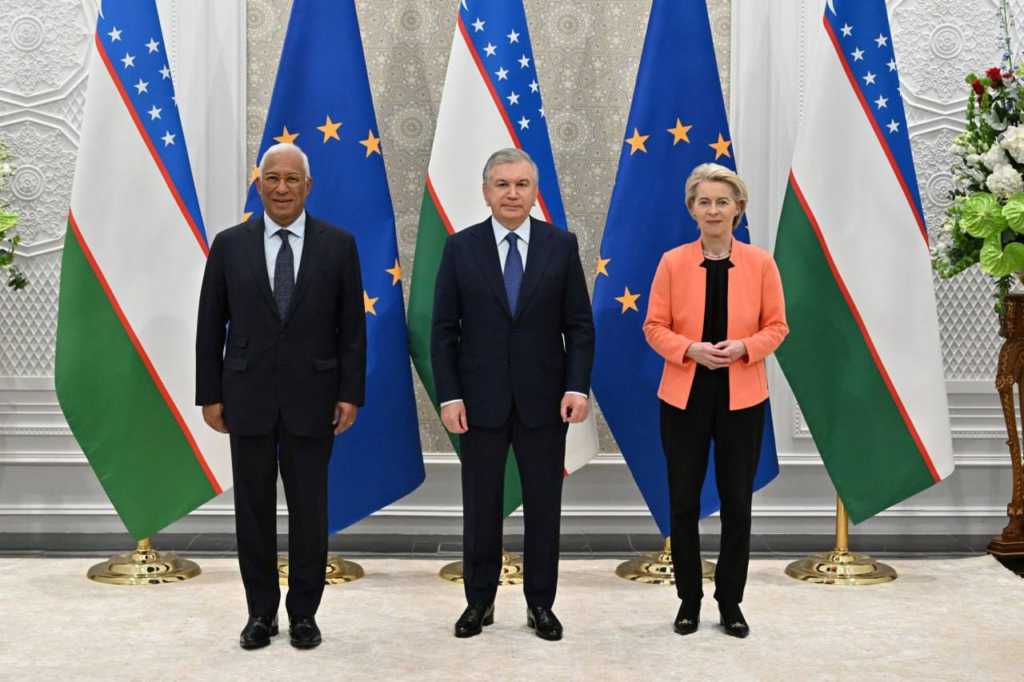
On October 24, 2025, Brussels will host a trilateral meeting between Shavkat Mirziyoyev – President of Uzbekistan, Ursula von der Leyen – President of European Commission, and Antonio Costa – President of European Council.
During this meeting, President Mirziyoyev is set to sign the Enhanced Partnership and Cooperation Agreement (EPCA) with the European Union, a milestone that marks a new era in relations between Uzbekistan and the European Union.
The EPCA represents more than just a diplomatic document. It replaces the 1999 Partnership and Cooperation Agreement with a framework that reflects the realities of today’s global economy and Uzbekistan’s evolving role within it.
This new accord broadens cooperation beyond trade to include governance, human rights, education, digital transformation, and sustainable development, areas that have become central to both Uzbekistan’s reform agenda and the EU’s regional strategy.
For the European Union, this agreement strengthens its long-term presence in Central Asia, aligning with its ambition to build a stable, connected, and resilient Eurasia.
For Uzbekistan, it is an acknowledgment of the country’s progress over the past decade, its reforms, openness to global markets, and determination to align with international standards.
Over the past several years, Uzbekistan and the European Union have cultivated an increasingly dynamic partnership. Following Uzbekistan’s inclusion in the EU’s GSP+ trade system in 2021, both sides intensified cooperation in areas such as governance, environmental sustainability, and investment.
Read More: Uzbekistan and Belgium: New Opportunities for Green Cooperation
Trade volumes between the two partners have more than doubled within five years, reaching about €6.4 billion in 2024. European companies from France, Germany, Belgium, and Italy have expanded operations in textiles, renewable energy, and logistics, contributing to a European investment portfolio now estimated at €40 billion. More than a thousand joint ventures are active across the country.
The Enhanced Partnership and Cooperation Agreement builds on this foundation. It provides legal stability and clearer rules for investors through transparent customs procedures, intellectual property protection, and dispute-resolution mechanisms.
Politically, it institutionalizes dialogue between Tashkent and Brussels on human rights, security, and migration management, areas that have become increasingly relevant in the evolving geopolitical environment.
The EPCA also stems from broader regional developments. During the EU–Central Asia Summit held in Samarkand in April 2025, Brussels announced a €12 billion Global Gateway package to support infrastructure, renewable energy, and transport connectivity across Central Asia.
Uzbekistan’s participation in this initiative underlines its central role as a bridge between Europe and Asia, especially within the Middle Corridor, a key route linking European and Asian markets through the South Caucasus and the Caspian Sea.
This partnership comes at a time when Uzbekistan’s foreign policy is defined by diversification and balanced engagement. Since 2017, the country has introduced wide-ranging reforms in governance, trade, and public administration, reshaping its investment climate and global image.
The signing of the EPCA reflects recognition of these achievements, as well as Uzbekistan’s readiness to participate in global governance systems based on transparency, cooperation, and mutual benefit.
Read More: SCO Summit: Uzbekistan Bridges Trust Across Eurasia
Beyond economics and politics, the agreement also places strong emphasis on social and educational cooperation. Programs such as Erasmus+, Horizon Europe, and joint academic initiatives with European universities are helping Uzbekistan nurture a new generation of skilled professionals.
Over the past decade, the number of students enrolled in higher education has increased fivefold in Uzbekistan, a remarkable shift that aligns with the country’s efforts to integrate more closely into the global knowledge economy. Collaboration in research, innovation, and digitalization will also help modernize key sectors such as agriculture, water management, and green technology.
Environmental partnership forms another important pillar of the EPCA. Under the EU’s Global Gateway initiative, new renewable energy and clean transport projects are planned across Uzbekistan, complementing the government’s own green transition strategy. These efforts are expected to support the gradual shift from fossil fuels to sustainable energy, a goal that both sides recognize as essential for long-term resilience.
For Uzbekistan, the Enhanced Partnership and Cooperation Agreement is more than a diplomatic success, it is a symbol of international credibility and growing confidence in its reform trajectory. It opens new markets, strengthens investor trust, and creates new opportunities for citizens through education, professional exchange, and innovation.
For the European Union, the agreement deepens its engagement with a key Central Asian partner while expanding Europe’s strategic presence in a region that is increasingly vital for global connectivity.
Ultimately, the success of this partnership will depend on implementation. The signing ceremony in Brussels will mark only the beginning of a long process of cooperation, adaptation, and shared progress. The main message from this agreement is clear: Uzbekistan and the European Union are ready to move forward together, with trust, vision, and a commitment to building a more connected future.

Adkhamjon Janobiddinov
Adkhamjon Janobiddinov is an independent researcher and journalist from Uzbekistan, focusing on Uzbekistan's foreign affairs, economy and tourism.