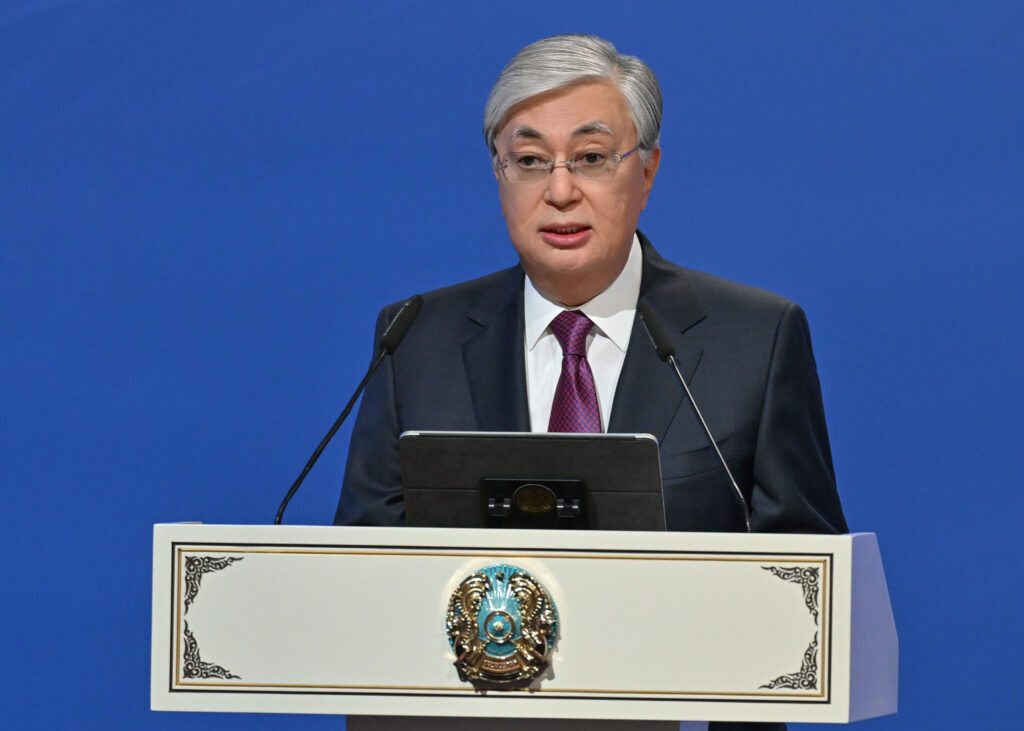
Astana (TDI): President Kassym-Jomart Tokayev has described the opening of Kazakhstan’s first Kurultai session as the beginning of a new phase in the country’s political development, following the approval of a new Constitution in a nationwide referendum.
Addressing the inaugural session on August 28, Tokayev said the newly established unicameral Kurultai would assume broader responsibilities in legislation, key institutional appointments and oversight of the Government.
Under the new constitutional framework, the President nominated Aibek Dadebay for Speaker of the Kurultai and said the Government had resigned its mandate before the newly elected legislature. He will subsequently submit nominees for Vice-President and Prime Minister before forming a new Government in consultation with deputies.
Tokayev said he would deliver his annual Address to the People of Kazakhstan once the Kurultai and Government had been fully constituted.
Read More: President Tokayev’s Address at the Opening of the First Session of the Kurultai
The President also announced plans to establish the Kazakhstan People’s Council, or Halyk Kenesi, in the second half of September. He described the body as the country’s highest consultative institution representing its ethnic, regional, social and political diversity, with a constitutional right to initiate legislation.
Tokayev said the new legislature would play a stronger role in maintaining institutional checks and balances. Appointments of Constitutional Court judges and members of the Central Election Commission and Supreme Audit Chamber will require the Kurultai’s approval. Deputies will also appoint and dismiss Supreme Court judges on the President’s proposal.
The legislature will review reports on national budget execution, hear the Constitutional Court’s annual address and may express no confidence in the Government. It can also propose the dismissal of individual ministers. The first Kurultai will additionally review existing legislation and bring sectoral laws into line with the new Constitution.
Tokayev called for the rapid introduction of an E-Parliament system designed to improve legislative analysis and identify legal risks at an early stage. He urged deputies to use artificial intelligence to improve the quality of legislation and reduce corruption risks, while warning that AI should not replace professional legal expertise.
The Government is also expected to prepare legislation related to artificial intelligence in secondary education, digital assets and the Digital Qazaqstan strategy. The Kurultai will examine regulation of online platforms and mass media as part of efforts to protect citizens’ rights in the digital information space.
The President said Kazakhstan’s economic reforms would focus on improving living standards through industrialization, foreign and domestic investment and major infrastructure development. He defended the use of National Fund resources for projects capable of generating long-term social and economic benefits, particularly modern infrastructure.
Tokayev also highlighted the Golden Visa initiative as a tool for attracting highly qualified specialists, advanced technologies and foreign capital. He called for broader migration reform and directed the Government to submit a relevant bill for expedited consideration.
Raed More: Tokayev Hails ‘Phygital’ Sport Milestone as Games of the Future Get Underway in Astana
Strengthening the resilience of the energy sector and developing alternative energy sources were also identified as legislative priorities.
Turning to foreign policy, Tokayev said the international system is becoming increasingly unpredictable, with declining trust among major powers and growing challenges to the effectiveness of the United Nations. He said regional organizations and middle powers are consequently assuming greater importance, explicitly placing Kazakhstan among the latter.
According to Tokayev, national sovereignty in the current environment depends on strengthening economic, scientific, defense and diplomatic capabilities while investing in human potential. He reaffirmed Kazakhstan’s commitment to peace, friendship and mutually beneficial partnerships, saying the country would continue defending its national interests through diplomacy and international engagement.
Tokayev called for legislation providing comprehensive support to children with disabilities, including access to education and improved medical and social services. He proposed establishing dedicated support centres in every regional capital and large district and encouraged greater participation by sponsors alongside the state.
The President also endorsed the Government’s proposal to prohibit children under 16 from registering on social-media platforms, calling on the Kurultai to treat the issue as a priority. A new law on libraries and publishing is also expected to be prepared this year, which Tokayev linked to Kazakhstan’s intellectual and cultural development.
Read More: Kazakh President Tokayev Congratulates Montenegro on Statehood Day
Tokayev said more than 74 percent of eligible citizens participated in the Kurultai election, while around 800 international observers visited Kazakhstan. He noted that the Adilet party secured the largest share of the vote and a constitutional majority in the new legislature, describing the result as a responsibility to consolidate society and advance reforms.
The President also highlighted the increased representation of women and young people in the Kurultai, saying personnel renewal across state institutions remains a central objective of the reforms. Urging deputies to reject populism and empty promises, Tokayev called for a political culture based on legality, transparency, mutual respect and pluralism.
He further called for a balanced approach to national history, arguing that Kazakhstan should remember past tragedies without defining its national identity through victimhood. Tokayev said knowledge, science, hard work and self-discipline should guide the country’s future, with national unity serving as the foundation for building what he described as a “Just, Safe, Clean and Strong Kazakhstan.”