London (TDI): The 2026 Global Report on Food Crises (GRFC) released by an international alliance of humanitarian and development agencies, on Friday, has placed Pakistan among the top 10 countries experiencing acute food insecurity.
The assessment, which synthesizes a decade of consensus-based data highlights that intensifying climate extremes and persistent economic pressures are driving these critical conditions.
The 2026 Global Report on Food Crises identifies Pakistan, along with Afghanistan, Bangladesh, the Democratic Republic of the Congo, Myanmar, Nigeria, South Sudan, Sudan, Syria and Yemen as key centers of acute hunger.
Nigeria has the highest number of people facing acute food insecurity at 30.6 million representing 15 percent of its population, while South Sudan has the highest proportion with 57 percent of its population affected.
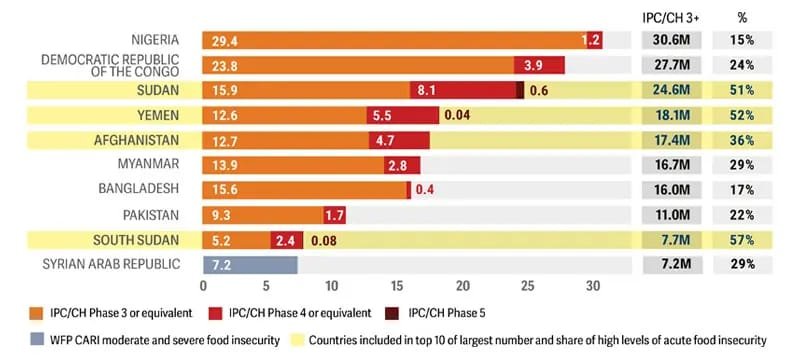
According to the report, nearly 11 million people in Pakistan faced high levels of acute food insecurity during 2025 and out of this population, 9.3 million individuals were classified under “crisis” conditions (IPC Phase 3), while 1.7 million were categorized in the more severe “emergency” phase (IPC Phase 4).
These classifications were based on the Integrated Food Security Phase Classification (IPC) system which identifies situations which require urgent action to protect lives and livelihoods.
The GRFC emphasizes that extreme weather remains a significant driver of food insecurity in Pakistan. Heavy monsoon rains and flash floods throughout 2025 destroyed vital cropland and infrastructure and impacted over 6 million people nationwide.
According to the Global Hunger Index (GHI), Pakistan ranks 92nd out of 116 countries which indicates a “serious” level of hunger in the country.
Read More: 10M Pakistanis at Risk of Acute Food Insecurity: World Bank
The report expanded its analysis coverage from 43 rural districts in 2024 to 68 districts in 2025 providing a more comprehensive view of the national situation.
Additionally the economic factors including an inflation rate projected to rise toward 6 percent which continue to stress the national system and limit access to affordable food.
The GRFC 2026 reports says that 266 million people across 47 countries faced high levels of acute food insecurity in 2025, a figure nearly double that of 2016.
For the first time in the report’s ten-year history, famine was confirmed in two separate contexts Gaza and parts of Sudan in the same year.
The report further warns that food insecurity has evolved from isolated and temporary shocks into a persistent global issue.
The primary driver of global hunger is conflict, and conditions for 2026 remain concerning, with international agencies calling for integrated and sustained geopolitical responses to address deepening humanitarian needs.

Muhammad Usman Hashmi is a researcher in International Relations, focusing on climate diplomacy, global governance, and political economy in the Global South. He has contributed to policy dialogues with the Foreign Policy Community of Indonesia and serves as a Senior Research Fellow at the International Council on Human Rights, Peace and Politics. He is also associated with Rethinking Economics Islamabad, contributing to research on development and sustainability.