Islamabad (TDI): Pakistan and Oman have signed six agreements and memoranda of understanding (MoUs) to expand bilateral cooperation in diplomacy, visa facilitation, information technology, telecommunications, media and archival records, as the two countries seek to deepen engagement across multiple sectors.
The agreements were signed on Wednesday during the eighth session of the Pakistan-Oman Joint Ministerial Commission (JMC), co-chaired by Pakistan’s Deputy Prime Minister and Foreign Minister, Senator Mohammad Ishaq Dar, and Omani Foreign Minister Sayyid Badr bin Hamad bin Hamood Al Busaidi.
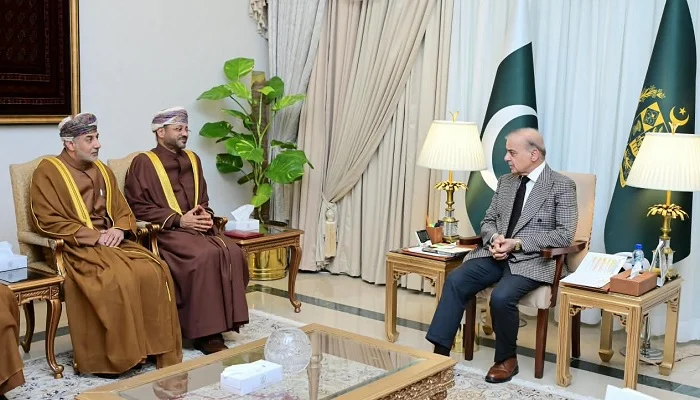
Prime Minister Shehbaz Sharif witnessed the signing and exchange of the documents during his meeting with the visiting Omani foreign minister and his delegation, according to statements issued by the Prime Minister’s Office and Pakistan’s Ministry of Foreign Affairs.
The six documents included the protocol recording the minutes of the eighth JMC session, an agreement on mutual visa exemption for holders of diplomatic, special, official and service passports, and an MoU on records and archives.
Three additional MoUs covered cooperation in information and broadcasting, information technology and telecommunications, and news exchange and media cooperation. The relevant federal ministers for information and broadcasting and IT and telecommunications signed the documents.
Read More: Qatar, Oman and Pakistan Coordinate Push to Restore US-Iran Negotiations
The agreements are intended to establish a framework for closer institutional coordination and create opportunities for collaboration in the sectors covered by the documents.
During his meeting with Sayyid Badr, Prime Minister Shehbaz welcomed the Omani minister and his delegation, highlighting the shared religious, cultural and historical connections between the two countries.
He pointed to Pakistan and Oman’s geographical proximity and centuries-old people-to-people exchanges as important foundations of their relationship, describing Oman as a brotherly country, a significant maritime neighbour and a valuable partner in a strategically important region.
The prime minister also welcomed the successful convening of the JMC session, saying it would provide a basis for expanding mutually beneficial cooperation and strengthening bilateral engagement.
He noted that Pakistan and Oman shared converging views on regional and international issues and appreciated Oman’s emphasis on dialogue and diplomacy as means of resolving disputes.
Oman has maintained an active diplomatic role in regional affairs, including efforts to facilitate dialogue during periods of heightened tensions. Pakistan, meanwhile, has also pursued diplomatic engagement aimed at reducing regional instability and encouraging peaceful solutions to outstanding disputes.
Read More: Pakistan, Oman Renew Mediation Efforts to De-escalate Iran-US Conflict
Sayyid Badr thanked the Pakistani government for the hospitality extended to him and his delegation and welcomed the successful conclusion of the JMC session.
He agreed that the meeting could help advance cooperation across a range of sectors for the mutual benefit of both countries. The Omani foreign minister also appreciated Pakistan’s continued diplomatic efforts to de-escalate tensions and promote peaceful approaches to regional challenges.
The eighth JMC session provides a platform for the two governments to review existing cooperation, discuss areas of mutual interest and identify opportunities for further engagement.
The latest agreements extend the relationship beyond traditional diplomatic exchanges, bringing administrative cooperation, technology, communications and media engagement into the framework of bilateral ties.
The visa-exemption agreement applies to holders of diplomatic, special, official and service passports, rather than constituting a general visa-free arrangement for all Pakistani and Omani citizens.
As Pakistan and Oman continue diplomatic consultations, the implementation of the six documents will be important in determining how far the agreements translate into practical cooperation. The two countries have identified several areas for closer engagement, with the JMC serving as a mechanism for coordinating future initiatives.