Bangkok (TDI): Gulf economies are unlikely to return to their pre-war growth trajectories in the medium term, the International Monetary Fund (IMF) has warned, citing lasting damage to infrastructure, disruptions across key industries and rising costs associated with strengthening economic resilience amid the widening regional conflict.
Jihad Azour, the IMF’s director for the Middle East and Central Asia, said on Thursday that even energy-rich economies would face a prolonged recovery as fighting involving Iran, Saudi Arabia and Yemen’s Houthi movement continued to disrupt economic activity and maritime energy transport.
“We will not go back to the pre-war trajectory in the medium term because this shock will have a scarring impact on various sectors and also will disrupt a certain number of infrastructure, and will require additional spending in order to increase resilience,” Azour told reporters.
The warning comes as the IMF forecasts an economic contraction across the Middle East and Central Asia in 2026, reflecting the impact of the war on energy production, trade, infrastructure and investor confidence.
In projections released on Tuesday, the IMF forecast that the Middle East and Central Asia region would contract by 0.3 per cent in 2026, as economies directly exposed to the conflict face mounting pressure.
Read More: The Billion-Dollar Shield: Why Houthi Drones Still Threaten Saudi Arabia
Saudi Arabia is projected to experience a 3.3 per cent contraction, according to the fund’s estimates. The forecast points to a rare recession for the kingdom, whose economy has historically benefited from substantial energy exports.
The latest fighting has brought renewed threats to Saudi airports and energy infrastructure, including an attack on the headquarters complex of state-owned oil giant Saudi Aramco in Dhahran. Saudi authorities said the incident caused a limited fire but reported no deaths or injuries.
The Houthis have threatened further attacks on airports and oil installations, describing them as legitimate military targets. The Saudi-led coalition, meanwhile, has continued operations against Houthi positions in Yemen.
Repeated strikes and threats to strategic infrastructure could affect more than immediate oil production. Disruptions to aviation, logistics, tourism and commercial activity could also weigh on growth, while governments may need to allocate additional resources to security and infrastructure protection.
The conflict has also intensified concerns about maritime trade through the Strait of Hormuz, a vital route for global oil and liquefied natural gas shipments.
Attacks on commercial vessels and restrictions on maritime traffic have increased uncertainty for energy markets and international shipping. Higher transport and insurance costs, combined with the risk of supply disruptions, have added pressure to an already uncertain global economic outlook.
The consequences extend beyond the Gulf. Higher energy costs can feed into inflation, raise production and transport expenses, and reduce household purchasing power in countries that rely heavily on imported fuel.
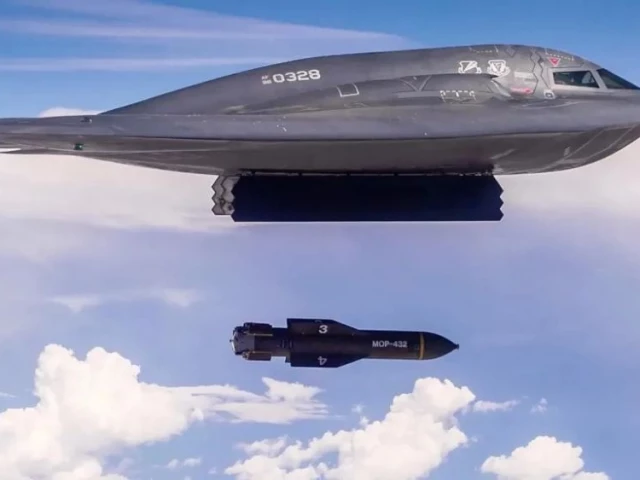
Read More: US Weighs ‘Mother of All Bombs’ in Potential Future Strikes on Iran
The IMF’s warning comes as finance officials and economic experts meet in Bangkok to examine challenges facing the global economy, including persistent energy-price pressures and uncertainty over the sustainability of the artificial intelligence investment boom.
The combination of geopolitical instability, disrupted supply chains and uneven economic performance has complicated the outlook for governments and central banks seeking to maintain growth while containing inflation.
Azour’s comments suggest that the economic consequences of the war could continue even after active hostilities subside. Damage to infrastructure, reduced activity in affected sectors and the need to strengthen resilience could slow the return to previous growth levels.
For Gulf economies, the challenge will be to maintain investor confidence and economic diversification while managing the immediate costs of conflict. Saudi Arabia, in particular, has pursued an ambitious program to expand non-oil industries and reduce its dependence on hydrocarbon revenues.
Sustained instability could complicate those efforts by affecting tourism, transport, investment and other sectors central to economic diversification.
IMF Managing Director Kristalina Georgieva also warned on Wednesday that continued attacks targeting Saudi Arabia could have consequences for people far beyond the immediate conflict zone.
Her remarks highlighted the broader economic exposure created by the region’s role in global energy markets and trade networks.