Billions of dollars spent on cutting-edge American defense systems, sophisticated radars scanning the skies, and some of the world’s most advanced interceptor missiles standing guard, yet Saudi Arabia continues to face a troubling question: how are Houthi drones and missiles still threatening its critical infrastructure? The kingdom’s costly air defense shield is facing a serious test, exposing the limits of military technology against an adversary that has learned to exploit its vulnerabilities. As concerns grow over the protection of airports, oil facilities and other strategic sites, the challenge is no longer simply about how powerful Saudi Arabia’s weapons are, but whether even the most sophisticated defense network can stop every attack.
The central challenge is not necessarily a lack of sophisticated weaponry. Rather, it reflects the difficulties of defending a vast territory against an adversary that can employ relatively inexpensive drones alongside cruise and ballistic missiles, potentially overwhelming even well-equipped military forces.
Saudi Arabia’s defense procurement includes major agreements for American-made Terminal High Altitude Area Defense (THAAD) and Patriot missile systems. In 2017, Washington approved a deal worth approximately $15 billion for THAAD launchers and missiles. A further $3 billion Patriot missile agreement followed in 2022, while another deal worth around $9 billion was concluded in 2026 to strengthen the kingdom’s missile defense capabilities.
Despite these investments, recent reports of attacks targeting Saudi infrastructure have renewed scrutiny of the kingdom’s ability to intercept incoming threats. The incidents have also highlighted a broader reality: no air defense network can guarantee that every hostile projectile will be destroyed before reaching its target.
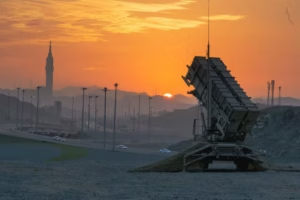
Saudi Arabia operates a network of air defense systems designed to counter threats at different altitudes and distances. The American Patriot PAC-3 system forms a central part of this network, offering capabilities against ballistic missiles and other aerial threats.
Its advanced radar and interception technology allows it to track and engage multiple targets. However, the missiles used to destroy incoming threats are expensive, making their repeated use against comparatively inexpensive drones a costly proposition.
This creates a difficult calculation for military planners. Using high-value interceptors against every incoming object can quickly consume limited stocks, while allowing a threat to approach critical infrastructure carries obvious risks.
To address smaller aerial threats, Saudi Arabia can also use lower-cost options, including Swiss-made Oerlikon 35mm anti-aircraft guns, which are intended to provide a more economical response to certain types of drones.
THAAD provides another layer of protection. Designed primarily to intercept ballistic missiles at high altitudes, the system can complement Patriot batteries by engaging threats at a different stage of their flight.
Saudi Arabia declared its first THAAD unit operational in July 2025. Nevertheless, the system is not a universal solution for every aerial threat. Its principal purpose is ballistic missile defense, and its expense makes it unsuitable as a routine response to large numbers of relatively inexpensive drones.
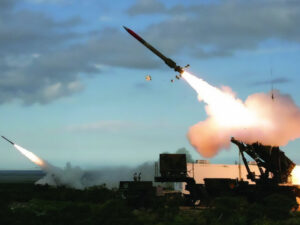
The kingdom also operates systems such as I-Hawk, Crotale, Shahine and MICA, which contribute to protection against threats at shorter and medium ranges. Together, these systems provide several layers of defense, but their effectiveness depends on how well they work as a coordinated network.
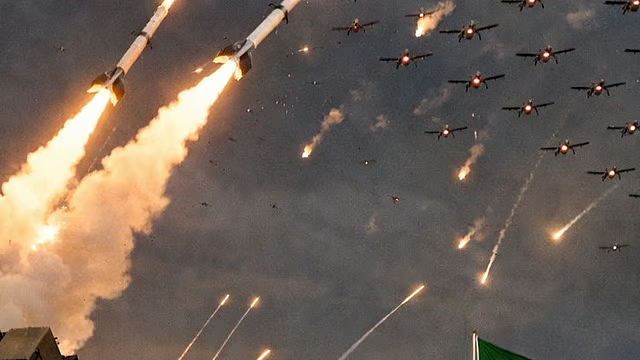
One of the most significant challenges is the growing diversity of weapons available to the Houthis, formally known as Ansar Allah. Drones, cruise missiles and ballistic missiles differ considerably in speed, altitude, flight path and radar visibility. A defense network must detect, identify and respond to each threat within the time available, often while managing several incoming objects simultaneously.
Small drones can fly at low altitudes and at relatively slow speeds, making them harder for some surveillance radars to distinguish from background activity. Terrain can further complicate detection, particularly when cruise missiles approach from directions that reduce the time available for interception.
Read More: Pakistan-Saudi-Turkiye Defense Pact: Who Gains Most?
Ballistic missiles present a different problem. They travel at extremely high speeds, leaving defenders with a limited window in which to identify the threat and launch an interceptor. Cruise missiles generally travel more slowly but can follow routes that make early detection difficult.
Attacks involving different types of weapons can place additional pressure on air defense networks. If drones, cruise missiles and ballistic missiles approach within a coordinated timeframe, defenders must manage multiple types of threats with different interception requirements.
Such attacks are often described as saturation strikes. Their purpose is to stretch defensive resources, complicate target tracking and increase the likelihood that at least some incoming weapons will get through.
Geography is another major obstacle for Saudi Arabia. The kingdom covers more than two million square kilometres and contains numerous strategically important sites, including airports, military installations, oil production facilities and pipelines. Protecting every location with the same intensity would require enormous financial and operational resources.
Consequently, advanced systems are generally concentrated around high-priority assets rather than distributed uniformly across the country. This leaves defense planners facing difficult decisions about where to position available batteries and how to respond when threats emerge from different directions.
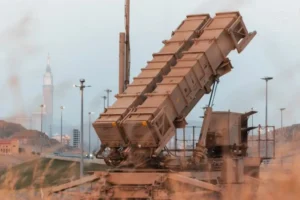
Saudi Arabia must also account for a wider regional security environment, including potential threats linked to Iran and, to a lesser extent, Iraq. These competing considerations can place additional demands on surveillance networks, interceptor stocks and military personnel.
The effectiveness of a layered defense system also depends on coordination. Radars operated by different military services must share information, while command centres need the software and communications infrastructure to establish a common operational picture.
Even when individual systems perform well, gaps in information-sharing, compatibility or response times can weaken the overall network. Integrating several sophisticated platforms into a single effective defense architecture remains a substantial challenge for countries around the world.
Read More: 25 Years After 9/11: From Al-Qaeda to ISIS to the Next Threat
Saudi Arabia faces a challenge that cannot be resolved simply by purchasing additional advanced missile systems. Improving radar coverage, strengthening coordination between military services, maintaining interceptor supplies and expanding more economical counter-drone capabilities could all form part of a more sustainable approach.
At the same time, the kingdom’s long-term security will depend on developments in Yemen and the wider regional balance of power.

Farkhund Yousafzai is a seasoned journalist and analyst with over a decade of experience in the media industry. He specializes in national politics and international relations and regularly contributes as an analyst to national and international media outlets.