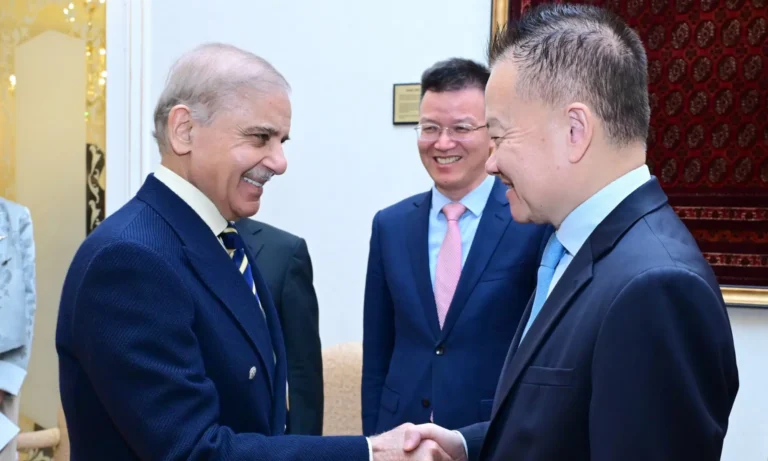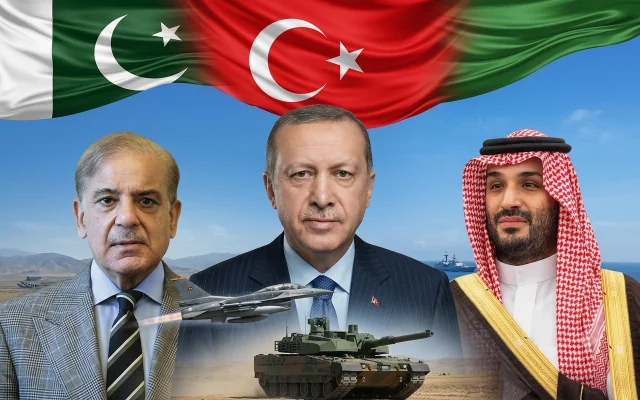
The trilateral defense agreement signed by Pakistan, Saudi Arabia and Turkiye in Makkah has triggered a fresh debate over the future of security cooperation in the Middle East and South Asia. Signed on August 7, the agreement has been described by the three countries as defensive in nature and not directed against any particular state. Yet its timing, the military capabilities of the three partners and the rapidly changing regional security environment have inevitably raised questions about what the pact could mean in practice.
At the heart of the debate is a simple question: who stands to gain the most from the new arrangement? For Saudi Arabia, the agreement offers access to Pakistan’s military experience and strategic capabilities alongside Turkiye’s increasingly sophisticated defense industry. For Pakistan, it could open the door to greater defense cooperation, economic support and a stronger diplomatic position in the region. Turkiye, meanwhile, could gain a larger market for its defense products, new investment opportunities and greater strategic access to both the Gulf and South Asia. But despite the ambitious expectations surrounding the agreement, treating it as a NATO-style alliance would be overoptimistic.
Saudi Arabia appears to have the most immediate security interests at stake. The Gulf has become increasingly vulnerable to missile and drone attacks, while the threat posed by Iran and Yemen’s Houthi movement has added another layer of uncertainty. Attacks on energy infrastructure, airports and shipping routes have demonstrated how exposed Gulf states can be when regional conflicts escalate.
Against this backdrop, Riyadh has been attempting to diversify its security partnerships rather than relying exclusively on any single external power. The inclusion of Pakistan and Turkiye gives Saudi Arabia access to two very different but complementary military capabilities. Pakistan brings decades of conventional military experience, including experience of operating in a highly contested security environment. It also has a substantial defense production base and nuclear deterrence capability.
Turkiye, meanwhile, has emerged as one of the world’s most closely watched defense exporters. Turkish drones, electronic warfare systems, air-defense technologies, sensors and precision weapons have attracted international attention in recent years. The combination could therefore provide Saudi Arabia with something it has long sought, a broader security network that combines military expertise, technology and strategic deterrence. The agreement could also strengthen Saudi Arabia’s efforts to reduce its dependence on traditional Western security partners.
For Pakistan, the agreement could be significant well beyond its immediate security implications. Islamabad has long maintained close defense ties with Riyadh, while its relationship with Ankara has deepened considerably in recent years. Bringing the three countries into a single framework gives Pakistan an opportunity to expand its role in Middle Eastern security without necessarily becoming directly involved in every regional conflict.
One of the most important potential benefits is defense-industrial cooperation. Turkiye could provide Pakistan with greater access to advanced technologies in areas such as unmanned aerial systems, counter-drone capabilities, electronic warfare, secure communications, sensors, precision weapons and air defense. At the same time, Saudi investment could potentially provide much-needed capital for Pakistan’s defense and broader industrial sectors.
The arrangement may also create opportunities for joint production rather than simply the purchase of foreign equipment. If the three countries move towards co-development and co-production, Pakistan could benefit not only as a buyer but also as a manufacturing partner.
Read More: Iran War: Is a New Middle East Order Emerging?
There is another important dimension, diplomacy. Pakistan’s role in the agreement reinforces its position as a country with strategic links to both South Asia and the Middle East. It could give Islamabad greater influence in regional security discussions and potentially strengthen its ability to act as a diplomatic bridge between competing powers. For Pakistan, however, the biggest advantage may come from avoiding unnecessary military entanglements. Instead of immediately committing troops to regional conflicts, Islamabad could benefit more from training programs, intelligence cooperation, defense production and technology transfers.
Turkiye’s defense industry could be a major beneficiary. Turkiye’s defense sector may ultimately emerge as one of the biggest economic beneficiaries of the agreement. Over the past decade, Ankara has invested heavily in developing an indigenous defense industry. Turkish companies have expanded into drones, naval systems, missiles, electronic warfare, armoured vehicles and combat aircraft. The country is also developing its KAAN fighter aircraft program, one of its most ambitious defense projects.
Such programs require enormous financial resources, and Saudi Arabia’s wealth could potentially become an important source of investment. For Ankara, the agreement therefore represents more than a security partnership. It could become a platform for expanding defense exports, attracting Gulf capital and developing joint production projects.
Saudi investment in Turkish defense companies or projects could help Turkiye accelerate research and development while reducing its dependence on Western capital and technology. At the same time, Pakistan offers Turkiye access to an important military market and a country with extensive operational experience.
The result could be a three-way arrangement in which Saudi Arabia provides financial strength, Turkiye contributes advanced defense technology and Pakistan brings military expertise, manpower and an established defense-production base.
But the big question is that is this a NATO-style mutual defense pact? This is where expectations need to be tempered. The agreement has generated speculation that an attack on any one of the three countries could automatically trigger military intervention by the other two. That interpretation, however, appears premature. The pact has been presented as a mechanism for collective defense and deterrence, but it does not automatically mean that Pakistan, Saudi Arabia and Turkiye would enter every war together.
Unlike NATO, the three countries do not have a fully integrated military command structure, permanent joint forces or a common defense architecture. Their strategic interests also differ. Pakistan’s primary security concerns are centred on South Asia, particularly India. Saudi Arabia’s security calculations are heavily influenced by Iran, Yemen, the Gulf and the Red Sea. Turkiye has its own priorities involving Syria, Iraq, the Eastern Mediterranean, the Black Sea and relations with both Russia and the West. These differences make a NATO-style response extremely difficult.
Read More: How the US-India Defence Pact is Fracturing BRICS
The more realistic possibility is that the agreement will initially function as a deterrence mechanism. In the event of a crisis, assistance could take the form of intelligence sharing, weapons, training, logistical support, diplomatic backing or defensive deployments rather than an automatic declaration of war.

Farkhund Yousafzai is a seasoned journalist and analyst with over a decade of experience in the media industry. He specializes in national politics and international relations and regularly contributes as an analyst to national and international media outlets.