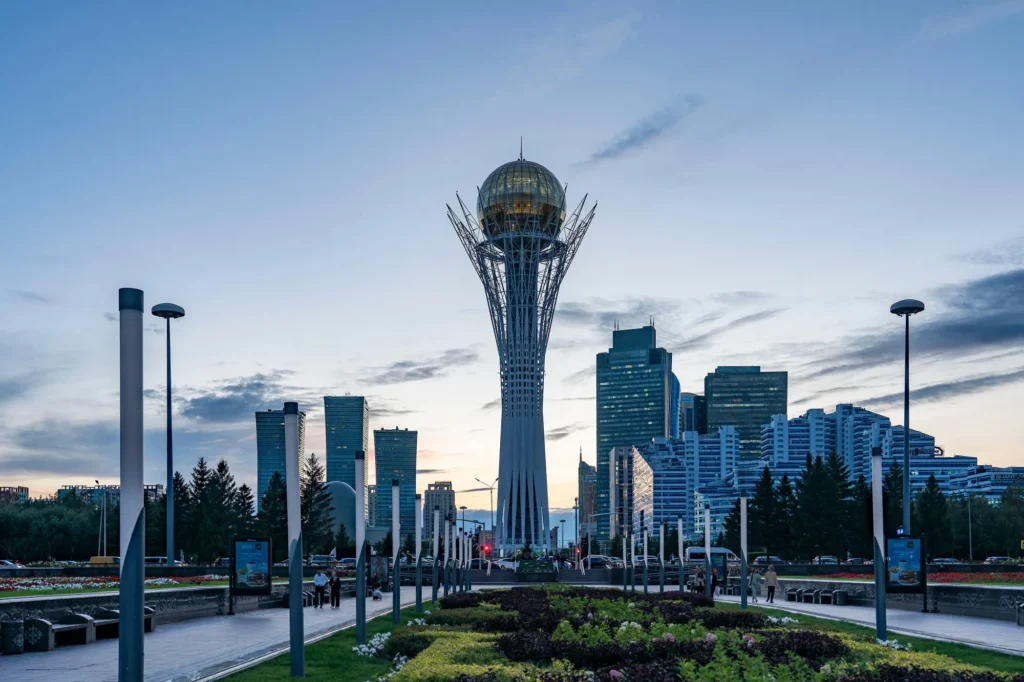
Kazakhstan’s economy grew 4.2 percent in nine months; the country hosted a Belgian king in October, signed eight agreements with Oman and welcomed a British trade minister, and proposed a $20 billion regional trade target. None of these events were reported internationally. Well, that’s exactly the idea.
As attention is still focused on how Central Asia is becoming a theatre of conflict between Russian, Chinese and Western interests, Kazakhstan has quietly built up a diplomatic engagement portfolio that renders the old ‘great game’ irrelevant. Astana is not on the game card; it is playing.
The key point of foreign policy Kazakhstan President Kassym-Jomart Tokayev is pursuing is not alignment, but accumulation. Tokayev was also hosting Oman’s Sultan Haitham bin Tariq Al Said for talks that resulted in eight bilateral agreements in the fields of investment, aviation, finance, and geological exploration in the same week that Belgian King Philippe visited the Alem.ai international center in Astana as part of a state visit that has seen more than $15 billion invested by Belgium in Kazakhstan since 2005.
Read More: Kazakhstan’s Tokayev Announces $14.27bn Infrastructure Program, Sets Out Economic Reforms
A UK trade minister came to talk about energy, transport and AI. All these relationships are not mutually exclusive. That is the design.
This extends to the great powers also. During his visit to Samarkand for the C5+1 ministerial meeting in mid-October, U.S. Secretary of State Marco Rubio made it clear that Washington did not require regional countries to give up their partnerships with Russia, China, or other powers. It is not a concession but a confirmation for Kazakhstan.
Today, the multi-vector approach is a rule of the region’s diplomacy, rather than an exception, as the city of Astana strives to maintain a balance of relations with all the major powers while working in the interests of the national economy.
The Economic Engine
The diplomatic flexibility is backed up by the economic numbers. During the first nine months of 2026, Kazakhstan’s GDP increased by 4.2 percent, while private investments jumped by 18 percent. Tokayev presented a draft Joint Action Plan to boost intraregional trade, currently about 8 percent of the total trade turnover of the countries, to at least $20 billion from $13 billion.
The proposal was not rhetorical, but one that would have truly benefited the children. It included a specific mechanism: governments were tasked with creating and adopting the plan.
This economic vision is a vision of connectivity, the physical infrastructure of connectivity. Kazakhstan is working on the Trans-Caspian fiber-optic link, laying 390 kilometers of fiber this October between Aktau and Sumgait, and setting up more than 4,000 5G base stations, along with launching Starlink Direct-to-Cell connectivity.
Tokayev has offered to involve the ports of Aktau and Kuryk in cooperation with the second-largest European port, Antwerp-Bruges, and connect Caspian logistics with Europe. The rationale is simple; the more vital Kazakhstan’s position is to east-west and north-south flows, the more important its voice is on the diplomatic landscape.
Read More: Kazakhstan Prepares to Receive Its Second Airbus
The most important aspect of Kazakhstan’s positioning is literal and underwater. The country has the largest uranium production in the world, and it has significant stocks of strategic minerals. In October, Cove Kaz Capital Group, of California, sought to acquire a 70 percent controlling stake in a tungsten deposit in Kazakhstan, thought to contain some 20 percent of the world’s tungsten reserves, with the U.S. International Development Finance Corp. and Export-Import Bank issuing letters of intent for potential financing of up to $1.6 billion.
Washington is not just interested in theory: the project’s executive chairman said that there is a “systemic shortage of tungsten” that isn’t going to be solved at the current mines, even in China.
The answer from Kazakhstan is to structure the region instead of just providing the demand. Uzbekistan offered to form a Regional Alliance on Critical Minerals based on a single digital map of critical mineral reserves. The C5+1 joint statement in Samarkand included cooperation in the field of management of geological data, resource development, resource processing, and higher value-added production.
Read More: Nvidia’s CEO Visits Astana as Kazakhstan Pitches Itself as a Physical AI Hub
It is not about selling raw materials, but also about attracting processing capacity and transferring technologies, which is exactly what Astana was looking for during the Belgian critical minerals talks.
All of this comes with its risks. As a writer described it, the Awaza summit’s joint statement was “largely aspirational. Tokayev’s proposal on the water framework convention is still being considered. The trade and economic cooperation program is still a document, not a roadmap. The structural gap between the upstream hydropower states and the downstream agriculture states has remained, and no leader has been willing to surrender control over water.
In the domestic arena, Kazakhstan will have snap maslikhat elections on November 29, which will test the strength of Tokayev’s reform agenda. The housing down payment reductions that the prime minister has ordered show that there’s no shortage of economic pain. But the shadow of 2022’s turmoil remains ominous in any evaluation of stability.
But the trend is evident. Kazakhstan is no longer a chessboard for great powers but has become a player in its own game. It has no allegiance to either side; rather, it has made itself useful to all of them, thus it hosts Belgian royalty, Omani sultans, British ministers and American secretaries of state.
This multi-vector approach is very often misunderstood and described as fence-sitting. It seems to be architecture in the case of Astana.
*The views presented in this article are the authors’ own and do not necessarily reflect the views of The Diplomatic Insight.*

Sibgha Hadi
Sibgha Hadi is pursuing Bachelors in International Relations from International Islamic University Islamabad, and is currently a fellow at Amal Academy. She has a keen interest in geo-politics and security.