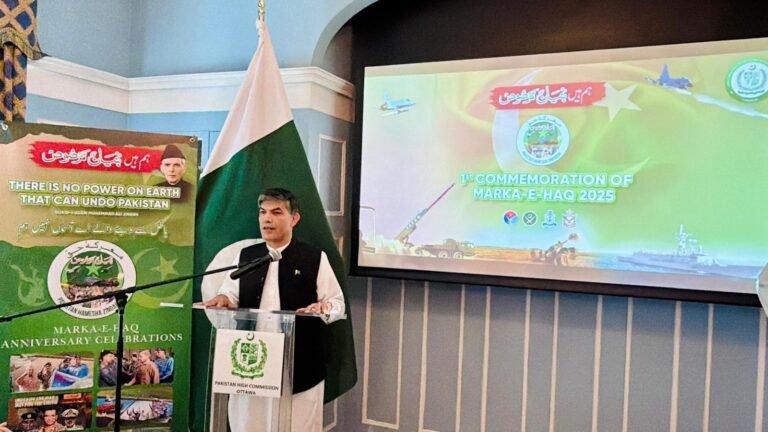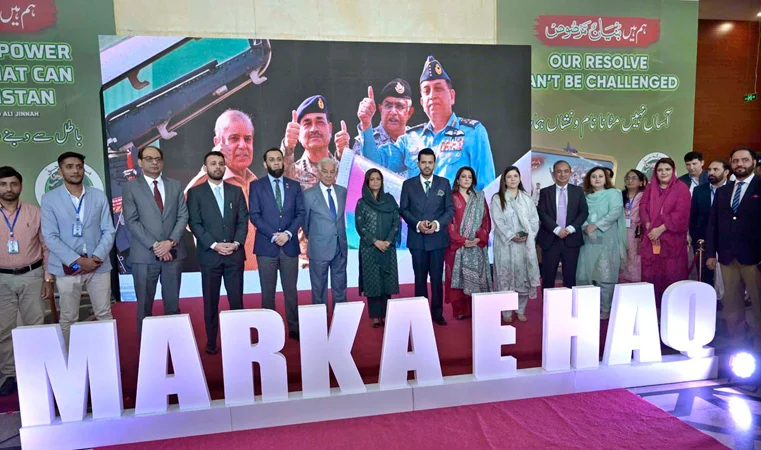
On 5 May 2026, Pakistan’s Ministry of Information and Broadcasting, in collaboration with Inter-Services Public Relations (ISPR), unveiled Marka-e-Haq: The Battle of Truth, a striking, large-format coffee-table book that chronicles the nation’s enduring resilience and the decisive triumph of May 2025.
Launched at the Pak-China Friendship Centre by Defense Minister Khawaja Muhammad Asif, Information Minister Attaullah Tarar, and senior leadership, the publication marks exactly one year since Pakistan’s historic victory, now commemorated as Marka-e-Haq.
More than a commemorative work, this pictorial volume serves as a compelling instrument of public diplomacy. Richly illustrated with rare photographs, operational timelines, and powerful imagery of national unity, it traces Pakistan’s journey from 1947 to the landmark success of Operation Bunyan-un-Marsoos. It stands as a lasting testament to Pakistan’s defense, dignity, and strategic diplomacy, a reflection of a nation that remained united and emerged victorious.
The 2025 crisis began on 22 April with a terrorist attack in Pahalgam, Indian-Occupied Kashmir, which claimed the lives of 26 tourists. Pakistan immediately condemned the incident and offered full cooperation for a transparent, joint investigation. However, India labeled it a “cross-border” attack without presenting credible evidence.
Pakistani officials and analysts have consistently described the episode as a false-flag operation, a tactic they argue has been used before to justify escalation and divert attention from internal challenges in occupied Kashmir.
Read More: Bridging Conflict: Pakistan’s Soft Power in the US-Iran Standoff
On 7 May, India launched Operation Sindoor, carrying out missile strikes using BrahMos and SCALP-EG systems that targeted Pakistani territory. These attacks struck civilian areas in Azad Kashmir and other regions, resulting in tragic loss of innocent lives.
According to official ISPR figures, the Indian strikes resulted in the martyrdom of 40 civilians and 11 personnel of the armed forces, underscoring the indiscriminate nature of the aggression. Contrary to claims of precision targeting, the strikes caused verifiable civilian casualties and underscored the risks of reckless escalation.
Pakistan responded with professionalism and resolve. On 10 May, its armed forces executed Operation Bunyan-un-Marsoos, a calibrated and proportionate counter-strike aimed strictly at legitimate Indian military installations. The operation demonstrated effective coordination across land, air, and sea domains, imposing significant costs on the aggressor while safeguarding national sovereignty.
Pakistani officials stated that six Indian fighter jets were shot down during the response, highlighting the effectiveness of Pakistan’s air defense and combat readiness. The claim was also echoed in subsequent international commentary. Through measured diplomacy and strategic restraint, Pakistan helped secure a ceasefire, reinforcing its image as a responsible nuclear power committed to peace without compromising its dignity.
Prime Minister Shehbaz Sharif subsequently declared 10 May as Youm-e-Marka-e-Haq, a day dedicated to honoring the martyrs and commemorating a defining national victory.
A Book That Preserves the Truth
Marka-e-Haq: The Battle of Truth transforms this chapter into a visually compelling and evidence-based record. Moving beyond sensational narratives, it presents verified timelines, documentation, and imagery that depict India’s actions and Pakistan’s measured response.
Its coffee-table format, both elegant and accessible, is designed to reach global audiences, from embassies to think tanks and private collections, ensuring Pakistan’s perspective endures beyond transient news cycles.
Spanning Pakistan’s history from its creation in 1947, and in places tracing roots to the spirit of 1857, the book features rare archival photographs, detailed operational timelines, and verified documentation of the April–May 2025 events. It presents an evidence-based account that leaves no room for ambiguity, ensuring that future generations and international readers encounter Pakistan’s truth unfiltered.
Read More: Marka-i-Haq Victory Enhanced Pakistan’s Global Position: Ministers
Information Minister Attaullah Tarar described the book as “a historic document” and “a comprehensive reflection of Pakistan’s defence, dignity, and wise diplomacy.” He emphasized that Pakistan’s success in Marka-e-Haq was achieved simultaneously on three fronts — military, diplomatic and narrative.
“The victory will be remembered for eternity,” he declared, noting that the nation stood shoulder-to-shoulder with its armed forces, defeating India not only through superior resolve but also through effective information warfare and principled diplomacy.
The coffee-table book is the latest and most enduring weapon in this narrative battle. Beyond military achievements, it highlights the spirit of national unity that turned a moment of crisis into a symbol of collective strength.
Narrative, Soft Power and Strategic Maturity
In the age of hybrid warfare, Marka-e-Haq reflects Pakistan’s strategic use of soft power. By presenting its narrative through a premium publication, Pakistan seeks to counter disinformation and project a fact-based account to international audiences.
This initiative builds upon Pakistan’s established strengths in strategic communication, particularly through ISPR’s media productions. The book elevates that effort, transforming visuals of military readiness, public unity, and leadership resolve into a lasting diplomatic asset.
One year on, the book also serves as a quiet but firm message to the international community: Pakistan’s deterrence remains robust, its commitment to peace is genuine, and any future adventurism will meet the same resolute response. Global observers noted Pakistan’s strategic maturity, and Marka-e-Haq has not only reinforced national pride but also elevated the country’s stature as a responsible actor in South Asia.
For diplomats, analysts, and policymakers, the book provides insight into Pakistan’s strategic outlook: a firm commitment to sovereignty, a preference for peace through strength, and a consistent emphasis on truth.
Marka-e-Haq: The Battle of Truth does more than document a moment of victory, it shapes narrative, inspires future generations, and amplifies Pakistan’s voice globally. As its pages turn, so too does the story: a narrative of resilience, unity, enduring resolve, and a victory that Pakistan will continue to defend and celebrate on the world stage for generations to come.
*The views presented in this article are the authors’ own and do not necessarily reflect the views of The Diplomatic Insight.

Nimra Khalil
Nimra Khalil is a geopolitical analyst and opinion writer. Her research and commentary explore international relations, security strategy, and the shifting balance of power in an increasingly multipolar world, with particular attention to South Asia and the Asia-Pacific.