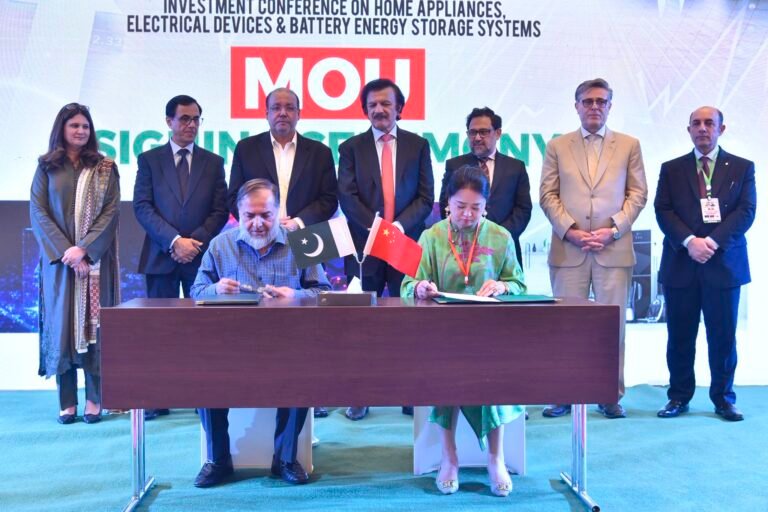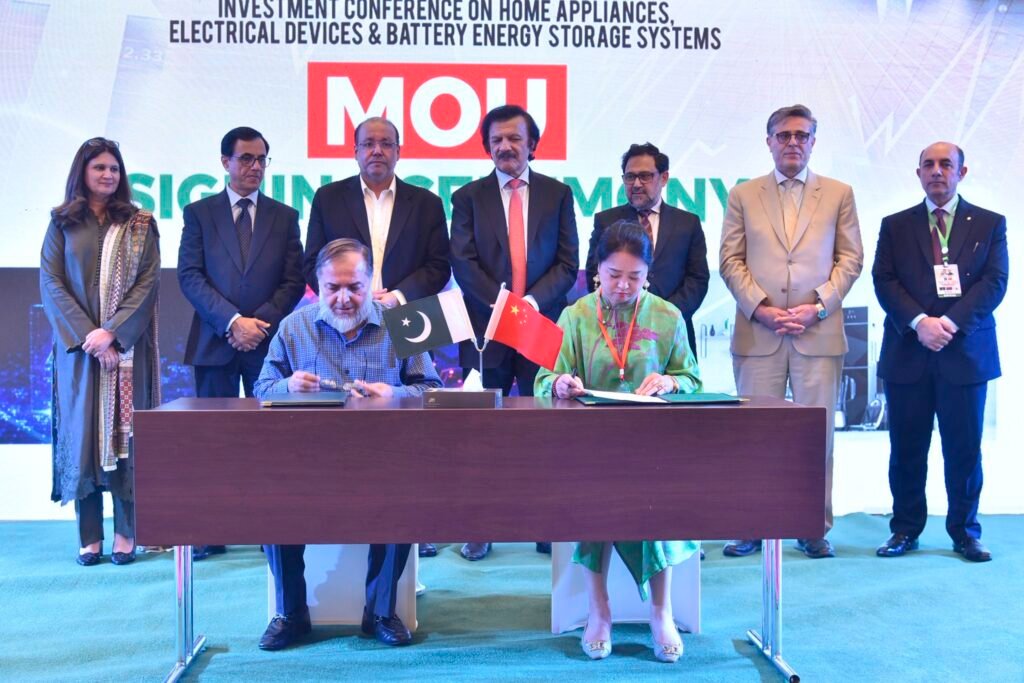
Lahore (TDI): A Chinese business delegation has signed more than fifty memoranda of understanding (MoUs) with Pakistani businesses in Pakistan–China B2B Conference on Home Appliances, Electrical Devices and Battery Energy Storage Systems (BESS) Manufacturing.
The conference was attended by over 100 Chinese and over 200 Pakistani participants, as an elaborate delegation of Chinese business leaders is currently on a visit to Pakistan. In Lahore, some thirty delegates also visited the regional office of the Federation of Pakistan Chambers of Commerce and Industry (FPCCI).
The delegation will also visit the Karachi office of the FPCCI, on Monday. The conference in Lahore was attended by Advisor to Pakistan’s Prime Minister on Industries and Production, Haroon Akhtar.
Pakistan’s Ambassador to China, Khalil Hashmi, is also in the country accompanying and facilitating the delegation. He also addressed the Lahore conference and witnessed the signing of MoUs.
The B2B Conference in Lahore witnessed extensive engagement throughout the day and yielded signing of more than 50 MoUs. Chinese delegates will now undertake factory visits to gain firsthand insight into Pakistan’s manufacturing capabilities and industrial potential.… https://t.co/NFA9Qu6PuK pic.twitter.com/92X2P3i0Ev
— Khalil Hashmi (@KhalilHashmi) May 10, 2026
At FPCCI’s regional office visit, the discussions focused on strengthening cooperation in manufacturing, agriculture, exports, and joint ventures.
According to a statement released by the FPCCI, sector-specific business-to-business (B2B) sessions were also organized to connect Chinese investors with Pakistani companies seeking partnerships in industrial production and value-added exports.
FPCCI President Atif Ikram Sheikh said Pakistan’s strategic geography positions it as a gateway linking China to markets in the Middle East, Africa and Europe.
He highlighted the role of Gwadar Port and the broader China-Pakistan Economic Corridor (CPEC) framework in facilitating regional connectivity and industrial relocation.
Read More: Pakistan, China Expand Ties with New Industrial, Health Deals
Regional Chairman Zaki Aijaz said Pakistan’s preferential trade access to Western markets makes the country an attractive manufacturing destination for Chinese firms.
He noted that Pakistan’s GSP Plus status with the European Union allows duty-free access on thousands of tariff lines, while existing trade arrangements also offer favorable entry into other global markets.
Pakistani officials promoted Punjab’s agricultural potential, encouraging Chinese investment in corporate farming, food processing and export-oriented agribusiness.
Delegates were also briefed on incentives available in Special Economic Zones, including tax holidays and infrastructure support designed to attract foreign manufacturers.