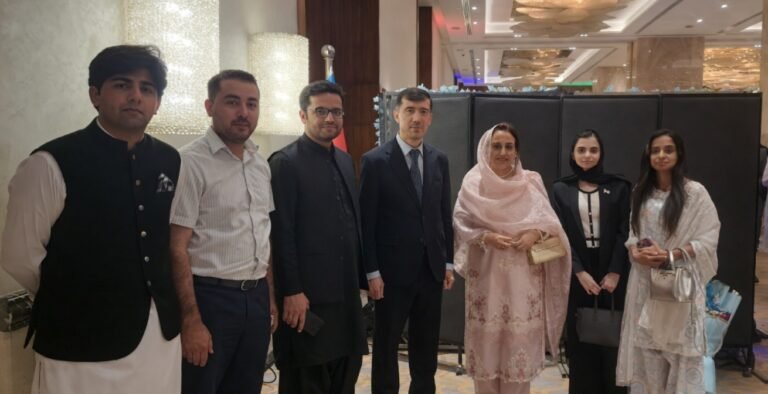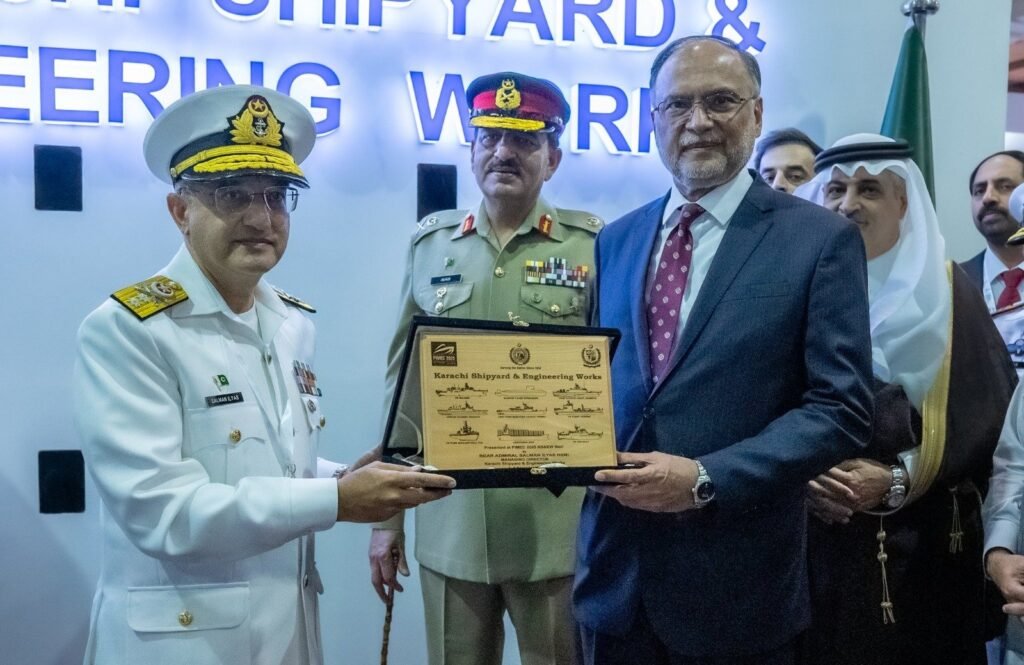
Attending the Pakistan International Maritime Expo and Conference (PIMEC) 2025 felt, to me, like witnessing a quiet turning point. It wasn’t just another official gathering filled with speeches and photo sessions. It was a moment when Pakistan seemed to realize that its story doesn’t stop at the shoreline.
In that crowded hall — among policymakers, naval officers, engineers, students, and foreign guests — there was a shared sense of discovery, a belief that our future may well flow from the waters we’ve too long taken for granted.
For decades, Pakistan’s national planning has been landlocked — centered on agriculture, industry, and energy corridors running through deserts and plains. But as I listened to the discussions at PIMEC, it became clear that a shift is underway. The sea, long treated as a boundary to guard, is finally being seen as an opportunity to build.
Federal Minister for Planning, Development and Special Initiatives Ahsan Iqbal Chaudhry captured that transformation in his keynote speech. He spoke about the government’s vision to turn Pakistan into a regional maritime hub — not through slogans, but by connecting ports, trade, and technology in one strategy.
Read More: ‘Made in Uzbekistan’ Products Draw Visitors at PIMEC 2025
His emphasis on the “blue economy” — the sustainable use of ocean resources for economic growth — felt like a long-overdue recognition of where our real potential lies.
I found myself thinking about how much we have overlooked the sea in our national imagination. Pakistan’s coastline stretches over a thousand kilometers, touching deep-water routes that connect the Gulf to the rest of Asia.
The opportunities are immense — fisheries, logistics, shipbuilding, renewable energy — yet policy and investment have remained slow to follow. The minister’s remarks, for once, suggested a plan that brings all these elements together.
Sindh Chief Minister Syed Murad Ali Shah followed with remarks that grounded this vision in realism. His focus on transforming Karachi into a modern marine economic hub reflected both ambition and urgency. Karachi, he said, is not just Pakistan’s economic heart — it is the anchor of its maritime identity.
Read More: Ahsan Iqbal Calls Pakistan a ‘Maritime Bridge’ Between East and West at PIMEC 2025
Federal and provincial coordination, he emphasized, is already underway to modernize port operations and improve connectivity. Listening to him, I couldn’t help but feel that Karachi’s revival could define the next phase of Pakistan’s economic story.
Then came the voice of the security establishment. Lieutenant General Muhammad Owais Dastgir, Commander 5 Corps, reminded everyone that maritime prosperity means little without maritime security.
His words — calm but firm — underscored that the Pakistan Army and Navy’s cooperation is the foundation of all coastal development. He described Karachi as both a “maritime fortress” and an “economic lifeline,” connecting the dots between defense, trade, and national stability.
What struck me most about PIMEC 2025 was the rare alignment of institutions. For once, the civil, military, and private sectors seemed to share a common purpose.
Read More: TDI Joins Hands With PIMEC as the National Media Partner
The conference was not just about technology exhibits or speeches — it was about vision. It reflected a collective realization that economic strength and national security are no longer parallel paths; they must now move together.
As the event concluded, participants praised the Armed Forces, the Ministry of Maritime Affairs, and the Sindh government for their coordination. But beyond the formalities, there was a deeper takeaway — that Pakistan is finally beginning to see itself as a maritime nation, not just a continental one.
Walking out of the expo center, I found myself looking at the Karachi shoreline differently. Those same waters that once seemed distant now felt like a promise — of trade, of resilience, of renewal. For a country often defined by its borders, perhaps it’s time we start defining ourselves by our horizons.

Yusufi Farzona
Yusufi Farzona is a researcher in the Department of European Studies at the Institute for the Study of Asian and European Countries, National Academy of Sciences of Tajikistan.