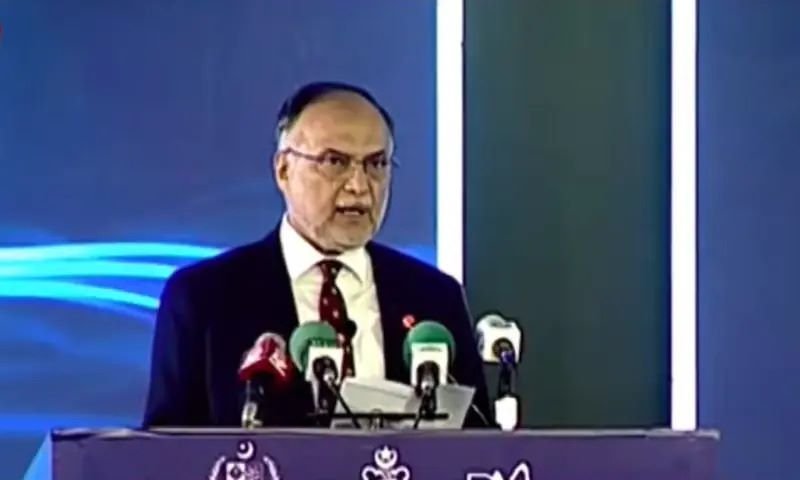
Karachi (TDI): Planning Minister Ahsan Iqbal on Monday described Pakistan as a “natural maritime bridge” linking the East and the West while inaugurating the second Pakistan International Maritime Expo and Conference (PIMEC) at Karachi Expo Centre.
Organized under the Pakistan Navy’s supervision with federal and provincial support, the three-day event (Nov 4–6) is hosting participants from 45 countries, highlighting Pakistan’s growing maritime relevance in regional trade and connectivity.
In his address, Iqbal said Pakistan’s geographical position, where South Asia, Central Asia, the Middle East, and Africa converge, gives it immense strategic potential. Yet, he noted, the maritime industry contributes less than one percent to the national GDP, far below the global average of 4–7 percent in other maritime economies.
He pointed out that Pakistan possesses a 1,000-kilometre coastline, an exclusive economic zone of 290,000 sq km, and abundant offshore resources in renewable energy, fisheries, and minerals. The minister linked maritime growth to the government’s “Uraan Pakistan” vision, aimed at turning Pakistan into a $1 trillion economy by 2035, anchored on the 5Es framework, Exports, e-Pakistan, Equity and Empowerment, Environment and Climate Change, and Energy and Infrastructure.
According to Iqbal, the government has also mapped out eight key drivers of export-led growth, including agriculture, manufacturing, IT and digital services, minerals, skilled manpower, creative industries, tourism, and the blue economy.
Read More: TDI Joins Hands With PIMEC as the National Media Partner
“The seas have again become the arteries of global commerce, energy, and communication,” he said. “Those who manage them wisely are shaping the next wave of global prosperity.”
Citing UNCTAD figures, Iqbal added that over 80% of world trade by volume and 70% by value moves through sea routes. The global blue economy, he said, generates more than $2.5 trillion annually and sustains 350 million jobs across industries such as shipping, ports, fisheries, and coastal tourism.
Sindh Chief Minister Murad Ali Shah, who was also present at the opening, called PIMEC a “significant platform” that brings together national and international maritime stakeholders. “This event not only promotes maritime trade but also opens new avenues of investment,” he remarked, reaffirming the Sindh government’s commitment to global collaboration in the sector.
Read More: Looking Back at the Success of PIMEC’s First Edition
The 2025 edition of PIMEC features 150 local and 28 international exhibitors, with delegates from 44 countries, including the UK, Saudi Arabia, China, Egypt, and Turkiye. Experts at the event believe Pakistan’s maritime sector could eventually contribute over $100 billion a year to the national economy if its full potential is tapped.