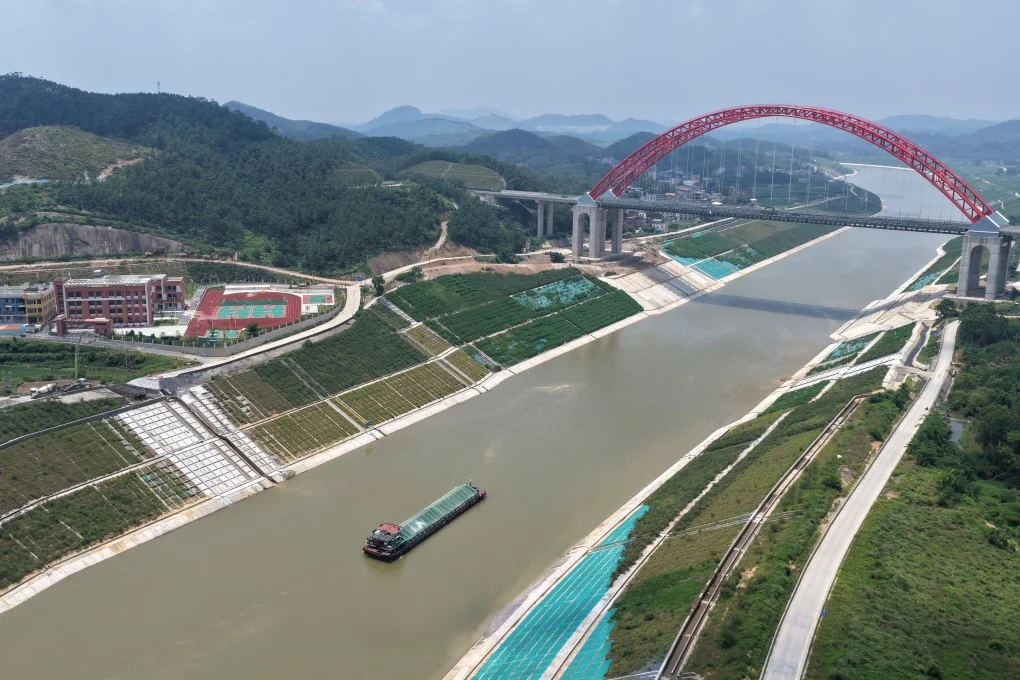
China opened the Pinglu Canal in Guangxi Zhuang Autonomous Region on Wednesday, establishing a new river-to-sea route connecting the country’s southwestern inland waterways with the Beibu Gulf and creating a shorter maritime gateway toward Southeast Asia.
Construction of the project began in August 2022, with an investment of approximately 72.7 billion yuan, or about US$10.8 billion.
The canal has been constructed to China’s Class I inland waterway standard and can accommodate vessels of up to 5,000 tons.
It has been described by Chinese authorities as the first major river-to-sea canal project planned and coordinated at the national level since 1949.
The waterway enables cargo from inland areas to reach the sea without following the longer route toward Guangzhou, reducing the inland shipping distance by more than 560 kilometers.
Read More: China Economic and Social Forum in Hangzhou Highlights Global Governance, Cooperation
The new waterway is expected to reduce comprehensive logistics costs for cargo from southwestern China by between 18 and 30 percent and generate annual transportation savings of more than 5 billion yuan.
The canal’s opening has also introduced new shipping services; an international freight route between Nanning Port and Can Tho Port in Vietnam began operations alongside a domestic route connecting Nanning Port with Yangpu Port in Hainan.
The first foreign-trade cargo shipment cleared customs ahead of the opening and is scheduled to travel from Nanning to Can Tho aboard the Beigang Nanning Borun.
Around 30 cargo vessels are expected to transit the canal during its opening-day operations, carrying commodities including construction materials, coal, minerals, steel and fertilizers.
Nanning Port and Qinzhou Port are handling the initial maritime operations. The canal has undergone navigation and safety trials, including tests involving vessels of up to 5,000 tonnes, patrol vessels and management ships before its formal opening.
The project is also expected to reinforce Guangxi’s role as a logistics and commercial gateway between China and Southeast Asia.
Read More: ASEAN-China Relations in Focus as Strategic Partnership Marks Fifth Anniversary
The Beibu Gulf provides access to the Gulf of Tonkin and the wider South China Sea, placing the canal within an increasingly important network linking southwestern China with Vietnam and other regional economies.
Beyond freight movement, the canal forms part of a broader effort to expand China’s inland waterway network and improve connections between river transport, ports, railways and international shipping routes.
Supporting infrastructure includes additional berths at Nanning’s Liujing Operations Area and links with wider regional transport networks, including the China-Laos railway corridor.
By providing inland manufacturing and commercial centers with a direct connection to the Beibu Gulf, the Pinglu Canal is expected to facilitate the movement of raw materials and finished products while strengthening the physical infrastructure underpinning China-ASEAN trade.
The canal will initially operate under a one-year trial navigation period from September 16, 2026, to September 15, 2027.
During this period, authorities will monitor navigation, port operations and the performance of the new waterway as commercial traffic expands.

Aqsa Fazilat
Aqsa Fazilat is a student of Political Science and Philosophy at Kinnaird College for Women. Her research interest lies in contemporary global politics and political geography.