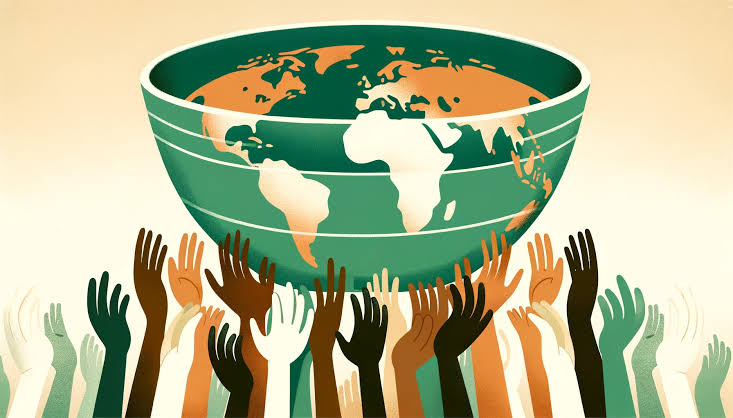
The relationship between the Global North and the Global South has been marked by a persistent imbalance. The industrialized economies of North America, Western Europe and parts of East Asia accumulated capital, technology and productive capacity earlier, while many countries across Africa, Asia, Latin America and the Caribbean entered the post-colonial period with economies heavily dependent on primary commodities, limited industrialization and weak access to capital and technology.
The divide remains visible today. According to the World Bank, In 2024, developing countries paid a record $921 billion in external debt service, while 3.4 billion people lived in countries spending more on interest payments than on health or education.
The question, therefore, is not simply why the Global South has remained less developed. It is whether developing countries are now building enough collective capacity to alter the conditions that have historically constrained them.
South-South cooperation has emerged as one answer to that question. It rests on a relatively straightforward proposition that developing countries do not have to rely exclusively on traditional North-South channels for trade, investment, knowledge and development assistance. They can increasingly become partners for one another.
Read More: Why the China-Egypt Partnership Offers a Blueprint for Global South Cooperation
The scale of this change is substantial. According to UN Trade and Development, South-South merchandise trade reached $7.2 trillion in 2025, while its share of global merchandise trade rose from 11 percent in 2000 to 28 percent in 2025. More than half of developing countries’ exports now go to other developing economies. The Global South is consequently becoming not merely a geographical category but an increasingly interconnected economic space.
This transformation is taking place through institutions that operate at very different levels. BRICS is one of the most visible, providing a political and economic platform for major emerging economies and, through the New Development Bank, a mechanism for financing infrastructure and sustainable development. But BRICS is only one part of a much larger institutional landscape.
In Africa, the African Continental Free Trade Area (AfCFTA) is attempting to create a continental market capable of increasing intra-African trade and encouraging regional value chains.
In Southeast Asia, ASEAN has built one of the world’s most important regional economic groupings, while MERCOSUR has strengthened economic integration in South America. The IBSA Dialogue Forum, bringing together India, Brazil and South Africa, demonstrates another form of cooperation among major developing democracies.
Read More: Beyond the AI Race: How BRICS Is Helping the Global South Harness Technology
The African experience demonstrates why this matters. For decades, many African economies have struggled with fragmented markets, high trade costs and dependence on commodity exports. AfCFTA attempts to address precisely these structural constraints by creating a common framework covering goods and services, investment, intellectual property and competition policy.
Trading under the agreement began in January 2021. Its importance goes beyond tariff reduction. A larger integrated market can make it more commercially viable to manufacture goods within Africa, build regional supply chains and move from exporting raw materials towards producing higher-value products.
The same principle can be seen in South-South trade arrangements that receive considerably less attention than BRICS. The Global System of Trade Preferences among Developing Countries (GSTP), established under the UNCTAD framework, seeks to increase trade between developing economies through preferential tariff reductions. Its São Paulo Round Protocol is now one ratification away from entering into force.
UN Trade and Development estimates that implementation could produce welfare gains of up to $14 billion and reduce tariffs by at least 20 percent on around 6,000 products, covering a potential market of approximately $18 trillion and more than four billion people.
Read More: Why Global South Women Must Lead AI Development or Watch It Fail Them
These figures demonstrate an important point: South-South cooperation is not merely diplomatic language. In the right institutional form, it can produce measurable changes in market access and economic opportunity.
Cooperation also extends beyond trade. One weakness in traditional measurements of development assistance is that they often fail to capture knowledge, technical expertise, scholarships, medicines, technology and other forms of support exchanged between developing countries.
The United Nations is now working to measure these contributions more systematically. Initial 2026 data from nine Latin American and Caribbean pilot countries found that almost all reported South-South cooperation activities were non-financial, while 11 percent consisted of non-monetized support such as goods, medicines and specialist expertise.
This is strategically important because development does not happen through money alone. A country can gain as much from agricultural expertise, digital knowledge, medical training, scholarships or institutional experience as from a financial transfer. South-South cooperation therefore increasingly represents the exchange of capabilities, not simply capital.
China has played a particularly significant role in demonstrating what greater agency within the Global South can look like in practice. Its engagement with Africa is perhaps the clearest example.
Through the Forum on China-Africa Cooperation, China has pursued investment, industrial and supply-chain cooperation, infrastructure development, technology partnerships and knowledge exchange, while the 2025–2027 Beijing Action Plan explicitly calls for deeper cooperation in industrialization, science and technology and African development strategies.
Read More: D-8 Secretary General Stresses South-South Cooperation at Zero Waste Forum
China has also placed South-South cooperation at the center of its diplomatic agenda through initiatives such as the Global Development Initiative, which was launched at the United Nations in 2021 and now involves more than 130 countries and international organizations, according to the UN-linked Chinese mission.
The significance of China’s role, therefore, goes beyond the volume of its overseas investment. It offers other developing countries a different model of international partnership in which a country from the Global South can itself become a source of capital, technology, infrastructure and institutional experience.
This is ultimately what makes 12 September, the United Nations International Day for South-South Cooperation, significant. The day is not simply an occasion to celebrate solidarity among developing countries. It provides an opportunity to recognize a structural change already visible in the data.
At the same time, the UN is increasingly trying to measure forms of cooperation that traditional statistics overlooked, including technical expertise and knowledge exchange. The message is therefore larger than the celebration of cooperation itself.
The Global South is still confronting a profound development gap, but it is increasingly developing the institutions, markets and partnerships through which it can address that gap on its own terms. The North-South divide remains real, but the geography of opportunity is changing.

Aqsa Fazilat
Aqsa Fazilat is a student of Political Science and Philosophy at Kinnaird College for Women. Her research interest lies in contemporary global politics and political geography.